
Triangle angle facts
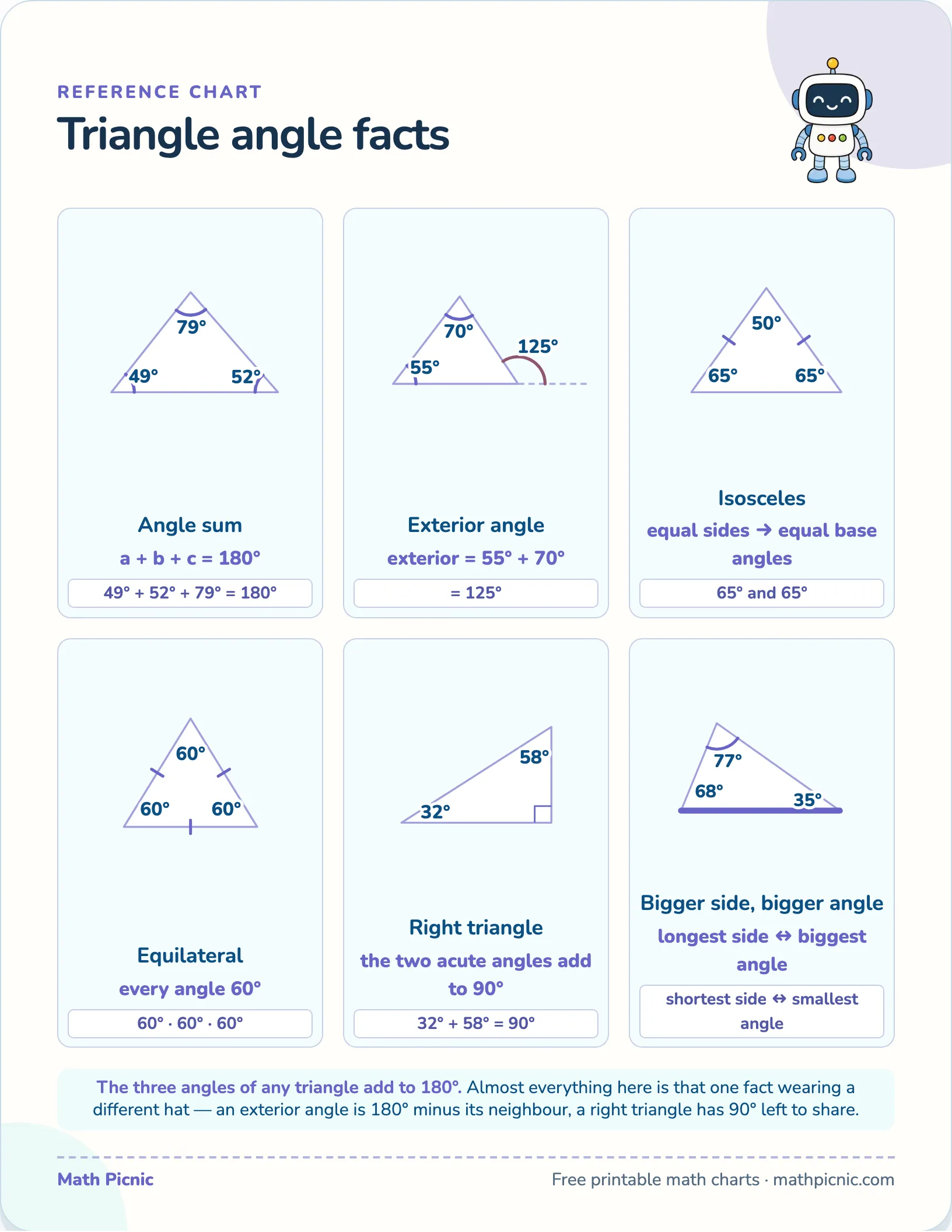
Six facts about the angles of a triangle, each drawn on the triangle it is true of. Almost all of them are the one rule — the three angles add to 180° — seen from a different side.
Reference chart
Triangle angle facts

Angle sum
a + b + c = 180°
49° + 52° + 79° = 180°
Exterior angle
exterior = 55° + 70°
= 125°
Isosceles
equal sides → equal base angles
65° and 65°
Equilateral
every angle 60°
60° · 60° · 60°
Right triangle
the two acute angles add to 90°
32° + 58° = 90°
Bigger side, bigger angle
longest side ↔ biggest angle
shortest side ↔ smallest angle
The three angles of any triangle add to 180°. Almost everything here is that one fact wearing a different hat — an exterior angle is 180° minus its neighbor, a right triangle has 90° left to share.
What's on this chart
The three angles of any triangle add to 180°. That single fact is the spine of the whole page, and once a student trusts it the rest follow: an exterior angle is what is left of a straight line after the interior angle, so it equals the two remote interiors; a right triangle has already spent 90°, so its two acute angles must share the other 90°. Drawing each rule on its own triangle is what turns a list to memorize into a set of things a child can see.
Why this chart helps
The special triangles carry their own angle facts. An isosceles triangle has two equal sides, and the angles opposite them are equal — the base angles — which is why marking the equal sides on the figure is enough to find them. An equilateral triangle takes that to its limit: three equal sides, so three equal angles, each exactly 60°.
More printable charts
- Naming 2D shapes
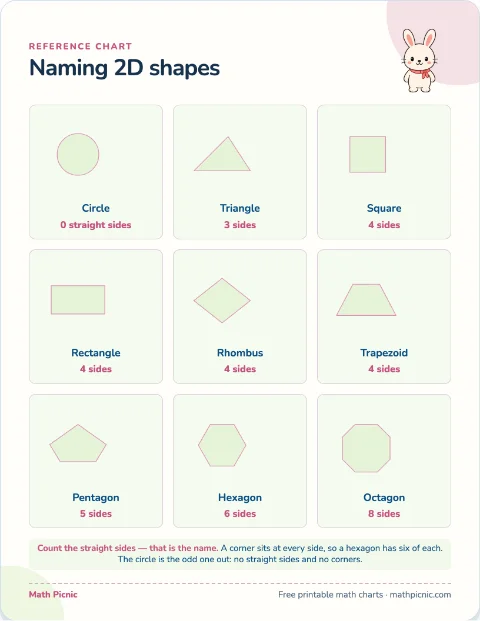 Print Count the straight sides on a shape, then read its name below it.
 - Quadrilateral family
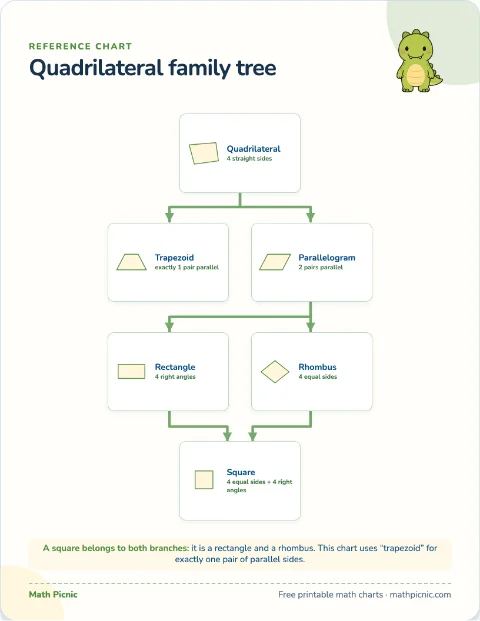 Print Follow the branches to see which names a shape inherits.
 - Lines of symmetry
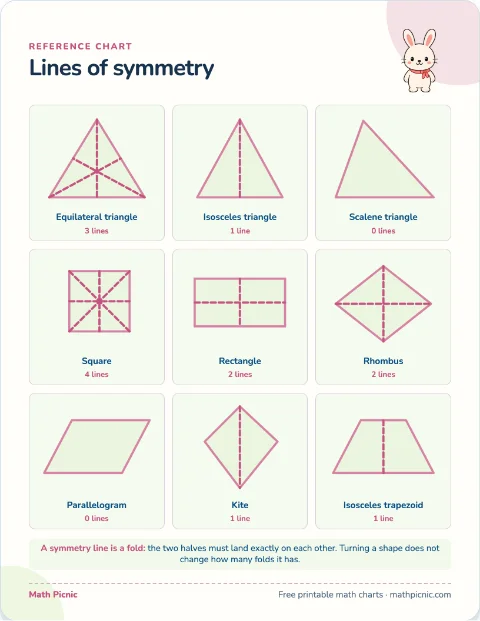 Print Fold each shape in your mind and count the matching halves.
 - Types of angles
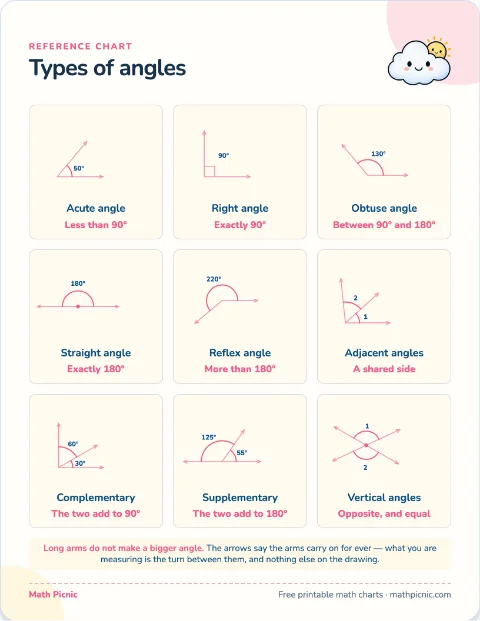 Print Find the picture that matches yours, and the name is under it.
 - Angles in parallel lines
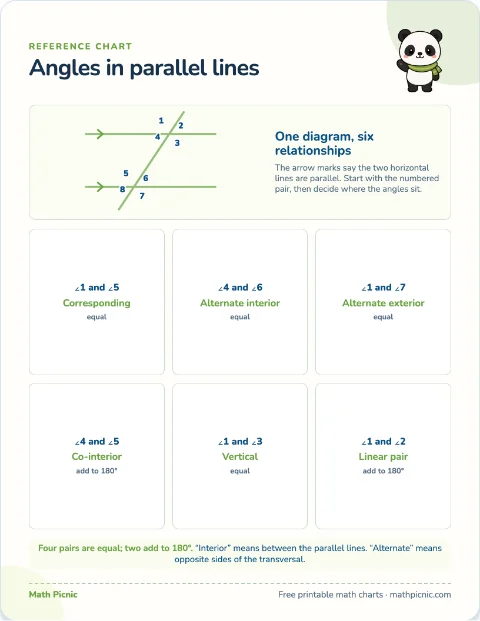 Print Match each numbered pair to its position around the transversal.
 - Perimeter formulas
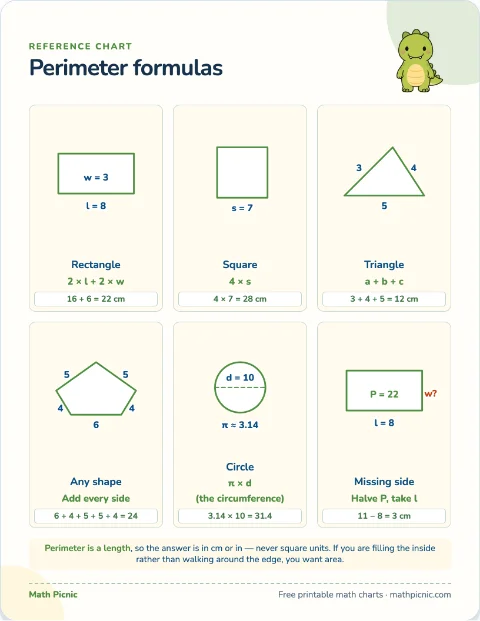 Print Follow the traced edge on the figure, then read the formula under it.
 - Area formulas
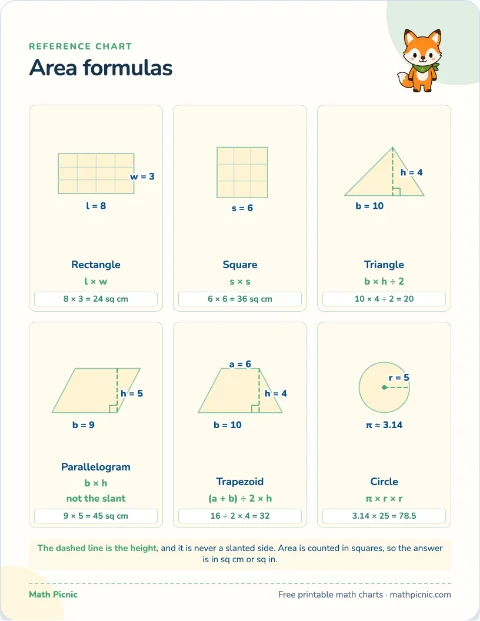 Print Match your shape to a figure and use the letters drawn on it.
 - Volume formulas
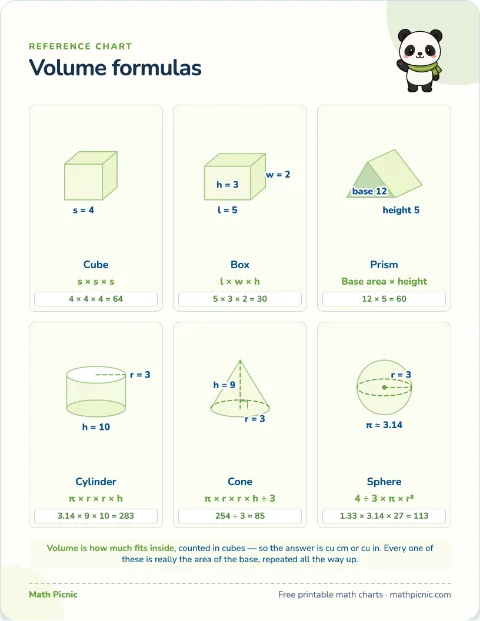 Print Find your solid, then multiply the base area by how tall it stands.