Free · Ready to print · Letter & A4
Division facts to 12
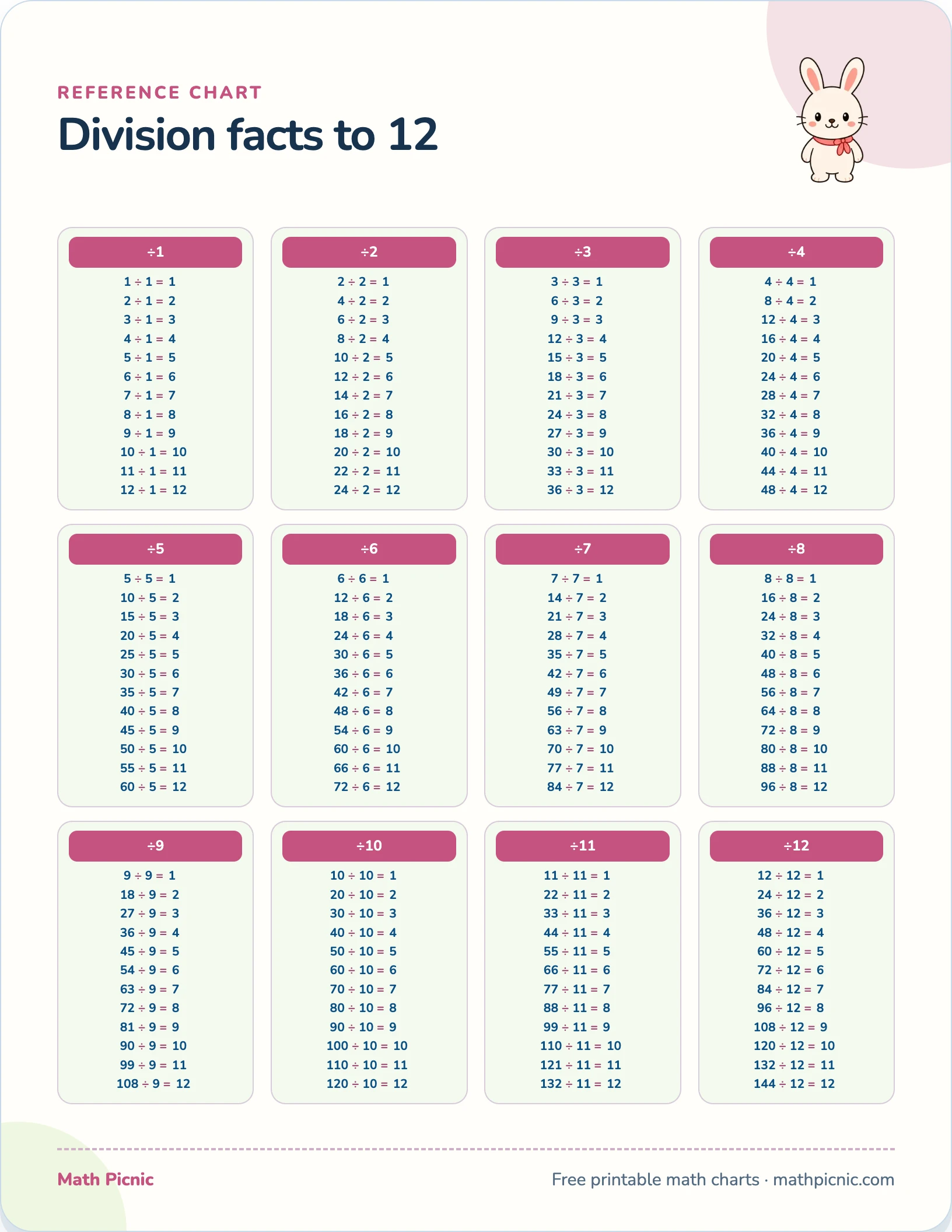
Need a division table within reach? Print it for the wall, or make a fact-list version to fill in.
- Letter & A4 ready
- Nothing to fill in
- Reprint it any time
Reference chart
Division facts to 12

÷1
- 1 ÷ 1 =1
- 2 ÷ 1 =2
- 3 ÷ 1 =3
- 4 ÷ 1 =4
- 5 ÷ 1 =5
- 6 ÷ 1 =6
- 7 ÷ 1 =7
- 8 ÷ 1 =8
- 9 ÷ 1 =9
- 10 ÷ 1 =10
- 11 ÷ 1 =11
- 12 ÷ 1 =12
÷2
- 2 ÷ 2 =1
- 4 ÷ 2 =2
- 6 ÷ 2 =3
- 8 ÷ 2 =4
- 10 ÷ 2 =5
- 12 ÷ 2 =6
- 14 ÷ 2 =7
- 16 ÷ 2 =8
- 18 ÷ 2 =9
- 20 ÷ 2 =10
- 22 ÷ 2 =11
- 24 ÷ 2 =12
÷3
- 3 ÷ 3 =1
- 6 ÷ 3 =2
- 9 ÷ 3 =3
- 12 ÷ 3 =4
- 15 ÷ 3 =5
- 18 ÷ 3 =6
- 21 ÷ 3 =7
- 24 ÷ 3 =8
- 27 ÷ 3 =9
- 30 ÷ 3 =10
- 33 ÷ 3 =11
- 36 ÷ 3 =12
÷4
- 4 ÷ 4 =1
- 8 ÷ 4 =2
- 12 ÷ 4 =3
- 16 ÷ 4 =4
- 20 ÷ 4 =5
- 24 ÷ 4 =6
- 28 ÷ 4 =7
- 32 ÷ 4 =8
- 36 ÷ 4 =9
- 40 ÷ 4 =10
- 44 ÷ 4 =11
- 48 ÷ 4 =12
÷5
- 5 ÷ 5 =1
- 10 ÷ 5 =2
- 15 ÷ 5 =3
- 20 ÷ 5 =4
- 25 ÷ 5 =5
- 30 ÷ 5 =6
- 35 ÷ 5 =7
- 40 ÷ 5 =8
- 45 ÷ 5 =9
- 50 ÷ 5 =10
- 55 ÷ 5 =11
- 60 ÷ 5 =12
÷6
- 6 ÷ 6 =1
- 12 ÷ 6 =2
- 18 ÷ 6 =3
- 24 ÷ 6 =4
- 30 ÷ 6 =5
- 36 ÷ 6 =6
- 42 ÷ 6 =7
- 48 ÷ 6 =8
- 54 ÷ 6 =9
- 60 ÷ 6 =10
- 66 ÷ 6 =11
- 72 ÷ 6 =12
÷7
- 7 ÷ 7 =1
- 14 ÷ 7 =2
- 21 ÷ 7 =3
- 28 ÷ 7 =4
- 35 ÷ 7 =5
- 42 ÷ 7 =6
- 49 ÷ 7 =7
- 56 ÷ 7 =8
- 63 ÷ 7 =9
- 70 ÷ 7 =10
- 77 ÷ 7 =11
- 84 ÷ 7 =12
÷8
- 8 ÷ 8 =1
- 16 ÷ 8 =2
- 24 ÷ 8 =3
- 32 ÷ 8 =4
- 40 ÷ 8 =5
- 48 ÷ 8 =6
- 56 ÷ 8 =7
- 64 ÷ 8 =8
- 72 ÷ 8 =9
- 80 ÷ 8 =10
- 88 ÷ 8 =11
- 96 ÷ 8 =12
÷9
- 9 ÷ 9 =1
- 18 ÷ 9 =2
- 27 ÷ 9 =3
- 36 ÷ 9 =4
- 45 ÷ 9 =5
- 54 ÷ 9 =6
- 63 ÷ 9 =7
- 72 ÷ 9 =8
- 81 ÷ 9 =9
- 90 ÷ 9 =10
- 99 ÷ 9 =11
- 108 ÷ 9 =12
÷10
- 10 ÷ 10 =1
- 20 ÷ 10 =2
- 30 ÷ 10 =3
- 40 ÷ 10 =4
- 50 ÷ 10 =5
- 60 ÷ 10 =6
- 70 ÷ 10 =7
- 80 ÷ 10 =8
- 90 ÷ 10 =9
- 100 ÷ 10 =10
- 110 ÷ 10 =11
- 120 ÷ 10 =12
÷11
- 11 ÷ 11 =1
- 22 ÷ 11 =2
- 33 ÷ 11 =3
- 44 ÷ 11 =4
- 55 ÷ 11 =5
- 66 ÷ 11 =6
- 77 ÷ 11 =7
- 88 ÷ 11 =8
- 99 ÷ 11 =9
- 110 ÷ 11 =10
- 121 ÷ 11 =11
- 132 ÷ 11 =12
÷12
- 12 ÷ 12 =1
- 24 ÷ 12 =2
- 36 ÷ 12 =3
- 48 ÷ 12 =4
- 60 ÷ 12 =5
- 72 ÷ 12 =6
- 84 ÷ 12 =7
- 96 ÷ 12 =8
- 108 ÷ 12 =9
- 120 ÷ 12 =10
- 132 ÷ 12 =11
- 144 ÷ 12 =12
What's on this chart
Division is the operation children trust least, and the reason is that the other three offer a way out. Addition and multiplication can be counted up to; subtraction can be counted back. Division has no path a child can walk if the fact will not come — which is exactly when a chart earns its place on the wall.
Why this chart helps
This one is a list of families instead of a square grid, and that is deliberate. A division grid would need every dividend down its side, all the way to 144, and no child reads a table that tall. Families are the shape division is actually learned in: the sixes together, in order, so a child can say them the way they say a times table.
More printable charts
- Multiplication table The whole times table on one page, from 1×1 to 12×12. Print this chart
- Addition table Every addition fact from 0+0 to 10+10 in one grid. Print this chart
- Subtraction table A subtraction chart built the way children actually read one: find the number you start with on the left, follow the row across to what you are taking away, and the answer is sitting there. Print this chart
- Hundreds chart One hundred numbers in ten neat rows — the most useful single page in early math. Print this chart
- Number bonds to 10 Every pair that makes ten, drawn as counters as well as numbers. Print this chart
- Fraction wall One whole, then the same width cut into halves, thirds, quarters, and on down to twelfths. Print this chart
- Place value chart Every column is worth ten times the one to its right — ones, tens, hundreds, and up to hundred thousands — with the number 453,027 placed in so the columns are more than labels. Print this chart
- Number line 0–20 A clean 0 to 20 number line — the model behind counting on, adding, subtracting, and the first place rounding to the nearest ten makes visual sense. Print this chart
- Prime numbers to 50 The fifteen primes below fifty, marked on a grid of ten. Print this chart
- Prime numbers to 100 All twenty-five primes below a hundred, marked on a grid of ten. Print this chart
- Prime numbers to 150 Every prime up to 150, marked on a grid of ten. Print this chart
- Prime numbers to 200 The full range to 200 on a grid of ten, every prime marked. Print this chart
- Factors chart Every factor of every number up to fifty, written out. Print this chart
- Divisibility rules Seven tests a child can run in their head, so "does 4 go into this?" stops being a long-division problem. Print this chart
- Fraction, decimal & percent The same amount written three ways — as a fraction, a decimal, and a percent — for the values a child meets most. Print this chart
- Fraction rules Six sentences that decide whether a fraction answer is right before any arithmetic happens. Print this chart
- Roman numerals Seven symbols, the numbers they build, and the three rules for putting them together. Print this chart
- Measurement conversions Length, weight, capacity, and time — metric and customary — on one page, ending with the bit children actually get wrong: whether to multiply or divide. Print this chart