
The Pythagorean theorem
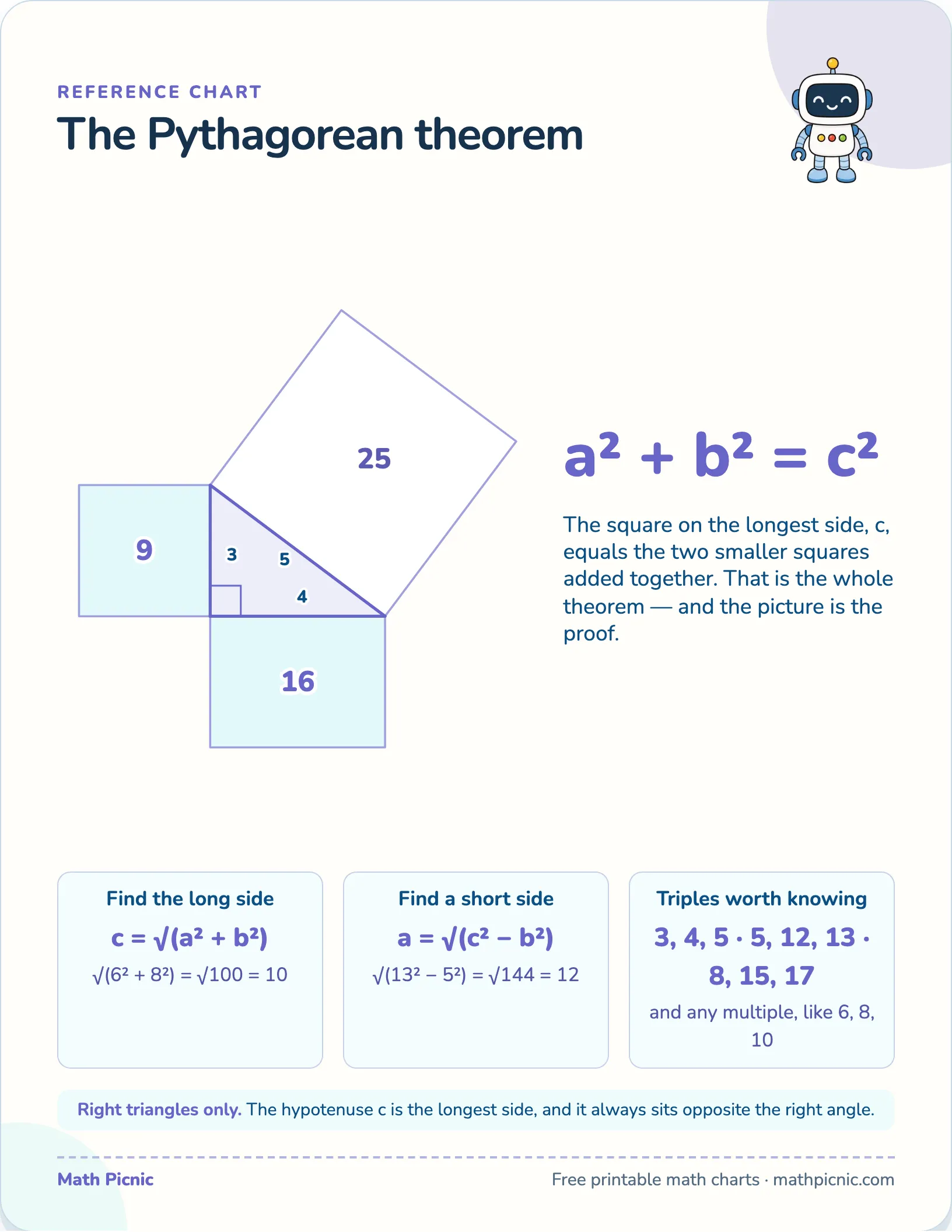
A square drawn on each side of a right triangle, so the theorem is something a child sees rather than believes. The two small squares — 9 and 16 — fill exactly the same space as the big one, 25.
Reference chart
The Pythagorean theorem

a² + b² = c²
The square on the longest side, c, equals the two smaller squares added together. That is the whole theorem — and the picture is the proof.
Find the long side
c = √(a² + b²)
√(6² + 8²) = √100 = 10
Find a short side
a = √(c² − b²)
√(13² − 5²) = √144 = 12
Triples worth knowing
3, 4, 5 · 5, 12, 13 · 8, 15, 17
and any multiple, like 6, 8, 10
Right triangles only. The hypotenuse c is the longest side, and it always sits opposite the right angle.
What's on this chart
The formula a² + b² = c² is short, and easy to misread as three letters to memorize. What it actually says is a statement about area: build a square on each side of a right triangle, and the two squares on the shorter sides, added together, cover exactly the square on the longest side. This chart draws that on a 3-4-5 triangle, where the squares come out to 9, 16 and 25 — and 9 + 16 = 25 is sitting there to be counted rather than trusted.
Why this chart helps
Once the picture makes sense, the two questions a child is actually asked follow from it. To find the long side, add the two smaller squares and take the square root: c = √(a² + b²). To find a shorter side, take the big square and subtract the one you know: a = √(c² − b²). Both need the square root, which is why this chart sits beside the squares and roots work — knowing that √100 is 10 is what turns the formula into an answer.
More printable charts
- Naming 2D shapes
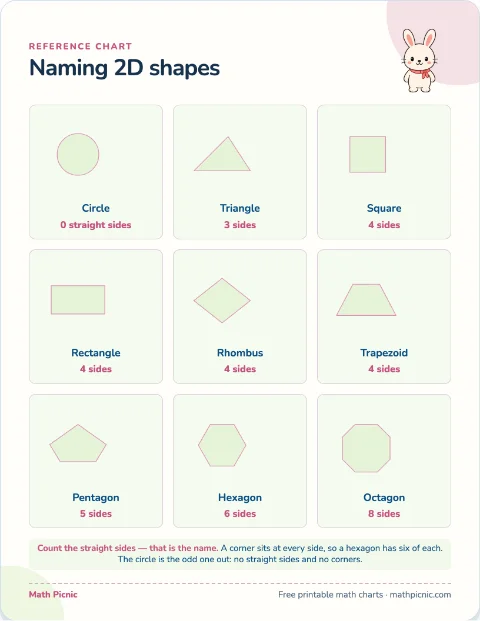 Print Count the straight sides on a shape, then read its name below it.
 - Quadrilateral family
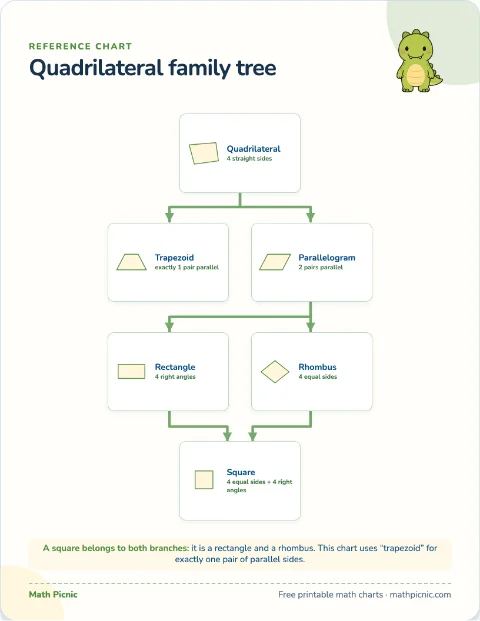 Print Follow the branches to see which names a shape inherits.
 - Lines of symmetry
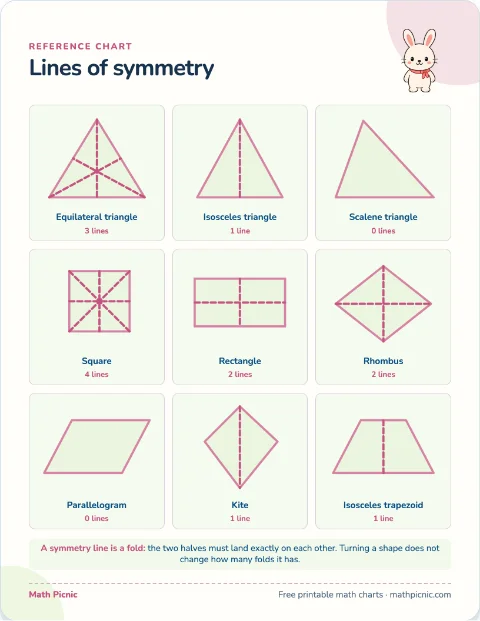 Print Fold each shape in your mind and count the matching halves.
 - Types of angles
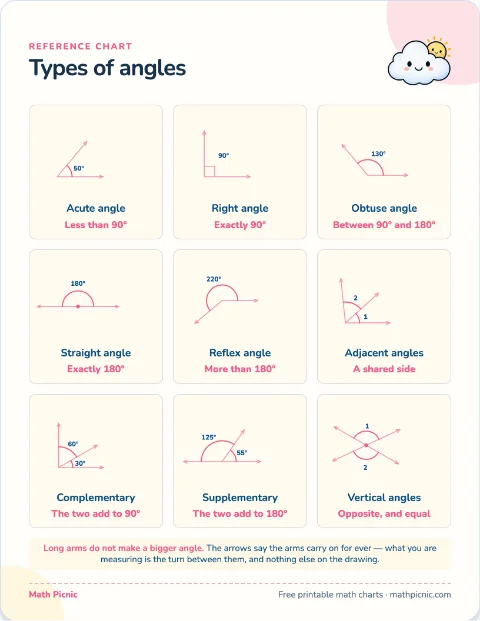 Print Find the picture that matches yours, and the name is under it.
 - Angles in parallel lines
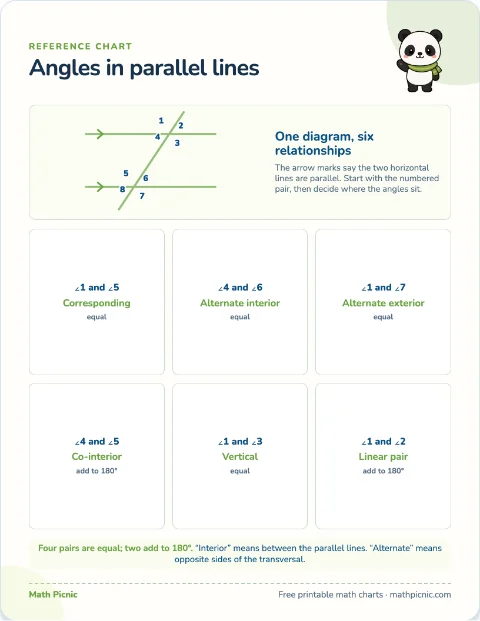 Print Match each numbered pair to its position around the transversal.
 - Perimeter formulas
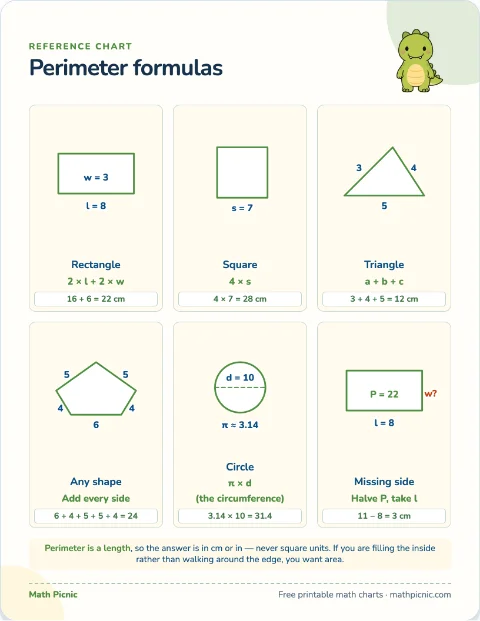 Print Follow the traced edge on the figure, then read the formula under it.
 - Area formulas
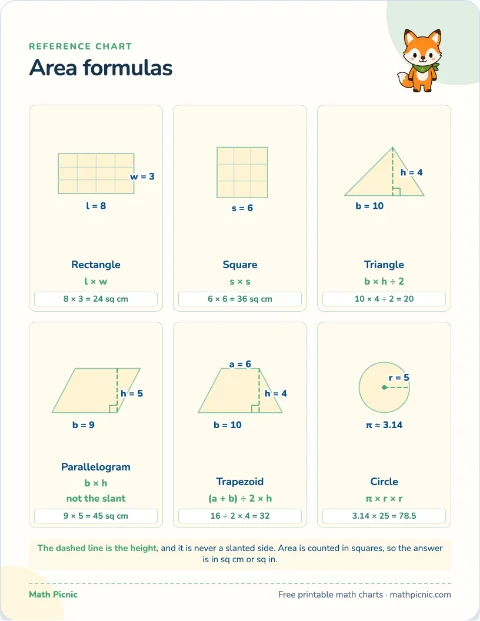 Print Match your shape to a figure and use the letters drawn on it.
 - Volume formulas
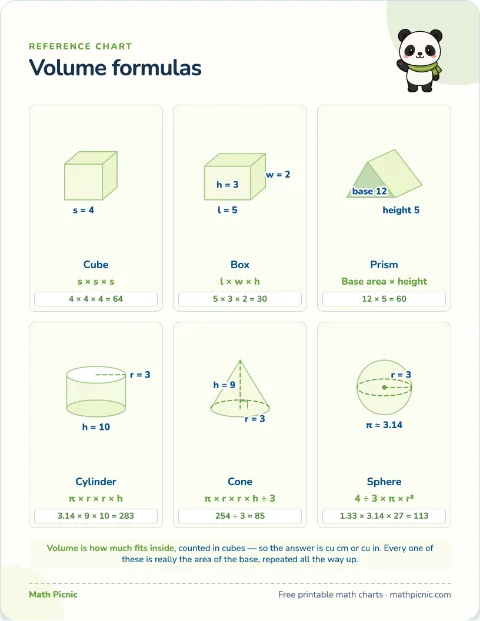 Print Find your solid, then multiply the base area by how tall it stands.