
Inequalities on a number line
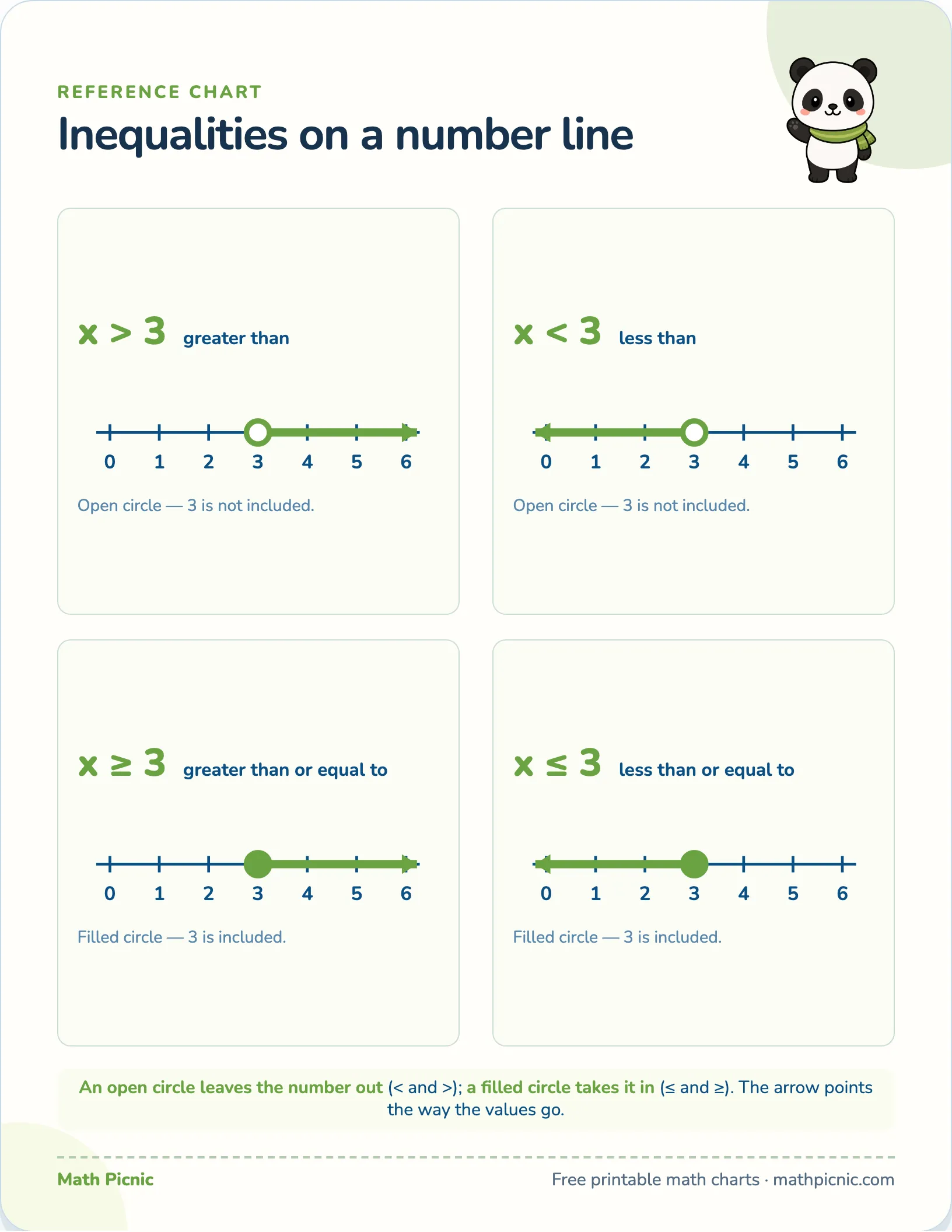
An inequality shows all the numbers that fit, not just one. x > 3 means every number bigger than 3, drawn on a number line as a circle at 3 with an arrow running the way the numbers go. Two things say exactly which numbers: whether the circle is open or filled, and which way the arrow points.
Reference chart
Inequalities on a number line

Open circle — 3 is not included.
Open circle — 3 is not included.
Filled circle — 3 is included.
Filled circle — 3 is included.
An open circle leaves the number out (< and >); a filled circle takes it in (≤ and ≥). The arrow points the way the values go.
What's on this chart
The circle answers one question: is the number itself included? For a plain greater-than or less-than, it is not — 3 is the edge but not part of the answer, so the circle is left open, an empty ring. For “or equal to” (≥ and ≤), the number is included — “greater than or equal to 3” takes the 3 in — so the circle is filled solid. Open means out, filled means in; that single difference is the whole reason there are four signs and not two.
Why this chart helps
The arrow answers the other question: which way do the numbers go? Greater than points toward the bigger numbers, to the right; less than points toward the smaller, to the left. Put the two together and any inequality reads straight off the line: a filled circle at 3 with the arrow going right is x ≥ 3, every number from 3 upward.
More printable charts
- Counting to 10
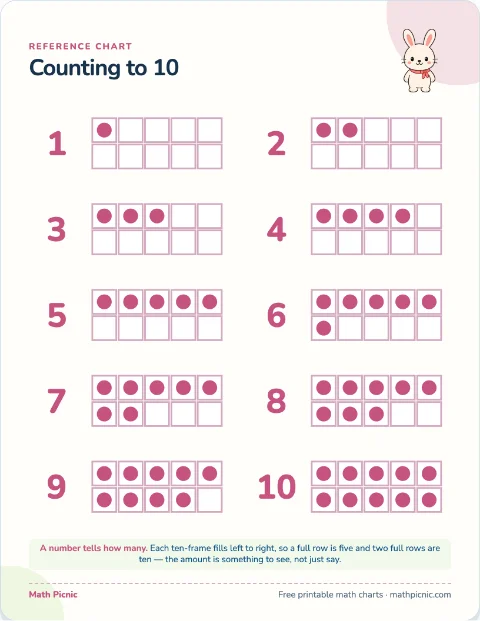 Print Count the dots in each ten-frame and read the number beside it.
 - Number bonds to 10
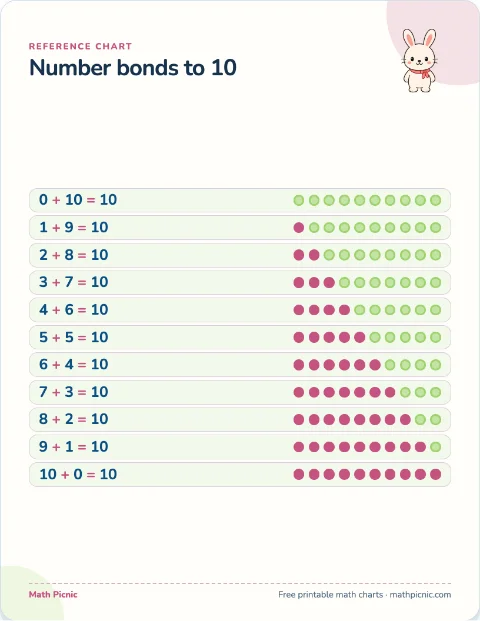 Print Read each row of counters and say the two numbers that make ten.
 - Comparing numbers
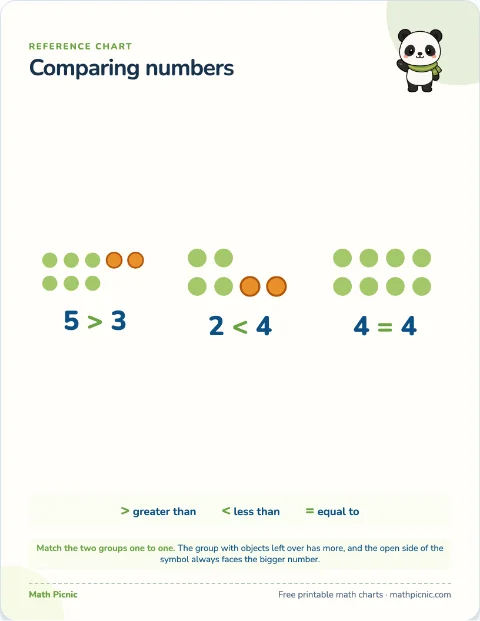 Print Line the two groups up one to one; the group with a leftover has more.
 - Odd and even
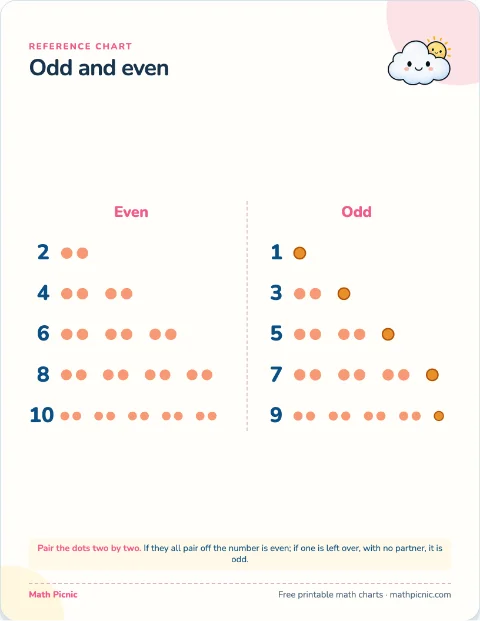 Print Pair the dots two by two; all paired is even, one left over is odd.
 - Number line 0–20
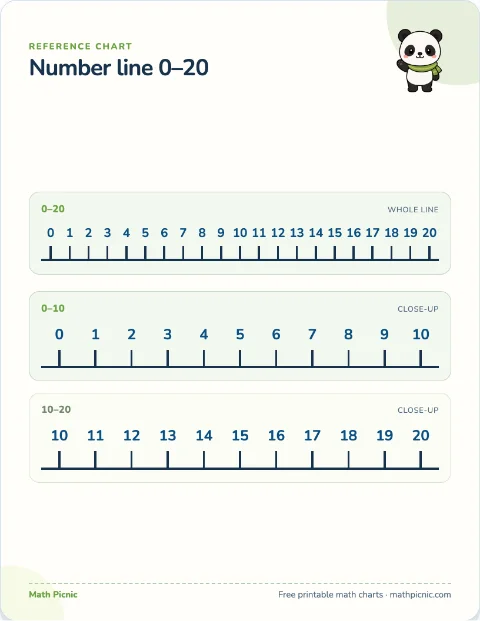 Print Count on or back by hopping along the line one number at a time.
 - Blank number line 0–20
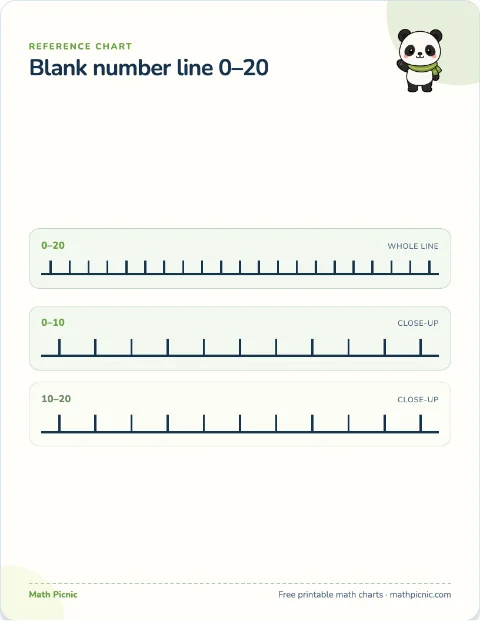 Print Label the ticks, mark a number, or draw equal jumps for an operation.
 - Number bonds to 20
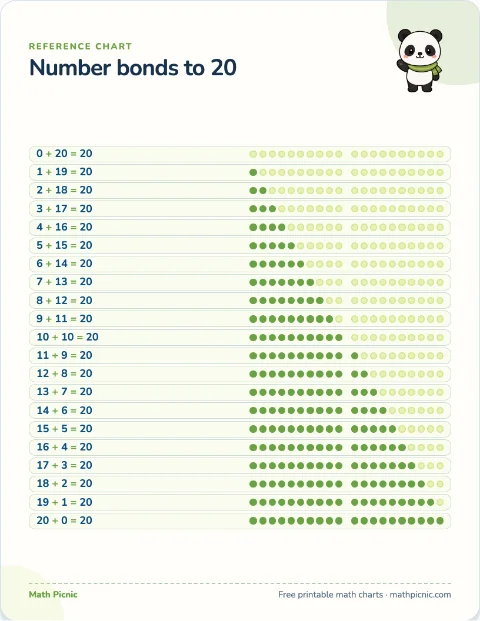 Print Count the two colors in a row and say the pair that makes twenty.
 - Telling the time
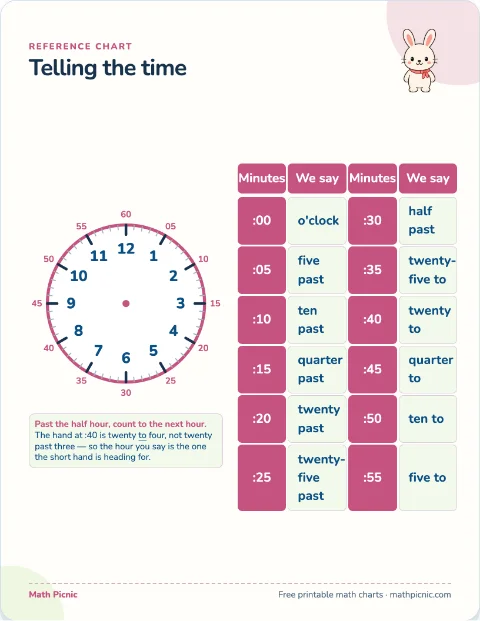 Print Read the hour inside the dial and the minutes printed outside it.