
The coordinate plane
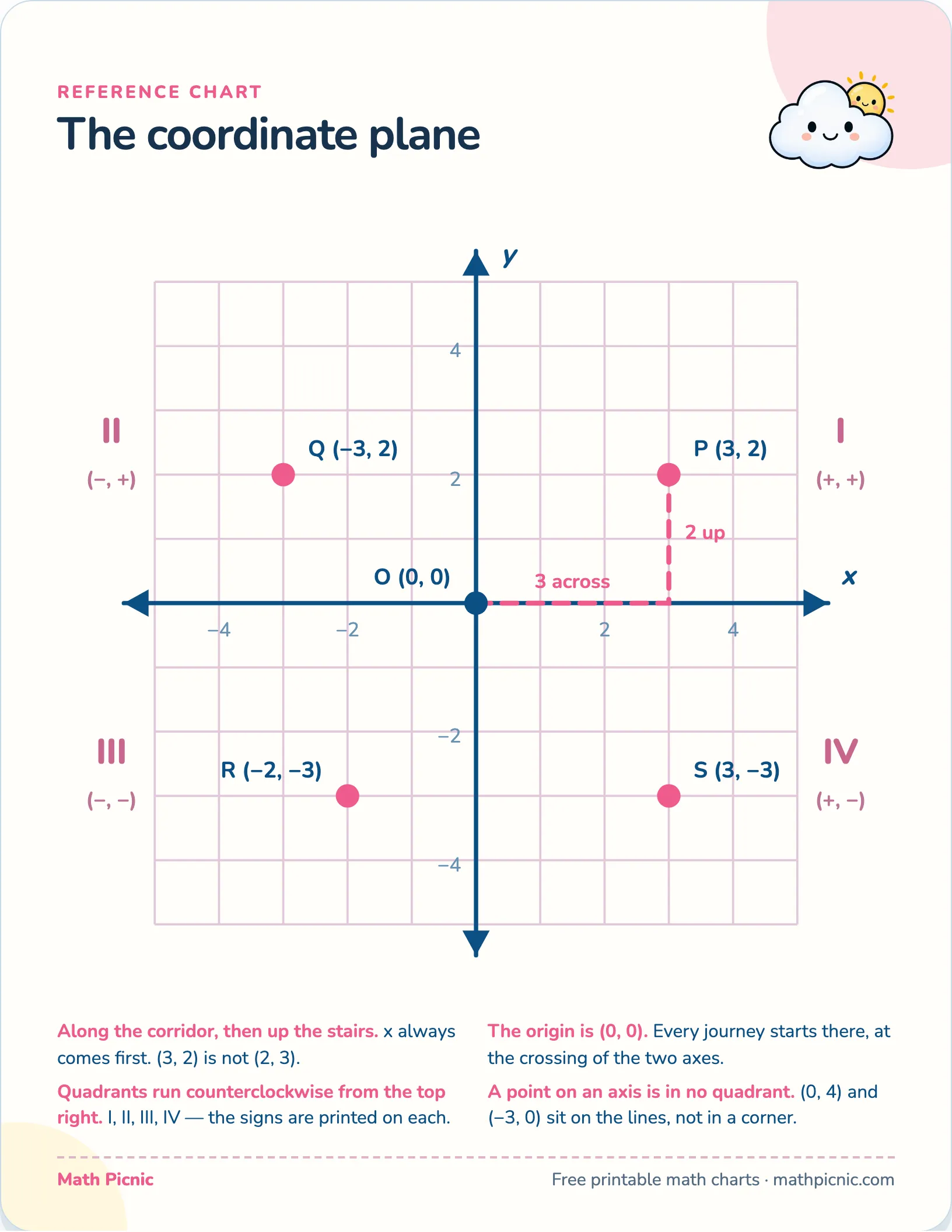
One grid from −5 to 5 with its four quadrants named and signed, five points plotted, and the journey to (3, 2) drawn along the axis and then up.
Reference chart
The coordinate plane

Along the corridor, then up the stairs. x always comes first. (3, 2) is not (2, 3).
The origin is (0, 0). Every journey starts there, at the crossing of the two axes.
Quadrants run counterclockwise from the top right. I, II, III, IV — the signs are printed on each.
A point on an axis is in no quadrant. (0, 4) and (−3, 0) sit on the lines, not in a corner.
What's on this chart
The order is the whole difficulty. (3, 2) and (2, 3) are different points and a child who mixes them plots everything a reflection away from where it belongs, which is a mistake that survives being told the rule because the rule is a sentence and plotting is an action. So the chart draws the action: a dashed line runs from the origin along the x-axis for three, then turns and goes up for two, and lands on the point. Along the corridor and then up the stairs, printed rather than recited.
Why this chart helps
The four other points are plotted without their routes, one in each quadrant, so the page can be read backwards as well. A child looking for practice can cover the labels and read the pairs off the dots, which is the other half of the skill and the half worksheets ask for more often. Every one of them has a whole-number pair on a grid line, because a chart is for checking against and a point between the lines gives an answer nobody can verify.
More printable charts
- Counting to 10
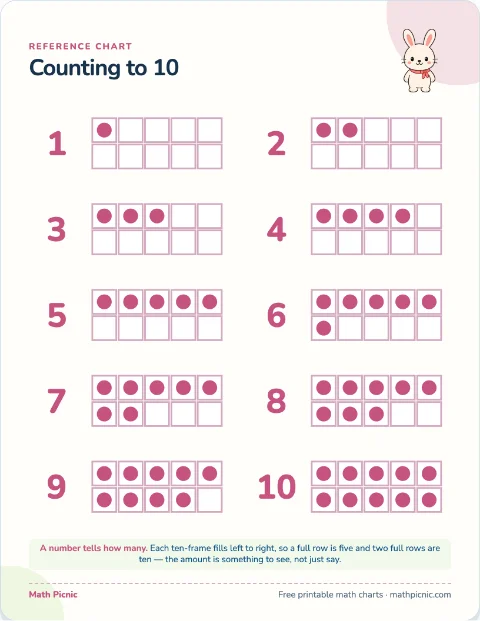 Print Count the dots in each ten-frame and read the number beside it.
 - Number bonds to 10
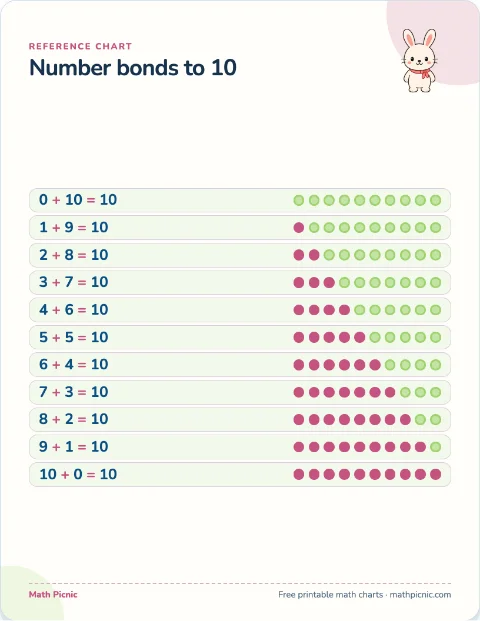 Print Read each row of counters and say the two numbers that make ten.
 - Comparing numbers
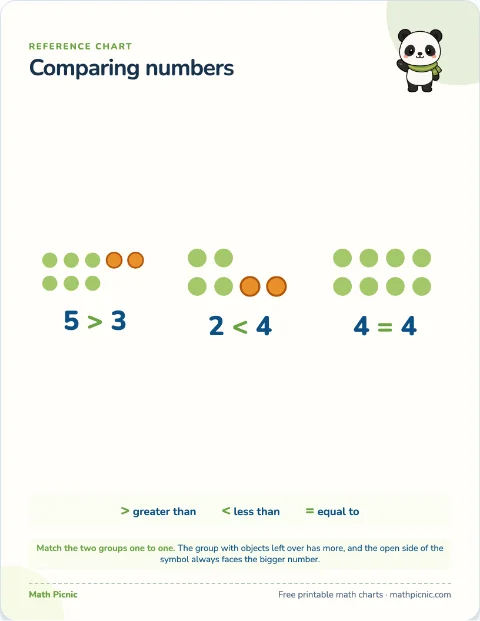 Print Line the two groups up one to one; the group with a leftover has more.
 - Odd and even
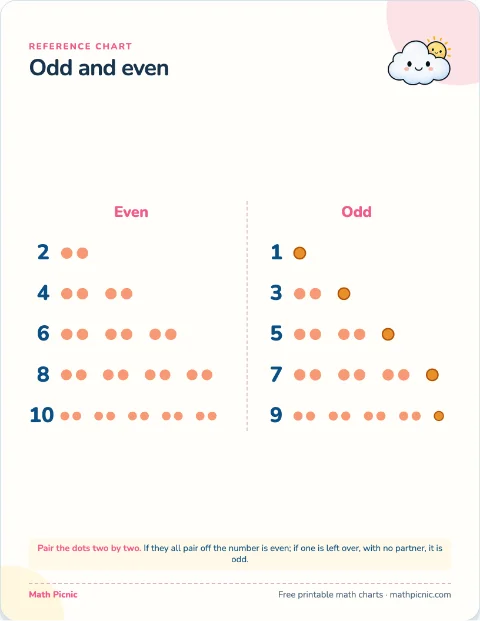 Print Pair the dots two by two; all paired is even, one left over is odd.
 - Number line 0–20
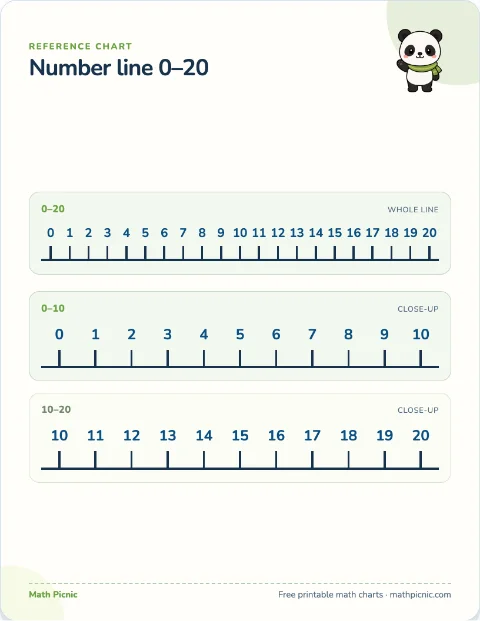 Print Count on or back by hopping along the line one number at a time.
 - Blank number line 0–20
 Print Label the ticks, mark a number, or draw equal jumps for an operation.
 - Number bonds to 20
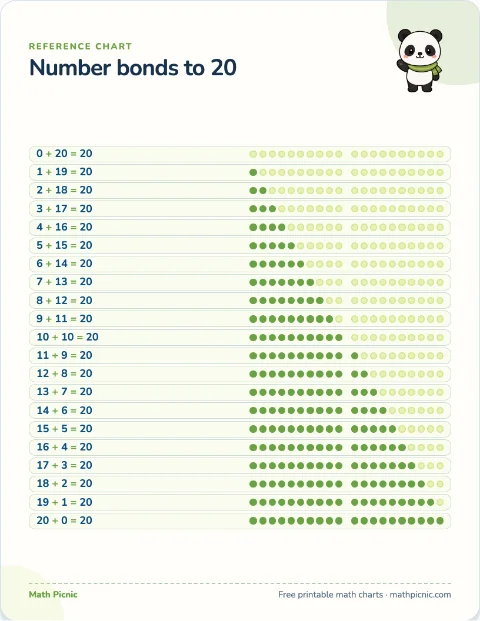 Print Count the two colors in a row and say the pair that makes twenty.
 - Telling the time
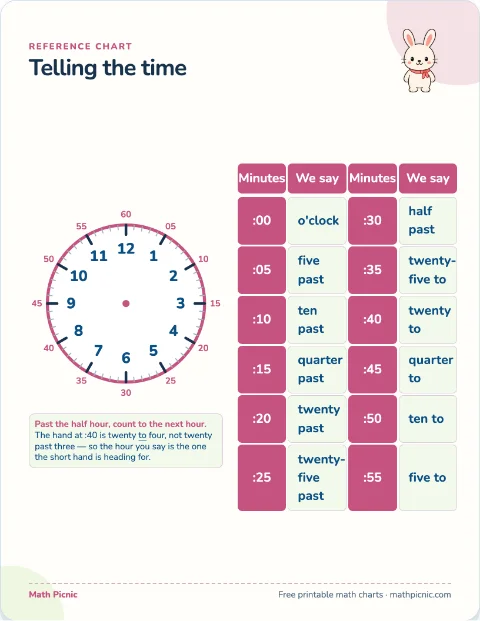 Print Read the hour inside the dial and the minutes printed outside it.