Two rules, two patterns worksheets

Two rules run side by side: add 3 along the top, add 9 along the bottom. Every term underneath is three times the one above it, and noticing that is the whole of the standard. Free printable sheets with an answer key.

Two rules, two patterns
Two rules, two patterns worksheet — Steps to 6, 9, or 12, free printable with answer key

The answer key prints on a separate page.

What's on this sheet

A single pattern — 2, 4, 6, blank, 10 — is a fourth-grade question, and there is a sheet for it already. What makes this a year harder is that there are two patterns and they are related: the child follows each rule down its own row, then looks across and sees that the bottom row is always the same multiple of the top. The relationship is not stated anywhere on the sheet; it is the thing to be found.

Why this sheet works

The second rule always counts in whole multiples of the first. Two freely chosen steps would still make two valid patterns, but the relationship between them comes out as something like “1.75 times” — true, unmarkable in a blank, and not what a fifth-grader is being asked to notice. Keeping the second step a multiple of the first is what makes the relationship a whole number worth writing down.

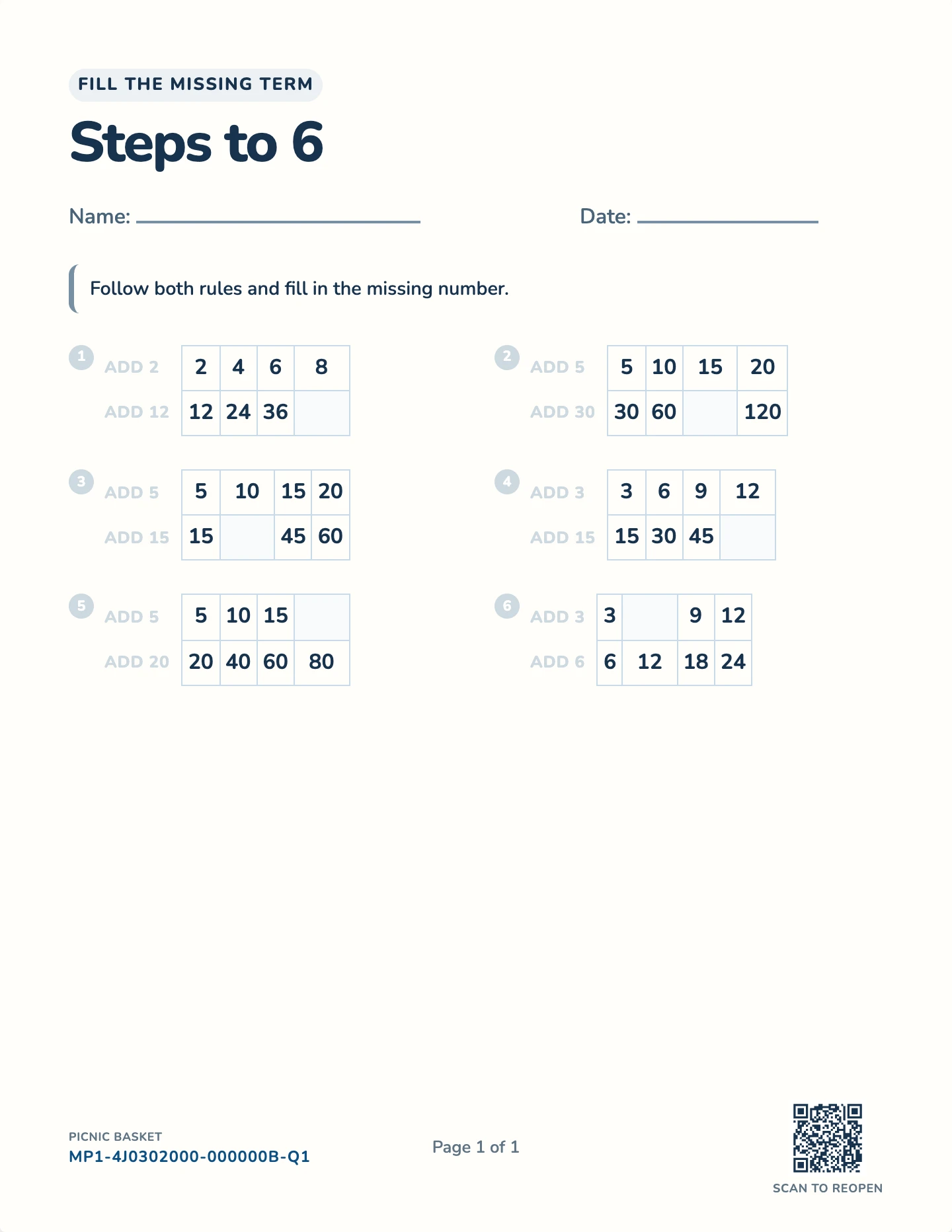
How this one works

Two rules, two patterns

row 1:212
row 2:424
row 3:636
row 4:8?
row 1:212
row 2:424
row 3:636
row 4:8?
row 1:212
row 2:424
row 3:636
row 4:8?
row 1:212
row 2:424
row 3:636
row 4:848
  1. Two patterns, and each column counts in its own step — so a gap CAN be filled by counting down its own column. But that is not what a table of pairs is for: the two sides are locked to each other, and the same link works on every row.
  2. Read the link off a row with nothing missing. Row 1: 2 on the left, 12 on the right — that is × 6.
  3. The same link holds all the way down, so use it on the gap: 8 × 6 = 48.
  4. Counting down the column gets there too — this is not a trick — but the link is what the two patterns were put next to each other to show.