Compass constructionsBisect an angle
Name: Date:
Bisect each angle. Leave your arcs showing.
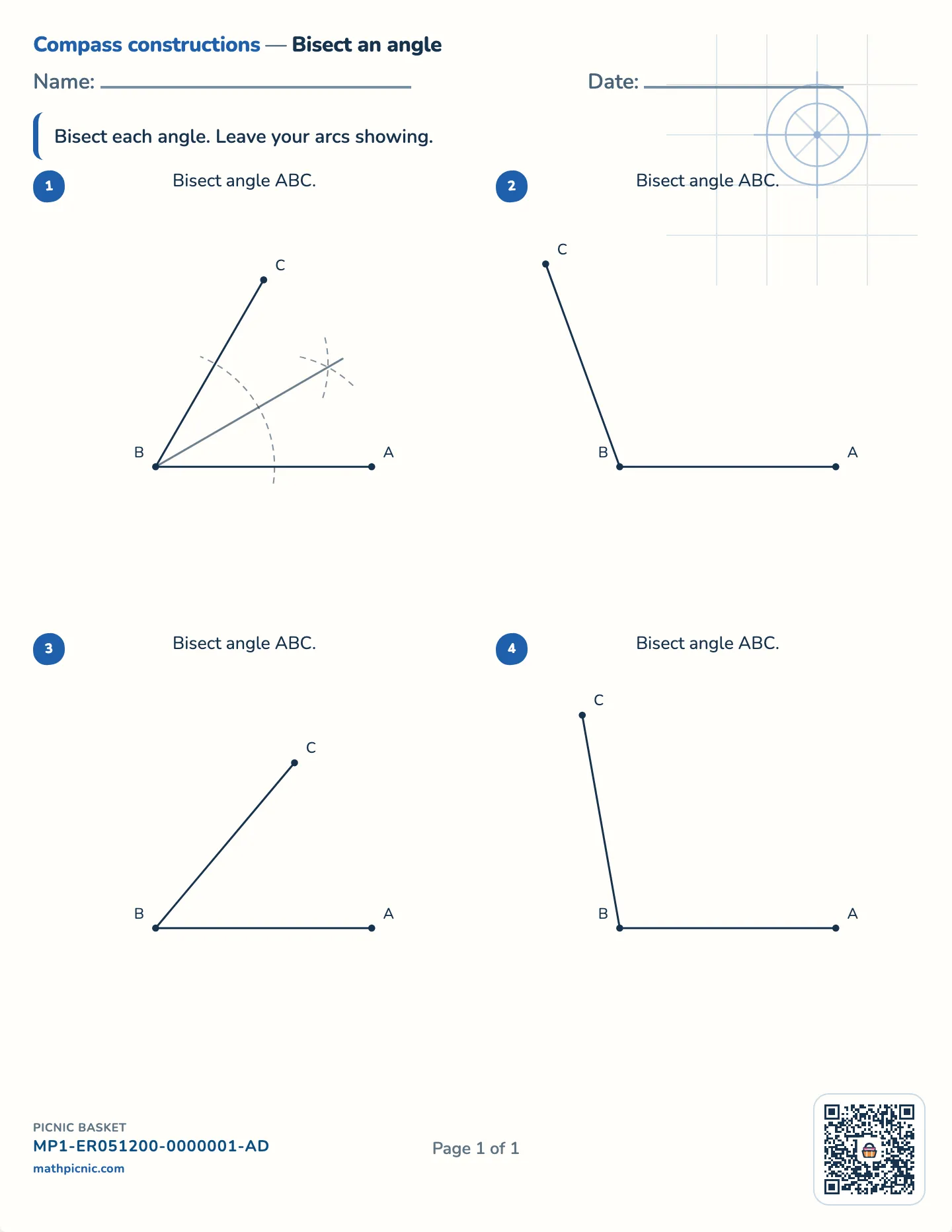
1Bisect angle ABC.
2Bisect angle ABC.
3Bisect angle ABC.
4Bisect angle ABC.

Cut an angle exactly in half with three arcs and a straightedge — no protractor, no division, and no need to know what the angle measures.
If they get stuck
The answer key prints on a separate page.
An arc from the vertex marks a point on each arm; equal arcs from those two points cross somewhere inside the angle; the line from the vertex through that crossing is the bisector. It is exact because the two marked points are the same distance from the vertex and the crossing is the same distance from both of them, which makes two congruent triangles either side of the line.
Bisecting an angle of 90° gives 45°, and repeating gives 22.5° — a sequence no protractor reads well and a compass produces perfectly. Angles on these sheets run from 40° to 110° in whole degrees at true size, so a protractor check on the finished halves reads half the number the key names.
One question off this sheet, worked a step at a time — with a sentence saying what just happened and why.
Bisect an angle, step by step