Compass constructionsInscribe a regular polygon
Name: Date:
Inscribe each shape in its circle. Leave your arcs showing.
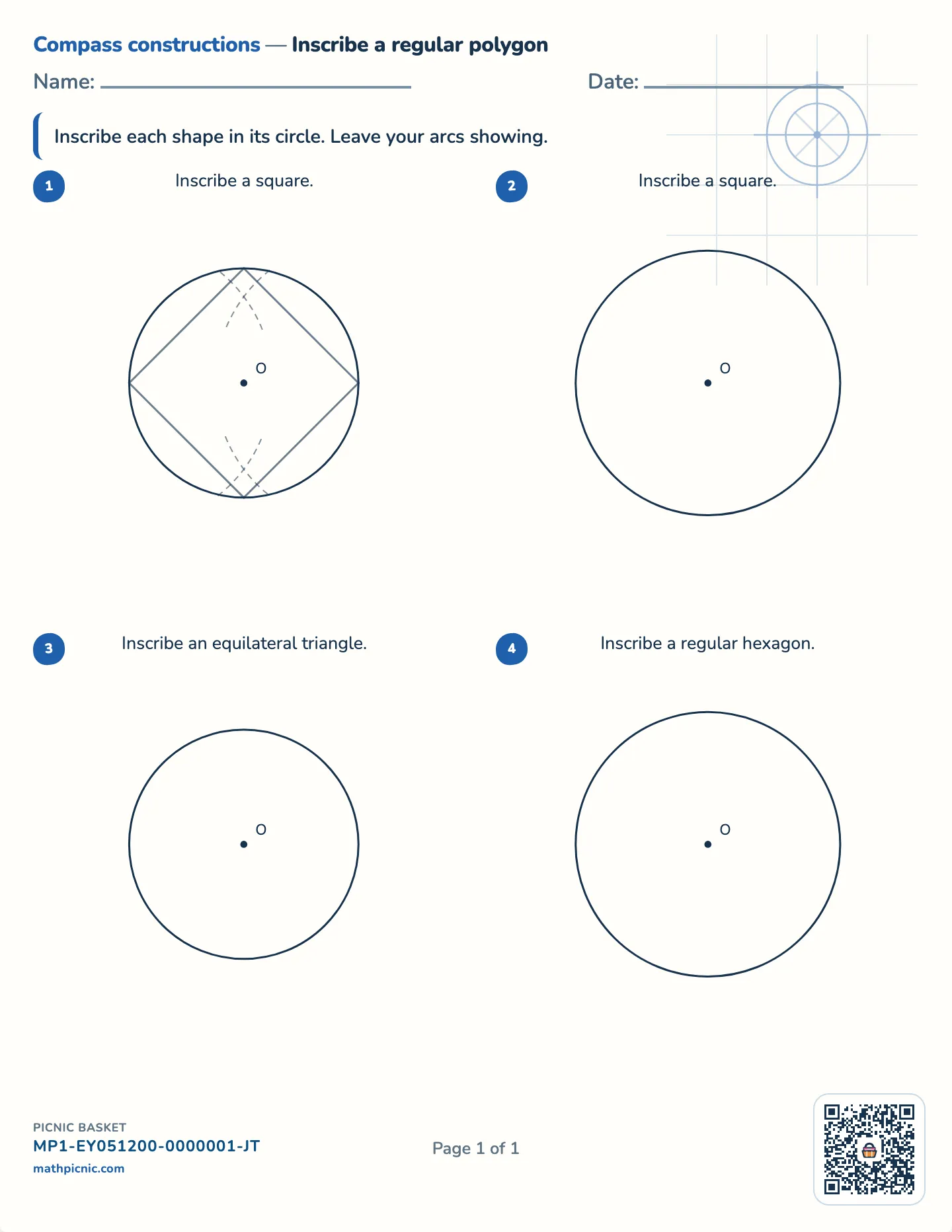
1Inscribe a square.
2Inscribe a square.
3Inscribe an equilateral triangle.
4Inscribe a regular hexagon.

The radius of a circle steps round it exactly six times. That single fact gives a regular hexagon, and joining every other mark gives an equilateral triangle — the square needs a different idea.
If they get stuck
The answer key prints on a separate page.
Keep the compass at the circle's radius and step it round from any point on the circle: you get six marks, evenly spaced, because six equilateral triangles fit round a centre. Join all six for a hexagon, join every other one for an equilateral triangle. Nothing is measured and nothing is divided — the hexagon falls out of the radius itself.
A square is the odd one out and the sheets treat it that way. Stepping the radius cannot produce four points, so the square is built from a diameter and the perpendicular bisector of that diameter — two diameters at right angles, meeting the circle at the four corners. Meeting all three on one sheet is what makes the difference visible.
One question off this sheet, worked a step at a time — with a sentence saying what just happened and why.
Inscribe a regular polygon, step by step