Compass constructionsCopy a segment
Name: Date:
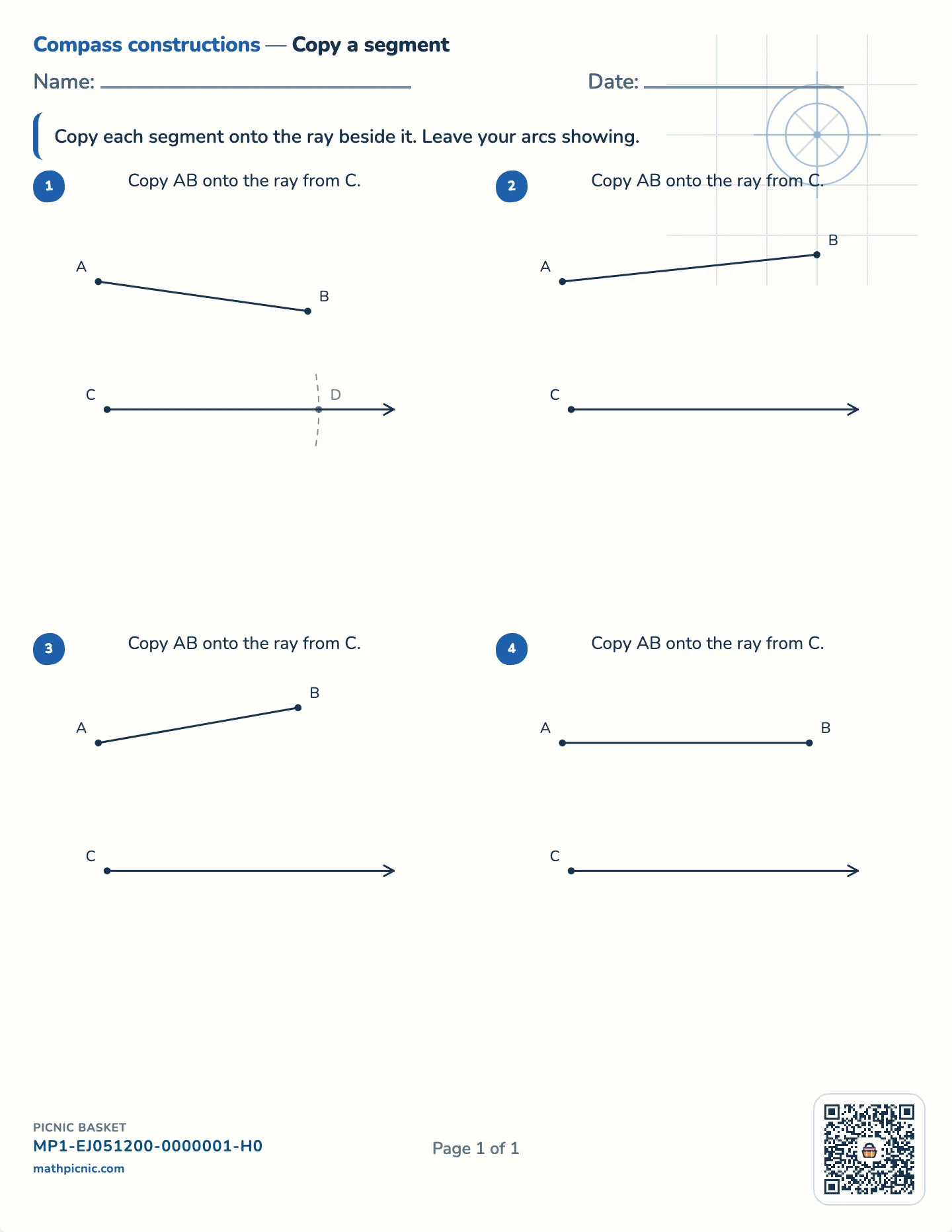
Copy each segment onto the ray beside it. Leave your arcs showing.
1Copy AB onto the ray from C.
2Copy AB onto the ray from C.
3Copy AB onto the ray from C.
4Copy AB onto the ray from C.

The first construction anyone learns, and the one every other construction rests on: set the compass to a segment, carry that length somewhere else, and cut it off a ray. Nothing is measured with a ruler — the compass does the carrying.
If they get stuck
The answer key prints on a separate page.
A construction is not a drawing of the answer, it is the answer arrived at with two tools. Here the child opens the compass so its point sits on A and its pencil on B, lifts it without changing the opening, sets the point on C and swings a short arc across the ray. Where the arc meets the ray is D, and CD is AB — not approximately, exactly, because the compass never changed.
Every segment on these sheets is a whole number of millimetres, printed at true size. That is deliberate and it is unusual: most geometry figures on this site are diagrams whose size means nothing, but a child sets a real compass against this one, so a sheet that printed the same question at two sizes would be lying about what it asks. A teacher checking the copy with a ruler reads the number the answer key names.
One question off this sheet, worked a step at a time — with a sentence saying what just happened and why.
Copy a segment, step by step