Quadratics with complex conjugate roots worksheets

When a quadratic has a middle term and a negative discriminant, its roots have both a real part and an imaginary part. These free printable worksheets work that full case, from x² − 4x + 68 = 0 to the pair a ± bi.

Quadratics with complex conjugate roots
Quadratics with complex conjugate roots worksheet — Whole real and imaginary parts, free printable with answer key

The answer key prints on a separate page.

What's on this sheet

These are the harder half of complex solutions. x² + 25 = 0 is one square root; x² − 4x + 68 = 0 needs the discriminant, the square root of a negative number, and then a division that has to reach both parts. The most common slip is dividing the imaginary part by 2a and forgetting the real part, or the other way around.

Why this sheet works

The discriminant comes first on every key, because it is the reason the answer changes kind. Every real and imaginary part is whole, so the arithmetic does not compete with the method, and the ± is printed for you. A real quadratic’s complex roots are always a conjugate pair, so finding one names both.

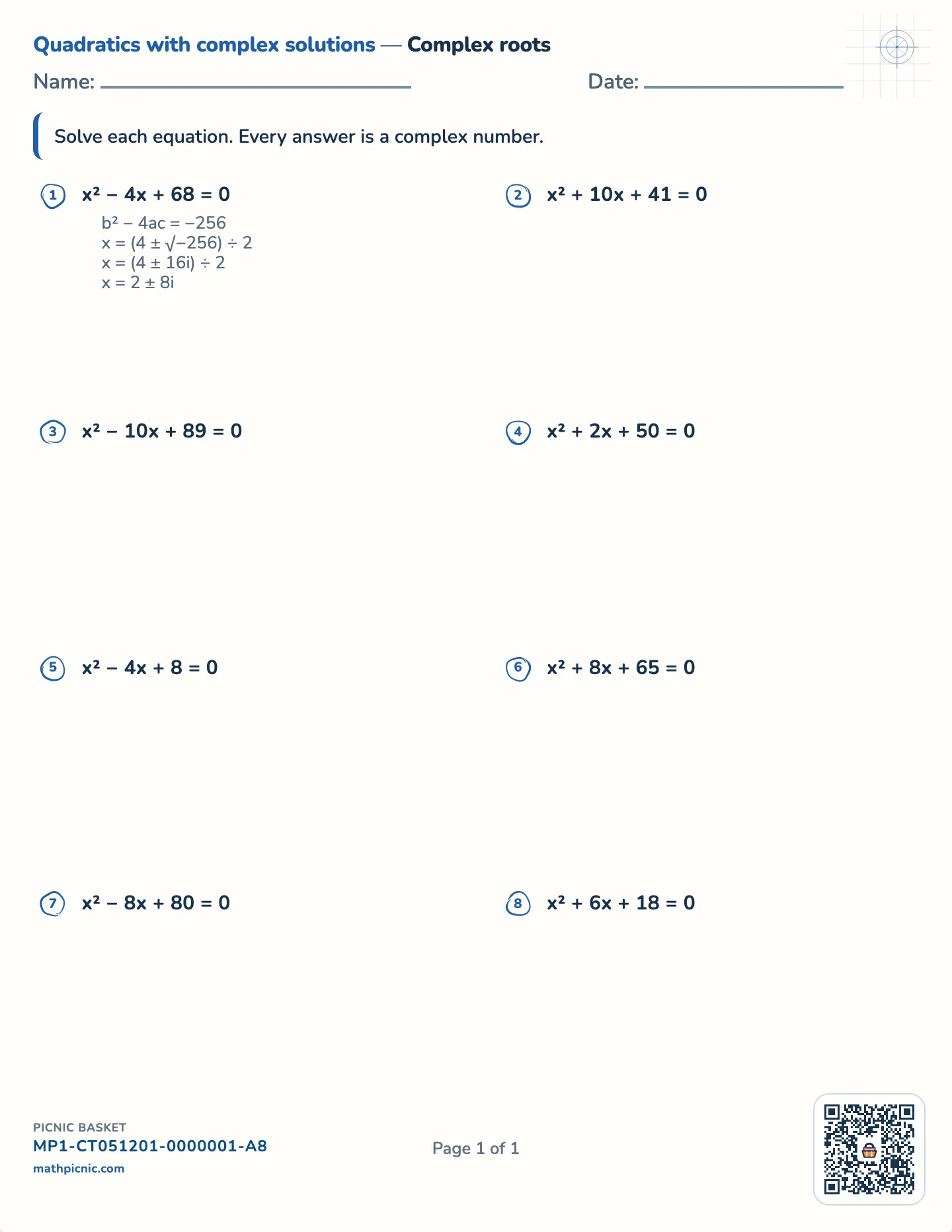
How this one works

Solve x² − 4x + 68 = 0

b² − 4ac = −256
x = (4 ± √−256) ÷ 2
x = (4 ± 16i) ÷ 2
x = 2 ± 8i
  1. Work out the discriminant first: b² − 4ac = (−4)² − 4(68) = 16 − 272 = −256. It is negative, so there are no real roots.
  2. Put it in the formula: x = (4 ± √−256) ÷ 2.
  3. √−256 = 16i, because √(−1) is i. So x = (4 ± 16i) ÷ 2.
  4. Divide both parts by 2: x = 2 ± 8i.