What's on this sheet
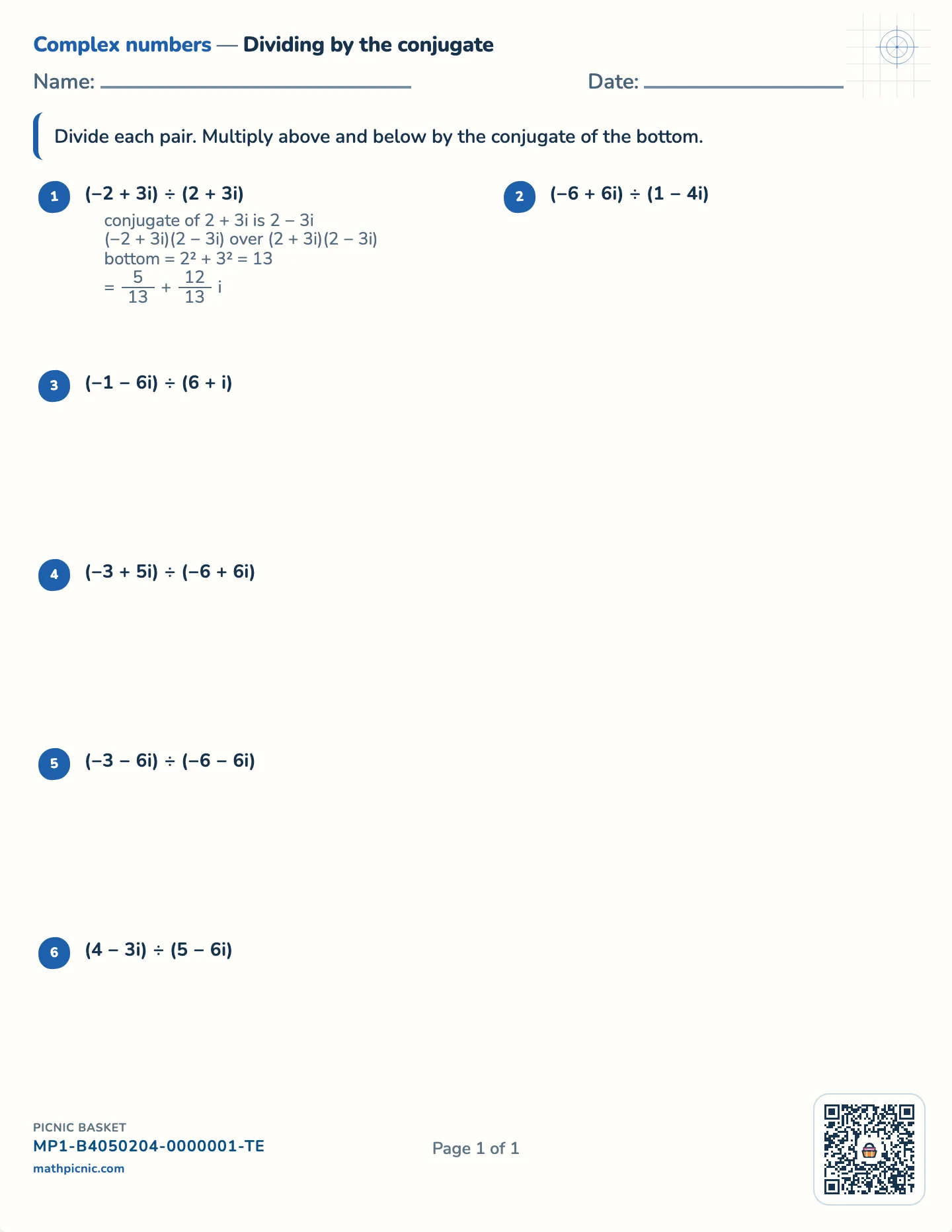
The conjugate of 2 + 3i is 2 − 3i, and it works because of a difference of two squares: (2 + 3i)(2 − 3i) is 4 − 9i², and since i² = −1 that is 4 + 9 = 13, a plain whole number. Multiplying the top by the same conjugate leaves the value unchanged, because together the two are a multiplication by (2 − 3i)/(2 − 3i), which is 1. So the division becomes a multiplication on top and a real number underneath.
Why this sheet works
The key writes that bottom as 2² + 3² = 13 rather than as a subtraction, because the usual slip is 4 − 9 = −5 with the i² forgotten. The other is multiplying only the bottom by the conjugate. Every divisor on the sheet has two non-zero parts, so the bottom always comes out between 10 and 72 and the conjugate is never a step that can be skipped.