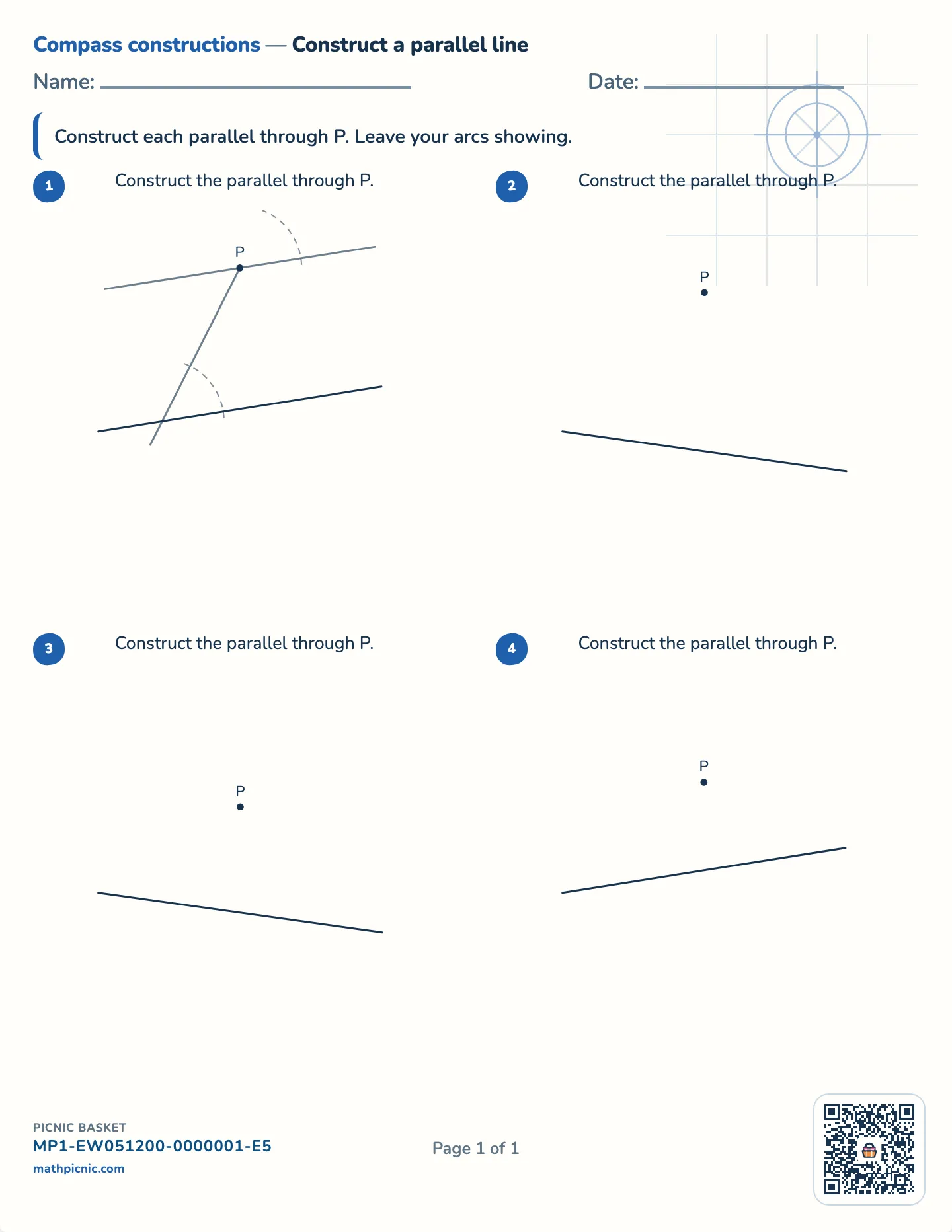
Draw any line through P that crosses the given line, copy the angle it makes at the crossing up to P, and the arm you draw is parallel. The reason is the converse of the corresponding-angles theorem: equal corresponding angles force the lines apart forever. A child who has copied an angle already knows every step of this; what is new is what the copy is FOR.
Why this sheet works
This is the last of the six constructions in G-CO.D.12 and the one that most obviously rests on the others — which is why the sheets are ordered the way they are. A child sent here without having copied an angle will be following a recipe; one who has will recognise the middle three steps and only have to learn the frame around them.
How this one works
One question off this sheet, worked a step at a time — with a sentence saying what just happened and why.
Construct each parallel through P. Leave your arcs showing.
1Construct the parallel through P.
2Construct the parallel through P.
3Construct the parallel through P.
4Construct the parallel through P.
Compass constructions · Construct a parallel lineAnswer key
1. Construct the parallel through P. (P 32mm from the line) — 1. Draw any line through P that crosses the given line. Call the crossing X. 2. Copy the angle at X onto the new line, with its vertex at P. 3. The arm you draw is parallel to the given line. 4. The two angles are corresponding angles, which is why the lines cannot meet.2. Construct the parallel through P. (P 36mm from the line) — 1. Draw any line through P that crosses the given line. Call the crossing X. 2. Copy the angle at X onto the new line, with its vertex at P. 3. The arm you draw is parallel to the given line. 4. The two angles are corresponding angles, which is why the lines cannot meet.3. Construct the parallel through P. (P 24mm from the line) — 1. Draw any line through P that crosses the given line. Call the crossing X. 2. Copy the angle at X onto the new line, with its vertex at P. 3. The arm you draw is parallel to the given line. 4. The two angles are corresponding angles, which is why the lines cannot meet.4. Construct the parallel through P. (P 20mm from the line) — 1. Draw any line through P that crosses the given line. Call the crossing X. 2. Copy the angle at X onto the new line, with its vertex at P. 3. The arm you draw is parallel to the given line. 4. The two angles are corresponding angles, which is why the lines cannot meet.