• Free
  • Grade 9
  • a ≠ 1, two, one or none

Discriminant with a leading coefficient worksheets

When the leading coefficient is not 1, b² − 4ac still decides it — but the a can no longer be ignored. These free printable worksheets use the discriminant with a real coefficient in front.

Kid stuck on one? You don’t just get the sheet.

  • Answer key included
  • Reopen this exact sheet
  • Letter & A4 ready
Ready to printDiscriminant with a leading coefficient
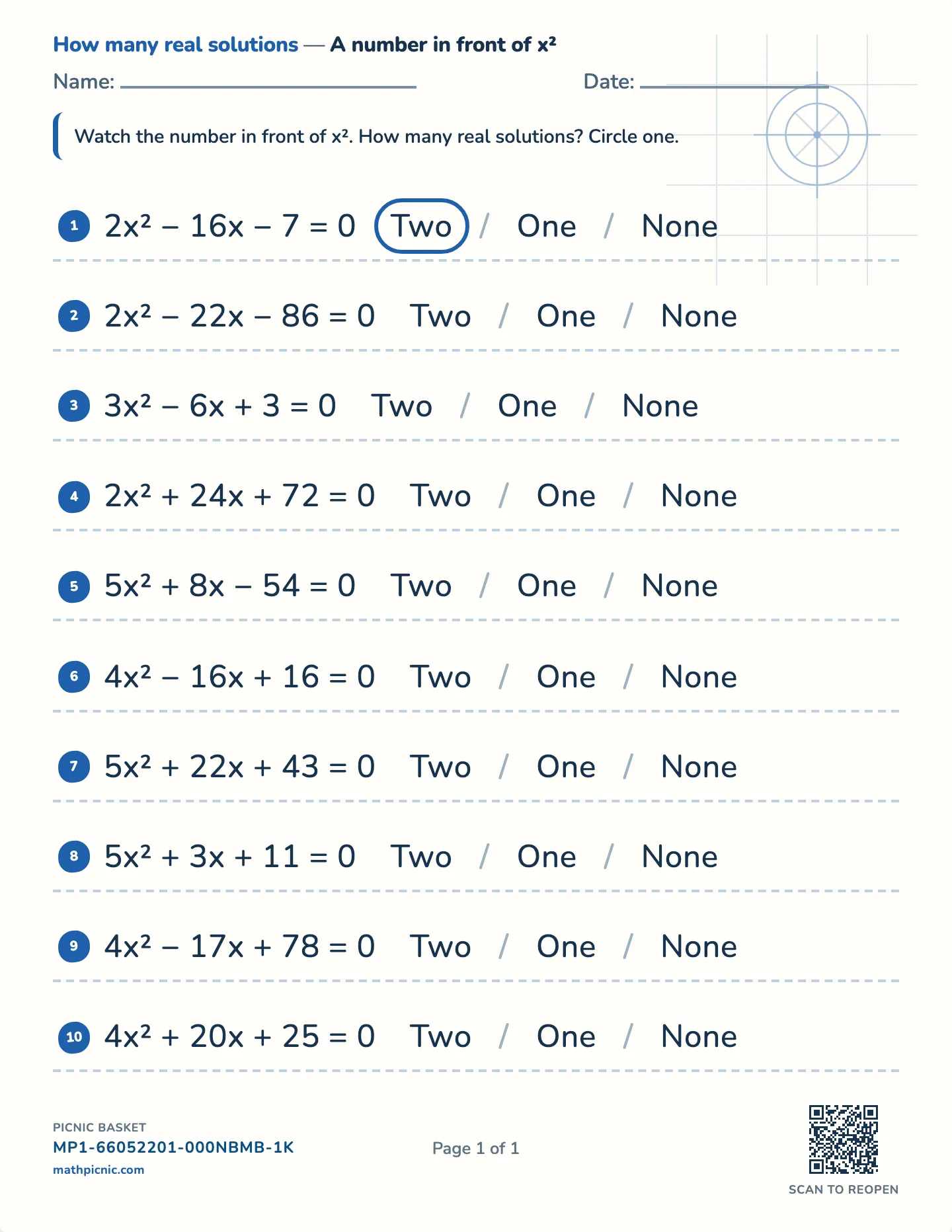
Discriminant with a leading coefficient worksheet — a ≠ 1, two, one or none, free printable with answer key

The answer key prints on a separate page.

What's on this sheet

With a = 1 a child can compute b² − 4c, forget the a entirely, and still be right. That habit breaks here. For 3x² + 4x + 2 the discriminant is 4² − 4·3·2 — the a is a factor of the 4ac term, and dropping it changes both the number and, often, the answer. Writing all three letters in is the whole discipline of this page.

Why this sheet works

The three cases read the same as always: b² − 4ac above zero means two real solutions, zero means one, below zero means none, because the last step of solving is a square root. What changes is only the middle of the calculation — 4ac is now a product of three numbers, not two — so this is the discriminant with the one shortcut removed.

How this one works

One question from this sheet, worked through a step at a time.

2x² − 16x − 7 = 0

2x² − 16x − 7 = 0
4ac
a = 2b = −16c = −7
(−16)² − 4 × 2 × −7
256 − −56=312
b² − 4ac = 312
How many?Two
  1. You do not have to solve this to answer it. One number decides how many real solutions a quadratic has, and it is b² − 4ac — the part that ends up under the square root sign when you do solve it.
  2. Read off a, b and c from 2x² − 16x − 7 = 0: a = 2, b = −16, c = −7. Write all three in, even the a — on this sheet it is 2, and forgetting it is the mistake that only shows up when it is not 1.
  3. Work it out: (−16)² is 256, and 4 × 2 × −7 is −56. That leaves 256 − −56 = 312.
  4. 312 is above zero, and a positive number has two square roots — one either way from the ±. So there are TWO real solutions.