x² − 64 is one square minus another, and it factors on sight into (x + 8)(x − 8). These free printable worksheets drill the plain difference of squares, no coefficient in front.
This is the one factorization with no search in it. There is no pair of numbers to hunt for and no middle term to match — the expression is one perfect square take away another, and it splits into the sum times the difference. What a child has to see is the shape: is each part a perfect square, and is the sign a minus.
Why this sheet works
The shape is exactly where the mistakes live. x² + 64 is a sum and does not factor at all, and x² − 20 is not a difference of squares because 20 is not a perfect square. A child who has learned the shortcut reaches for it on both; every walk here checks the two conditions before it factors anything.
How this one works
One question from this sheet, worked through a step at a time.
x² − 25
x² − 25
x² = (x)²25 = 5²
(x + 5)(x − 5)
+5x−5xcancel
x² − 25
x² − 25=(x + 5)(x − 5)
Before factoring anything, check the shape. There are two parts with a − between them, and each part has to be a perfect square: x² is x squared, and 25 is 5 squared. Both are, and it is a minus — so this is a difference of two squares.
That shape always factors the same way, and there is nothing to search for: it is the SUM times the DIFFERENCE of the two things being squared — (x + 5)(x − 5).
Multiply it back out if you want to see why. The outer pair gives −5x and the inner pair gives +5x; they cancel, which is why there is no middle term left. What survives is x² − 25.
So the missing number is 5: 25 is 5 squared, so the two brackets are (x + 5) and (x − 5).
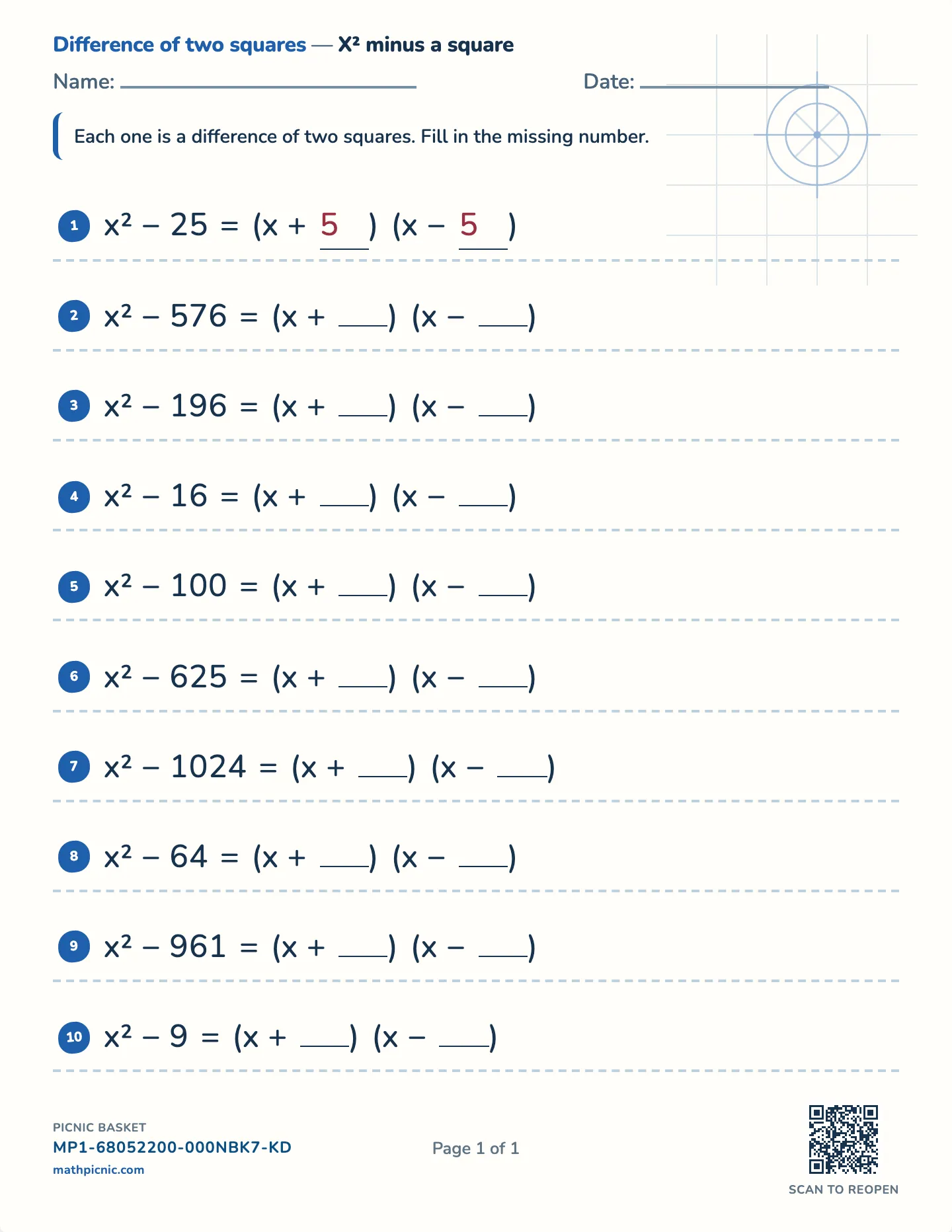
Each one is a difference of two squares. Fill in the missing number.
1x² − 25=(x + )(x − )
2x² − 576=(x + )(x − )
3x² − 196=(x + )(x − )
4x² − 16=(x + )(x − )
5x² − 100=(x + )(x − )
6x² − 625=(x + )(x − )
7x² − 1024=(x + )(x − )
8x² − 64=(x + )(x − )
9x² − 961=(x + )(x − )
10x² − 9=(x + )(x − )
Difference of two squares · X² minus a squareAnswer key
1. x² − 25 = (x + 5)(x − 5) (25 is 5 squared, so the two brackets are (x + 5) and (x − 5))2. x² − 576 = (x + 24)(x − 24) (576 is 24 squared, so the two brackets are (x + 24) and (x − 24))3. x² − 196 = (x + 14)(x − 14) (196 is 14 squared, so the two brackets are (x + 14) and (x − 14))4. x² − 16 = (x + 4)(x − 4) (16 is 4 squared, so the two brackets are (x + 4) and (x − 4))5. x² − 100 = (x + 10)(x − 10) (100 is 10 squared, so the two brackets are (x + 10) and (x − 10))6. x² − 625 = (x + 25)(x − 25) (625 is 25 squared, so the two brackets are (x + 25) and (x − 25))7. x² − 1024 = (x + 32)(x − 32) (1024 is 32 squared, so the two brackets are (x + 32) and (x − 32))8. x² − 64 = (x + 8)(x − 8) (64 is 8 squared, so the two brackets are (x + 8) and (x − 8))9. x² − 961 = (x + 31)(x − 31) (961 is 31 squared, so the two brackets are (x + 31) and (x − 31))10. x² − 9 = (x + 3)(x − 3) (9 is 3 squared, so the two brackets are (x + 3) and (x − 3))