• Free
  • Grade 9
  • Small base and ratio

Geometric sequence nth term worksheets

A geometric sequence multiplies by the same factor every step, so its nth term is the start times the ratio raised to a power. These free printable worksheets ask for a term far enough out that multiplying it through by hand is the long way round.

Kid stuck on one? You don’t just get the sheet.

  • Answer key included
  • Reopen this exact sheet
  • Letter & A4 ready
Ready to printGeometric sequence nth term
Geometric sequence nth term worksheet — Small base and ratio, free printable with answer key

The answer key prints on a separate page.

What's on this sheet

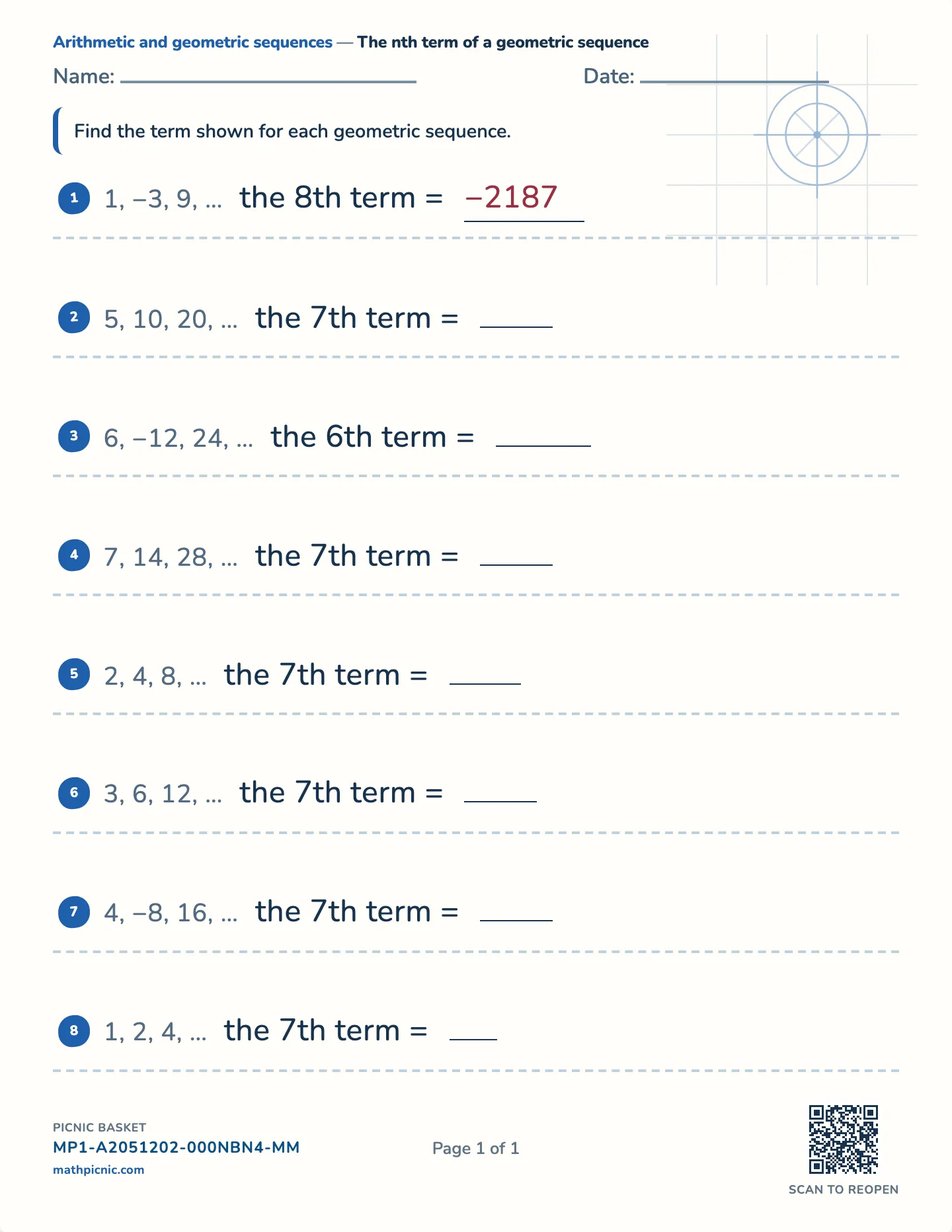
The formula is a₁ · rⁿ⁻¹. For 3, 6, 12, … the ratio is 2, so the 8th term is 3 · 2⁷ = 3 · 128 = 384. As with the arithmetic version, the exponent is (n − 1) and not n, because the first term already sits at the start before any multiplying happens — a child who uses n multiplies one time too many. Where the combined sequences sheet mixes arithmetic and geometric work, this page stays with geometric terms so the power of the ratio is the whole focus.

Why this sheet works

The base and the ratio are both kept small so a term like 3 · 2⁷ stays a readable whole number rather than running to seven digits. That is a deliberate choice: the lesson is the pattern, not the size of the product, and a sequence whose terms are fractions is a separate sheet for when the halving is the point.

How this one works

One question from this sheet, worked through a step at a time.

1, −3, 9, … — the 8th term

ratio = −3
a₈=1 × −3^7
1 × −2187=−2187
the 8th term = −2187
  1. This is a geometric sequence: each term is the one before times −3 (−3 ÷ 1 = −3).
  2. The first term is already there, so to reach the 8th term you multiply by −3 only 7 times — that is (n − 1), not n.
  3. −3 to the power 7 is −2187, and 1 × −2187 = −2187.
  4. So the 8th term is −2187.