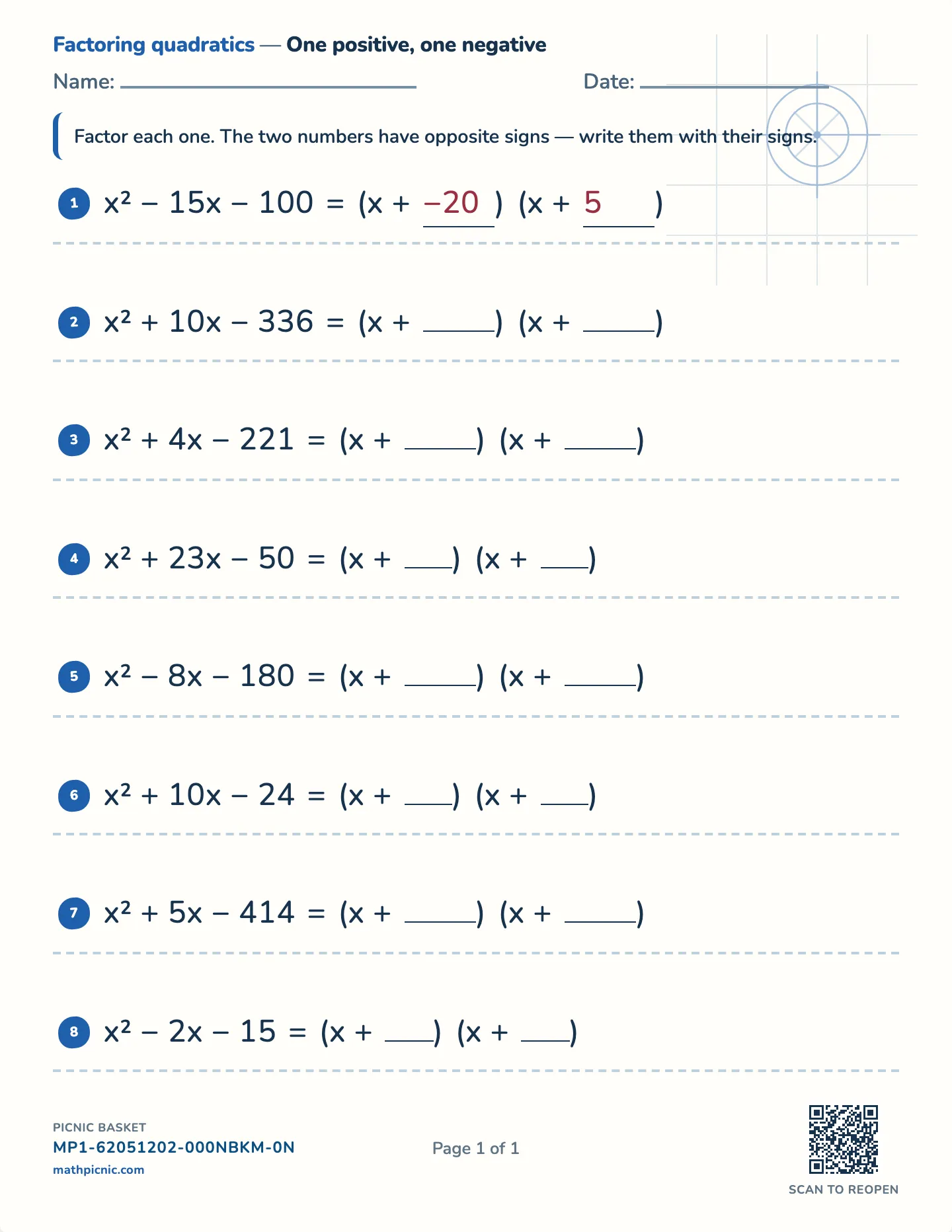
Factoring quadraticsOne positive, one negative
Name: Date:
Factor each one. The two numbers have opposite signs.
1x² − 15x − 100
2x² + 10x − 336
3x² + 4x − 221
4x² + 23x − 50
5x² − 8x − 180
6x² + 10x − 24
7x² + 5x − 414
8x² − 2x − 15

x² + 3x − 28 factors into (x + 7)(x − 4) — two numbers with opposite signs that multiply to −28. These free printable worksheets drill the case teachers see most.
If they get stuck
The answer key prints on a separate page.
When the last term is negative, the two numbers have opposite signs: one plus, one minus. That is the case a test reaches for most, and the one where a child is likeliest to attach the wrong sign to the bigger number. They multiply to a negative and add to the middle term, and which one is bigger is decided by the sign of b.
So for x² + 3x − 28 the pair multiplies to −28 and adds to +3, which is +7 and −4 — the larger number takes the sign of b. Swap them to −7 and +4 and the product is still −28 but the sum is −3, and the whole answer is wrong by a sign. The walks decide the size first and the signs second, so that swap cannot slip through.
One question from a sheet like this one, worked a step at a time — with a sentence saying what just happened and why.
Factoring x² + bx − c, step by step