Scientific notationDividing
Name: Date:
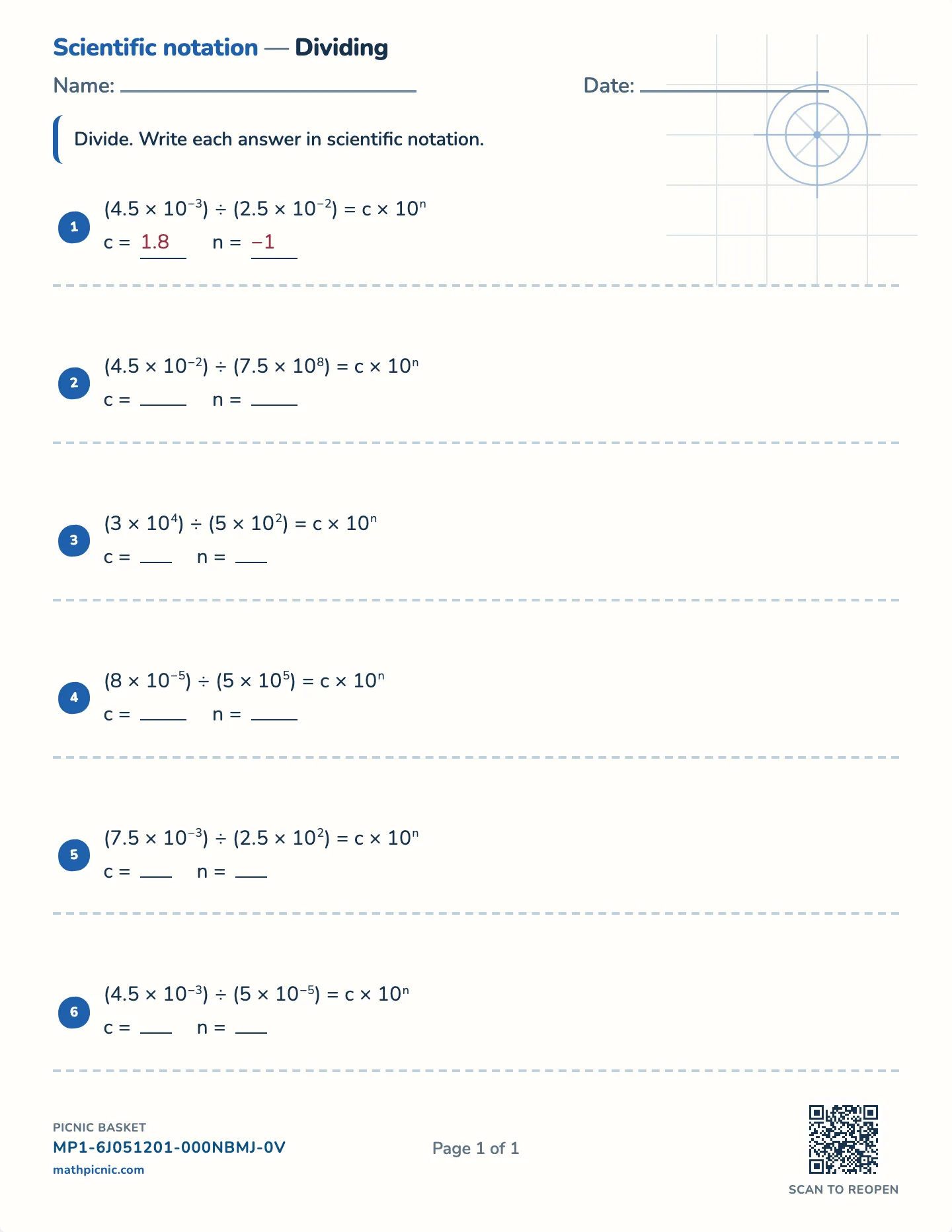
Divide. Write each answer in scientific notation.
1(4.5 × 10⁻³) ÷ (2.5 × 10⁻²)
2(4.5 × 10⁻²) ÷ (7.5 × 10⁸)
3(3 × 10⁴) ÷ (5 × 10²)
4(8 × 10⁻⁵) ÷ (5 × 10⁵)
5(7.5 × 10⁻³) ÷ (2.5 × 10²)
6(4.5 × 10⁻³) ÷ (5 × 10⁻⁵)

Dividing in scientific notation splits into two tidy jobs: the coefficients divide, and the powers of ten subtract. These free printable worksheets keep to division alone, so a child practices the subtraction of exponents until it is automatic.
If they get stuck
The answer key prints on a separate page.
The whole move is (8 × 10⁵) ÷ (2 × 10²) = (8 ÷ 2) × 10⁵⁻² = 4 × 10³. The coefficients handle the front, the powers of ten handle the size, and they never mix. Keeping to division on its own sheet is what makes the subtraction of exponents stick — the mixed sheet asks a child to switch between adding and subtracting powers, and this one removes that decision so the one rule is the only rule.
Renormalizing is the second habit these build. When the coefficients divide to something below one — say 3 ÷ 6 = 0.5 — the answer is written 0.5 × 10ⁿ before it is fixed to 5 × 10ⁿ⁻¹, because scientific notation wants a single digit in front of the point. A child who stops at 0.5 × 10³ has the right value in the wrong dress, and every step-by-step walk here shows the shift.
One question from a sheet like this one, worked a step at a time — with a sentence saying what just happened and why.
Dividing in scientific notation, step by step