• Free
  • Grade 8
  • Powers from 10⁻⁵ to 10⁸

Multiplying and dividing in scientific notation worksheets

Work the coefficients, work the powers — then check the answer is still IN scientific notation. Free printable worksheets.

Kid stuck on one? You don’t just get the sheet.

  • Answer key included
  • Reopen this exact sheet
  • Letter & A4 ready
Ready to printMultiplying and dividing in scientific notation
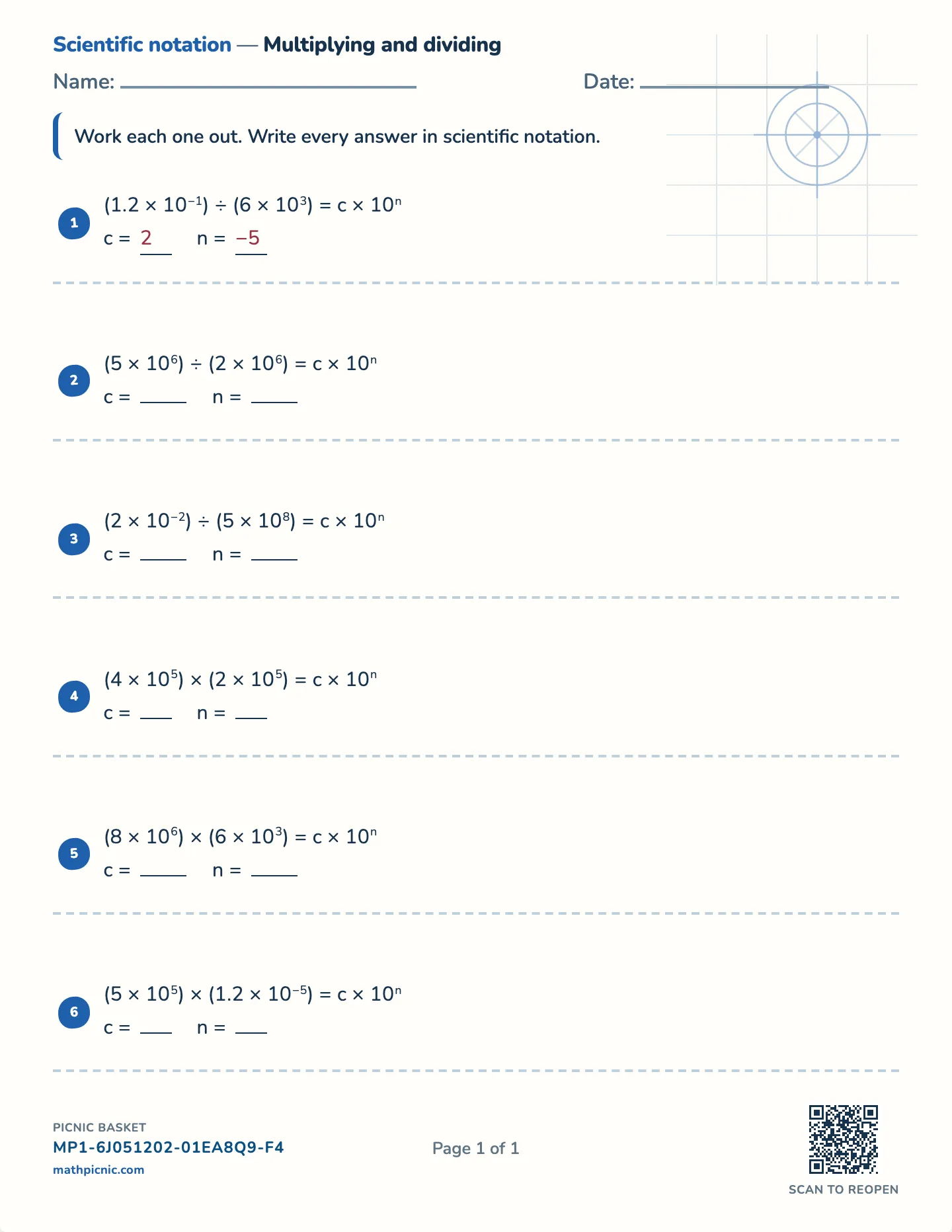
Multiplying and dividing in scientific notation worksheet — Powers from 10⁻⁵ to 10⁸, free printable with answer key

The answer key prints on a separate page.

What's on this sheet

Multiplying two numbers in scientific notation is two moves that do not interfere with each other: multiply the coefficients, and add the exponents. Dividing is the same with the other two operations. A student who does both of those gets a true statement about two thirds of the time, and that is the problem — the other third is true and is not an answer.

Why this sheet works

5 × 10³ times 4 × 10² is 20 × 10⁵. That is exactly the right quantity, and it is not written in scientific notation, because the notation has one rule: the coefficient sits at 1 or above and below 10. The answer is 2 × 10⁶. Dividing has the mirror case, where the coefficient falls under 1 and the exponent goes down instead.

How this one works

One question from this sheet, worked through a step at a time.

(1.2 × 10⁻¹) ÷ (6 × 10³)

1.2 × 10⁻¹÷6 × 10³
coefficients1.2 ÷ 6powers10⁻¹ ÷ 10³
1.2÷6=0.2
−13=−4
0.2 × 10⁻⁴
is0.2outside 1 to 10
0.2 × 10⁻⁴
2 × 10⁻⁵
(1.2 × 10⁻¹) ÷ (6 × 10³)=2 × 10⁻⁵
  1. A number in scientific notation is two things multiplied: a coefficient and a power of ten. They travel separately — the coefficients divide with each other and the powers subtract with each other — so take them one at a time.
  2. Divide the coefficients: 1.2 ÷ 6 = 0.2.
  3. Now the powers. Dividing powers of the same base SUBTRACTS the exponents: −1 − 3 = −4. So the powers give 10⁻⁴.
  4. Put them together: 0.2 × 10⁻⁴. Now CHECK it — a coefficient has to be at least 1 and less than 10, and 0.2 is not. This is a true number and it is not in scientific notation yet.
  5. Move one factor of ten the other way: make the coefficient ten times BIGGER and the power ten times SMALLER. 0.2 × 10 = 2, and −4 − 1 = −5. The quantity has not changed — that is why the line above was true.
  6. So the answer is 2 × 10⁻⁵ — 1.2 ÷ 6 = 0.2 and the powers give 10⁻⁴, and 0.2 is not between 1 and 10 — so it becomes 2 × 10⁻⁵.