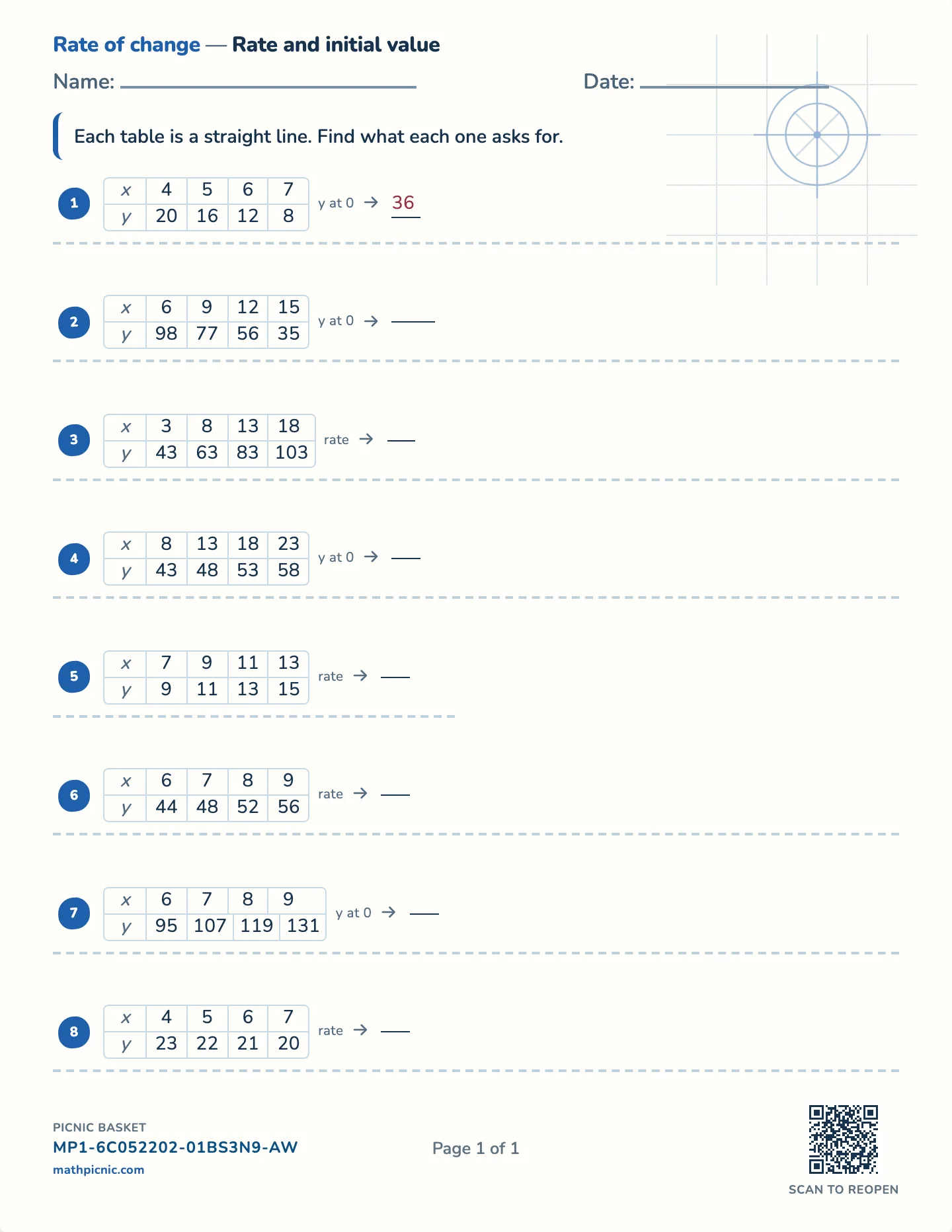
1. x: 4, 5, 6, 7 y: 20, 16, 12, 8 → 36 (at x = 4 the value is 20, and stepping back 4 of them at −4 each gives 36)2. x: 6, 9, 12, 15 y: 98, 77, 56, 35 → 140 (at x = 6 the value is 98, and stepping back 6 of them at −7 each gives 140)3. x: 3, 8, 13, 18 y: 43, 63, 83, 103 → 4 (y moves 20 while x moves 5, and 20 ÷ 5 = 4)4. x: 8, 13, 18, 23 y: 43, 48, 53, 58 → 35 (at x = 8 the value is 43, and stepping back 8 of them at 1 each gives 35)5. x: 7, 9, 11, 13 y: 9, 11, 13, 15 → 1 (y moves 2 while x moves 2, and 2 ÷ 2 = 1)6. x: 6, 7, 8, 9 y: 44, 48, 52, 56 → 4 (y moves 4 while x moves 1, and 4 ÷ 1 = 4)7. x: 6, 7, 8, 9 y: 95, 107, 119, 131 → 23 (at x = 6 the value is 95, and stepping back 6 of them at 12 each gives 23)8. x: 4, 5, 6, 7 y: 23, 22, 21, 20 → −1 (y moves −1 while x moves 1, and −1 ÷ 1 = −1)