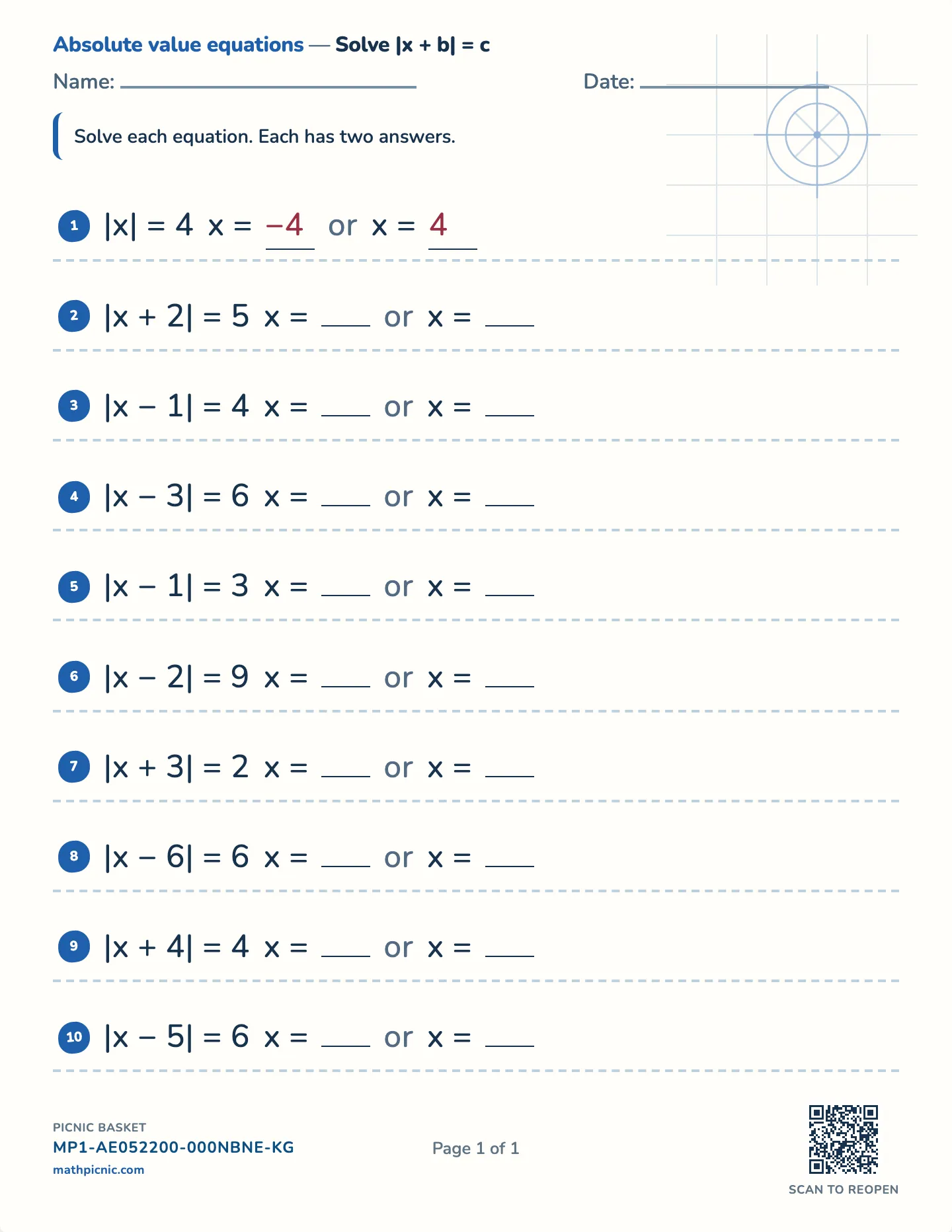
Absolute value equationsSolve |x + b| = c
Name: Date:
Solve each equation. Each has two answers.
1|x| = 4
2|x + 2| = 5
3|x − 1| = 4
4|x − 3| = 6
5|x − 1| = 3
6|x − 2| = 9
7|x + 3| = 2
8|x − 6| = 6
9|x + 4| = 4
10|x − 5| = 6

An absolute value equation has two answers because the bars mean distance: whatever is inside can be c above zero or c below it. These free printable worksheets stay at the entry level, |x + b| = c, so the splitting into two equations is the whole lesson.
If they get stuck
The answer key prints on a separate page.
The bars ask which numbers sit a fixed distance from a point. |x − 3| = 7 means the inside is 7 away from zero, so it is 7 or −7, splitting into x − 3 = 7 and x − 3 = −7 and giving 10 and −4. A child who writes only the first equation finds just the positive answer and misses half of every question, which is exactly the habit this level is built to fix — every step-by-step walk here writes both equations before solving either.
This is the version with no number in front of x, so once the bars are split each equation is a single add or subtract from its answer. Keeping the coefficient at one means the two-answer idea gets all the attention; the sheet with a coefficient in front, where a divide follows the split, is the next step and its own page.
One question from a sheet like this one, worked a step at a time — with a sentence saying what just happened and why.
Solving absolute value equations, step by step