Factoring polynomialsEasy
Name: Date:
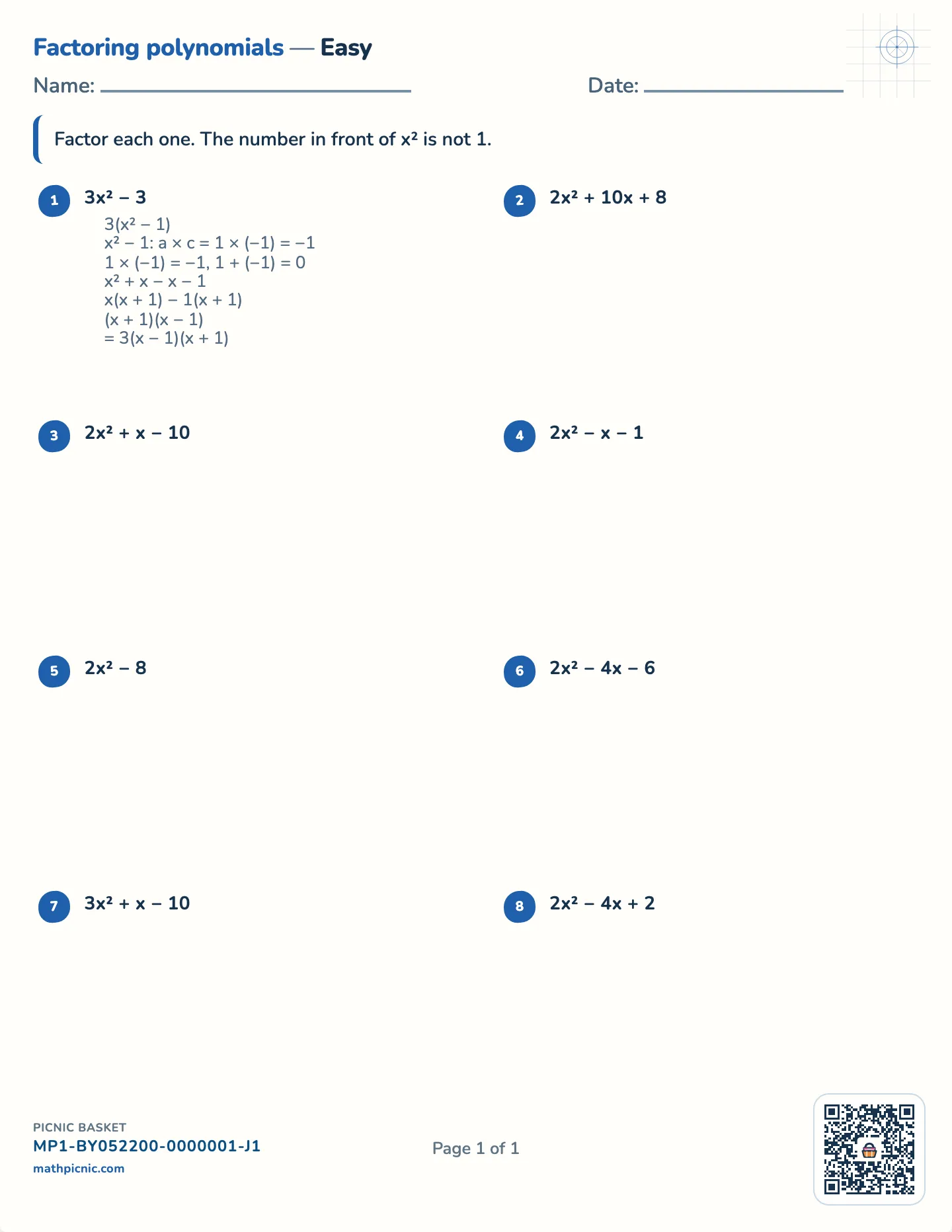
Factor each one. The number in front of x² is not 1.
13x² − 3
22x² + 10x + 8
32x² + x − 10
42x² − x − 1
52x² − 8
62x² − 4x − 6
73x² + x − 10
82x² − 4x + 2

Once the number in front of x² is not 1, “two numbers that multiply to c and add to b” stops working on its own. These free printable worksheets factor trinomials like 2x² + x − 10 and 6x² + 17x − 10, and the answer key splits the middle term and groups, line by line.
If they get stuck
The answer key prints on a separate page.
The first question on every one of these is not about brackets at all: is there a number that divides all three terms? 3x² − 3 is 3(x² − 1) before it is anything else, and 2x² + 10x + 8 is 2(x² + 5x + 4). About a third of each sheet is built that way on purpose, because a student who skips the common factor is left searching for two brackets that multiply to 2x² + 10x + 8 — which exist, and are much harder to find.
The rest have a leading coefficient that stays in a bracket: (2x + 1)(x − 1), (3x + 1)(x − 3). The key works these by splitting the middle term. For 2x² + x − 10, a × c is −20; the pair −4 and 5 multiplies to −20 and adds to 1; so x becomes −4x + 5x, and grouping the four terms gives 2x(x − 2) + 5(x − 2) = (x − 2)(2x + 5). Every line of that is on the key, because guessing brackets gets slow once a is 4 or 6, and this method does not.
3x² − 3