• Free
  • Grade 8
  • Value at x = 0

Initial value from a table worksheets

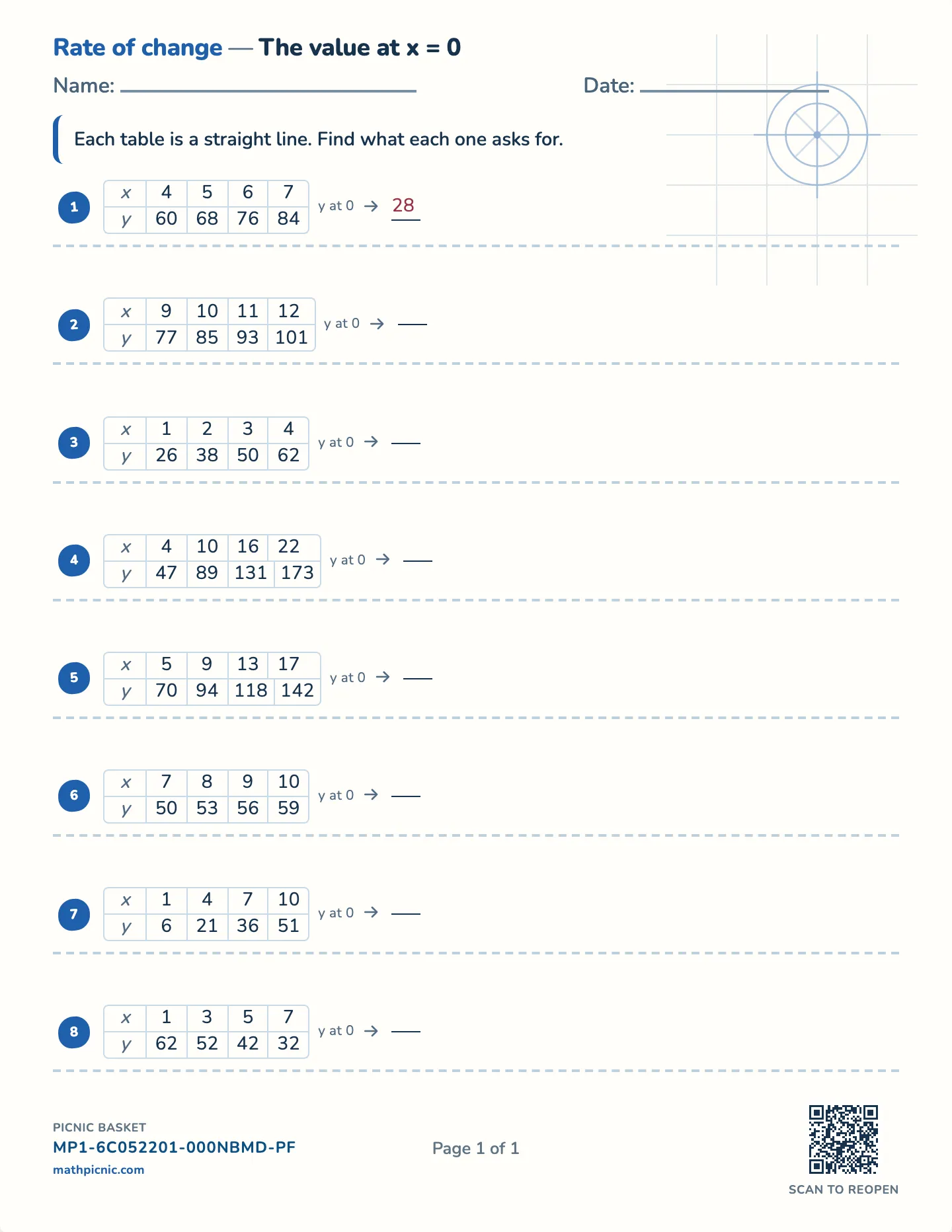
The initial value is y when x is 0 — and these tables never print that row. These free printable worksheets find it by stepping the table back at its own rate.

Kid stuck on one? You don’t just get the sheet.

  • Answer key included
  • Reopen this exact sheet
  • Letter & A4 ready
Ready to printInitial value from a table
Initial value from a table worksheet — Value at x = 0, free printable with answer key

The answer key prints on a separate page.

What's on this sheet

No table on this sheet shows the x = 0 row, and that is deliberate: if it did, the answer would be a number to copy rather than one to work out. Finding the initial value means stepping backward from the first point at the table's own rate until x reaches 0 — which is why the rate has to be found first.

Why this sheet works

So the skill is really two moves in order. Read the rate of change off the table, then walk it back: if x = 2 gives y = 9 and the rate is 4, then x = 1 gives 5 and x = 0 gives 1. A child who tries to read the start straight off the table has nothing to read; a child who has the rate can always recover it.

How this one works

One question from this sheet, worked through a step at a time.

x: 4, 5, 6, 7 y: 60, 68, 76, 84

x4567y60687684
x steps111y steps888
8÷1=8
x = 4x = 0
8 each step× 4
at x = 028
  1. Rate of change means how much y moves for every ONE x. So it is a division, and the two things being divided are both differences: how far y went, over how far x went.
  2. Take both rows of steps. x moves 1, 1, 1 — the same each time — and y moves 8, 8, 8. They are steady, so this table really does have one rate rather than a different one in every gap.
  3. Now divide: 8 ÷ 1 = 8. Dividing by one changes nothing, which is exactly why it is worth writing down — on a table whose x steps by more, it will not.
  4. The table starts at x = 4, not at 0, so the value there is not written down — step back to it. Going one x backwards takes 8 off y each time, and there are 4 to go.
  5. 60 − 32 = 28. So at x = 0 the value would be 28 — at x = 4 the value is 60, and stepping back 4 of them at 8 each gives 28.