Solve by square roots(x − h)² = k
Name: Date:
Solve each equation by taking square roots.
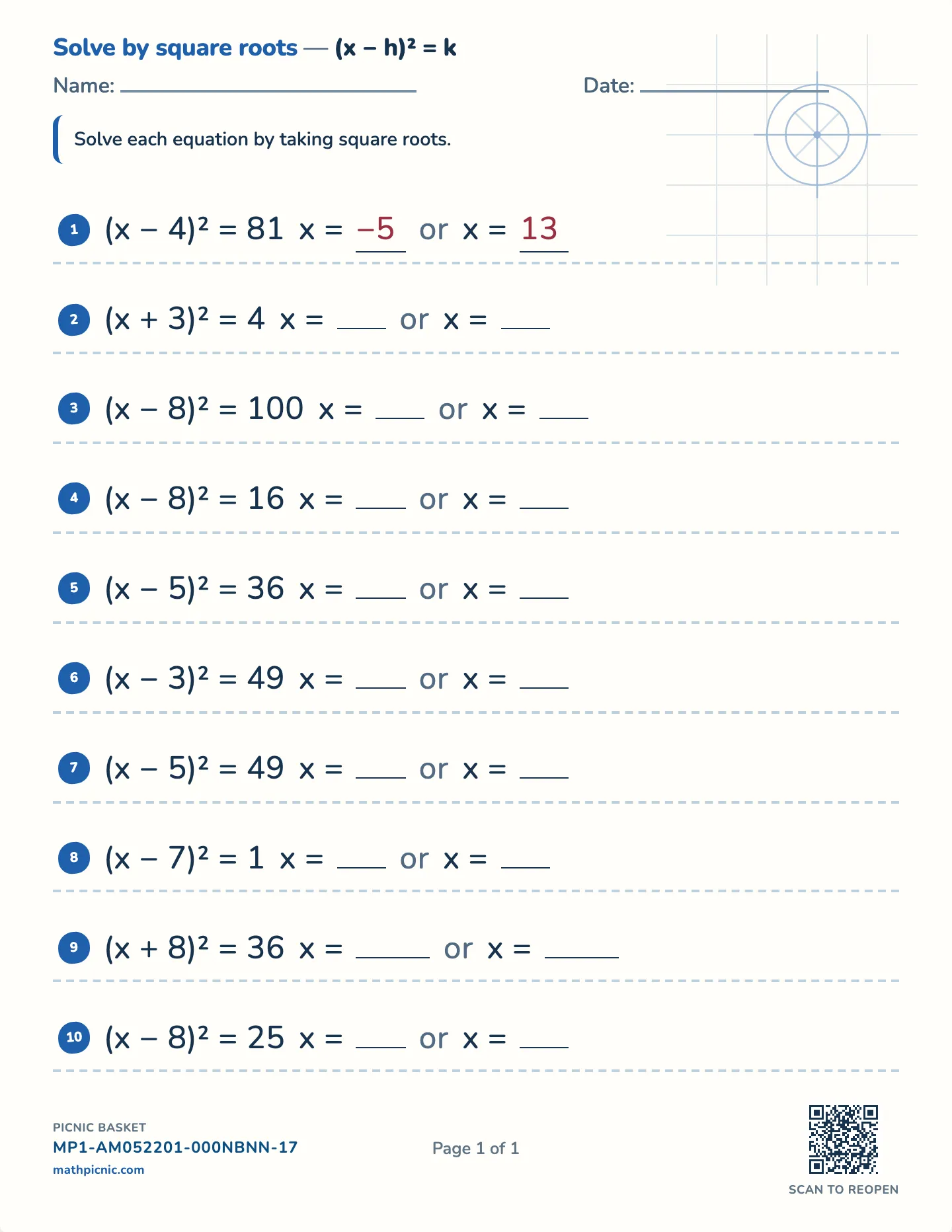
1(x − 4)² = 81
2(x + 3)² = 4
3(x − 8)² = 100
4(x − 8)² = 16
5(x − 5)² = 36
6(x − 3)² = 49
7(x − 5)² = 49
8(x − 7)² = 1
9(x + 8)² = 36
10(x − 8)² = 25

A shifted square adds one move to the square root method: after rooting both sides, the shift inside the bracket has to be undone. These free printable worksheets solve (x − h)² = k, and each one still has two answers.
If they get stuck
The answer key prints on a separate page.
The square is already isolated, so the first move is the same as the bare case — take the root of both sides — but here it leaves x − h = ±√k rather than x by itself. For (x − 2)² = 9 that is x − 2 = ±3, and then the shift is undone by adding 2, giving x = 5 and x = −1. The ± carries through both branches, so the +3 and the −3 each finish as their own answer, and every step-by-step walk here keeps the two apart from the moment the root is taken.
This is the reason it is a separate sheet from x² = p: the subtraction inside the bracket means the root does not land on x directly, and a child has to resist reading the answer off before undoing the shift. Meeting it after the bare square is secure keeps the ± habit and the new undo-the-shift step from tangling.
One question from a sheet like this one, worked a step at a time — with a sentence saying what just happened and why.
Solving (x − h)² = k by square roots, step by step