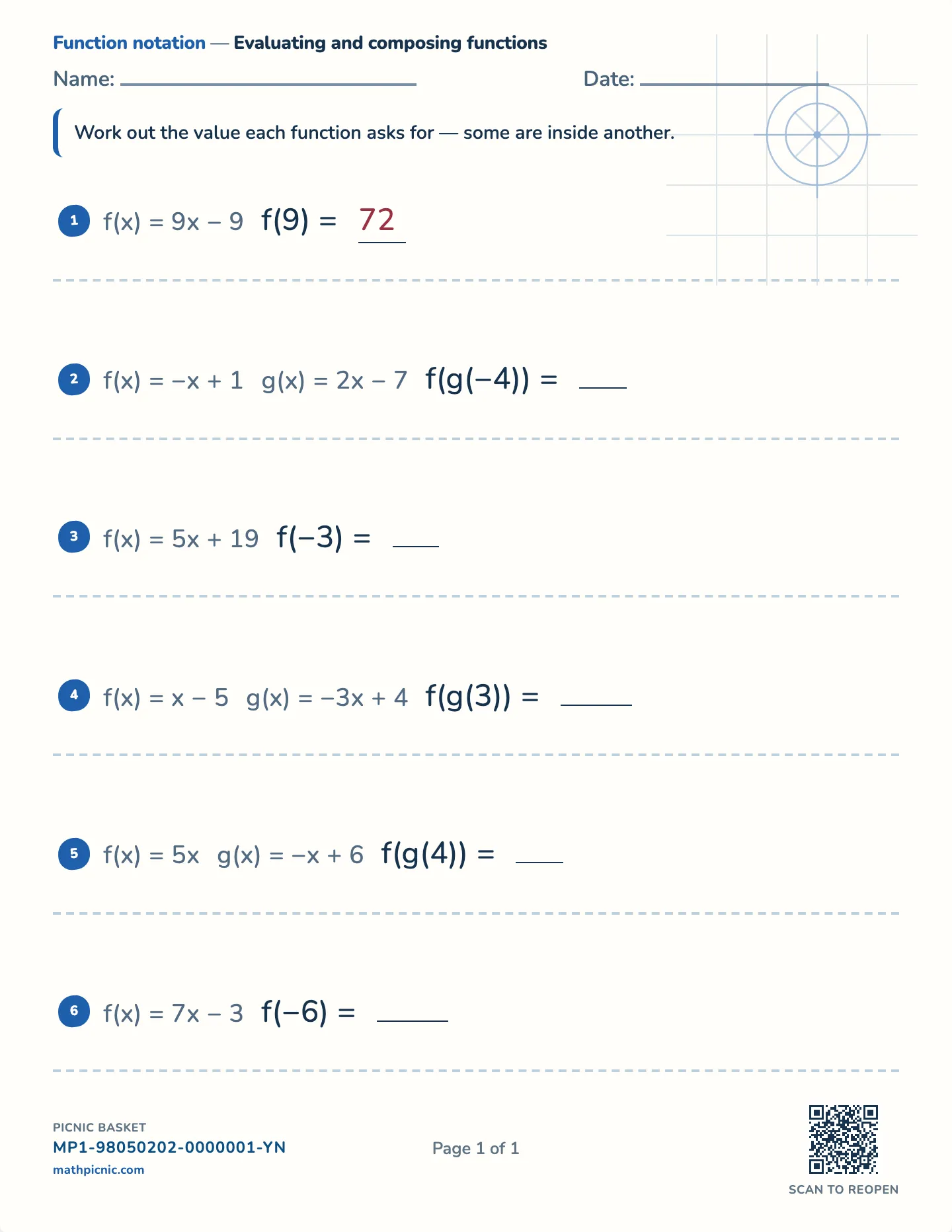
f(4) is a name for a value, not f times 4. These free printable worksheets read function notation and work it — evaluating f(x), and composing f(g(x)).
The whole skill is the notation. A child who can work out 3x − 5 can stall on f(4) for one reason: it looks like multiplication. So the first line of every walk says what f(4) names — the value of the rule when x is 4 — before a single number is multiplied. Once that reading lands, the arithmetic is the substitution they already know.
Why this sheet works
The numbers are Algebra 1's, not sixth grade's. Coefficients run to ±9, inputs to ±12, and answers across the whole number line, so a good share of both the inputs and the answers are negative. That is the point at this level: f(−5) with a negative coefficient is where a sign gets dropped, and a sheet that never goes below zero never asks the question. The input is never 0 or 1 either — f(0) just reads the constant off the rule, and f(1) is the one substitution a child can do without meaning to.
How this one works
One question from a sheet like this one, worked a step at a time — with a sentence saying what just happened and why.