A system of equations is easiest to see as a scene: two things you do not know, and two facts that pin them down. These free printable worksheets give that scene — two containers, or two shopping baskets — and ask a child to name both unknowns and solve.
Two shapes cover the standard cases. In the first, two like quantities have a given sum and difference — two jars holding so many marbles between them, one with a few more than the other — which sets up x + y and x − y. In the second, two goods are bought in two different baskets at fixed prices, so three apples and two pears cost one amount and a different mix costs another; the unit prices are the unknowns.
Why this sheet works
Every problem is built backward from whole-number answers, so a child never lands on 3.5 apples or half a marble — the arithmetic checks out cleanly and the focus stays on the setup. Each story names both unknowns and always says which quantity is larger, so a sum and a difference is never left as a puzzle about which container holds more.
How this one works
One question from this sheet, worked through a step at a time.
How many books are in the top shelf, and how many in the bottom shelf?
The top shelf holds 9 more books than the bottom shelf, and the two together hold 65 books.
(65 + 9) ÷ 2 = 37
65 − 37 = 28
asked:How many books are in the top shelf, and how many in the bottom shelf?
The top shelf: 37 books, the bottom shelf: 28 books
Read it through. There are TWO amounts to find. You are told their SUM and their DIFFERENCE, and those two facts pin both amounts down.
Add the sum and the difference — that total is twice the bigger amount, so halve it: (65 + 9) ÷ 2 = 37.
The smaller amount is the sum minus the bigger: 65 − 37 = 28.
Answer what was asked — "How many books are in the top shelf, and how many in the bottom shelf?": The top shelf: 37 books, the bottom shelf: 28 books.
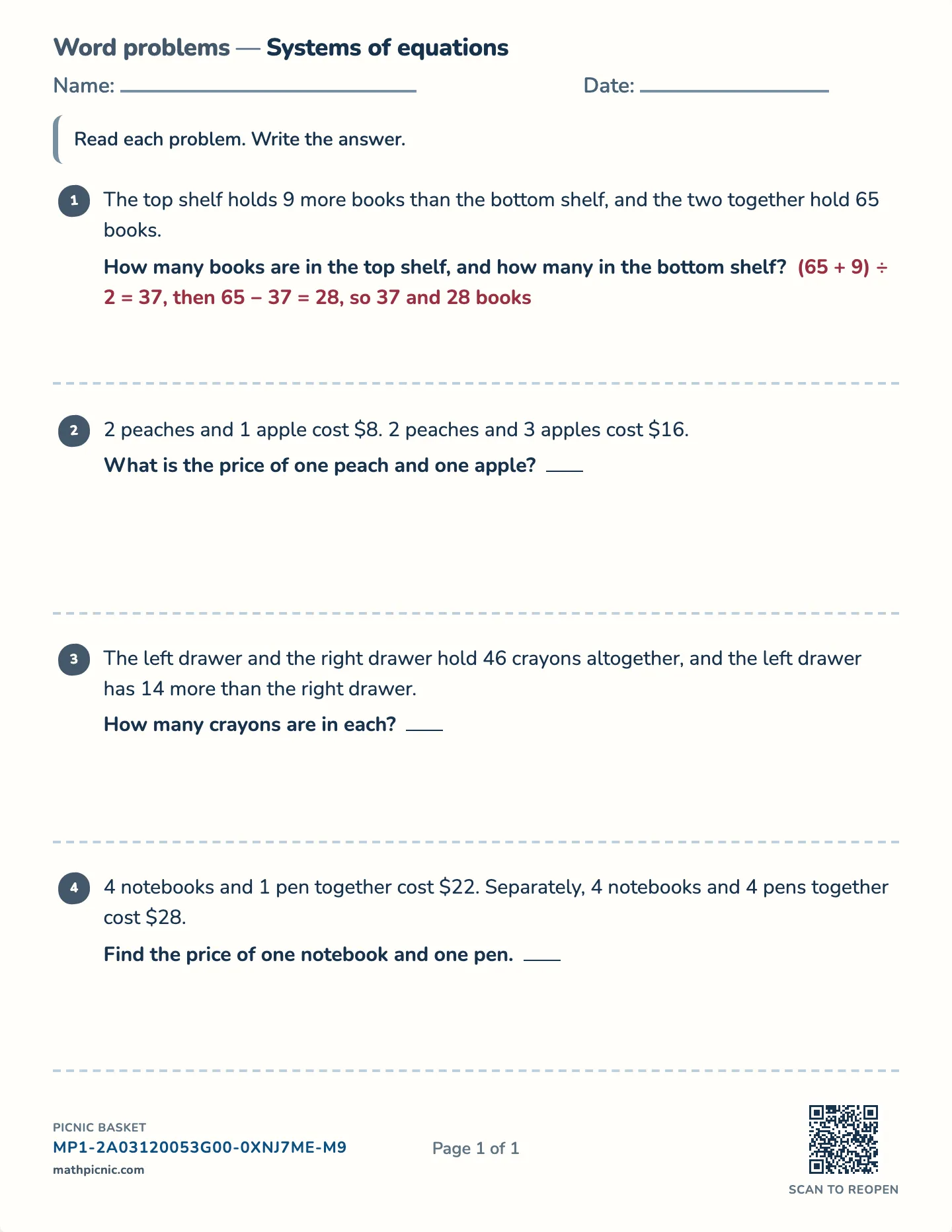
1The top shelf holds 9 more books than the bottom shelf, and the two together hold 65 books.How many books are in the top shelf, and how many in the bottom shelf?
22 peaches and 1 apple cost $8. 2 peaches and 3 apples cost $16.What is the price of one peach and one apple?
3The left drawer and the right drawer hold 46 crayons altogether, and the left drawer has 14 more than the right drawer.How many crayons are in each?
44 notebooks and 1 pen together cost $22. Separately, 4 notebooks and 4 pens together cost $28.Find the price of one notebook and one pen.
Word problems · Systems of equationsAnswer key
1. (65 + 9) ÷ 2 = 37, then 65 − 37 = 28, so 37 and 28 books2. a peach = $2, an apple = $4 (check: 2 × 2 + 1 × 4 = 8)3. (46 + 14) ÷ 2 = 30, then 46 − 30 = 16, so 30 and 16 crayons4. a notebook = $5, a pen = $2 (check: 4 × 5 + 1 × 2 = 22)