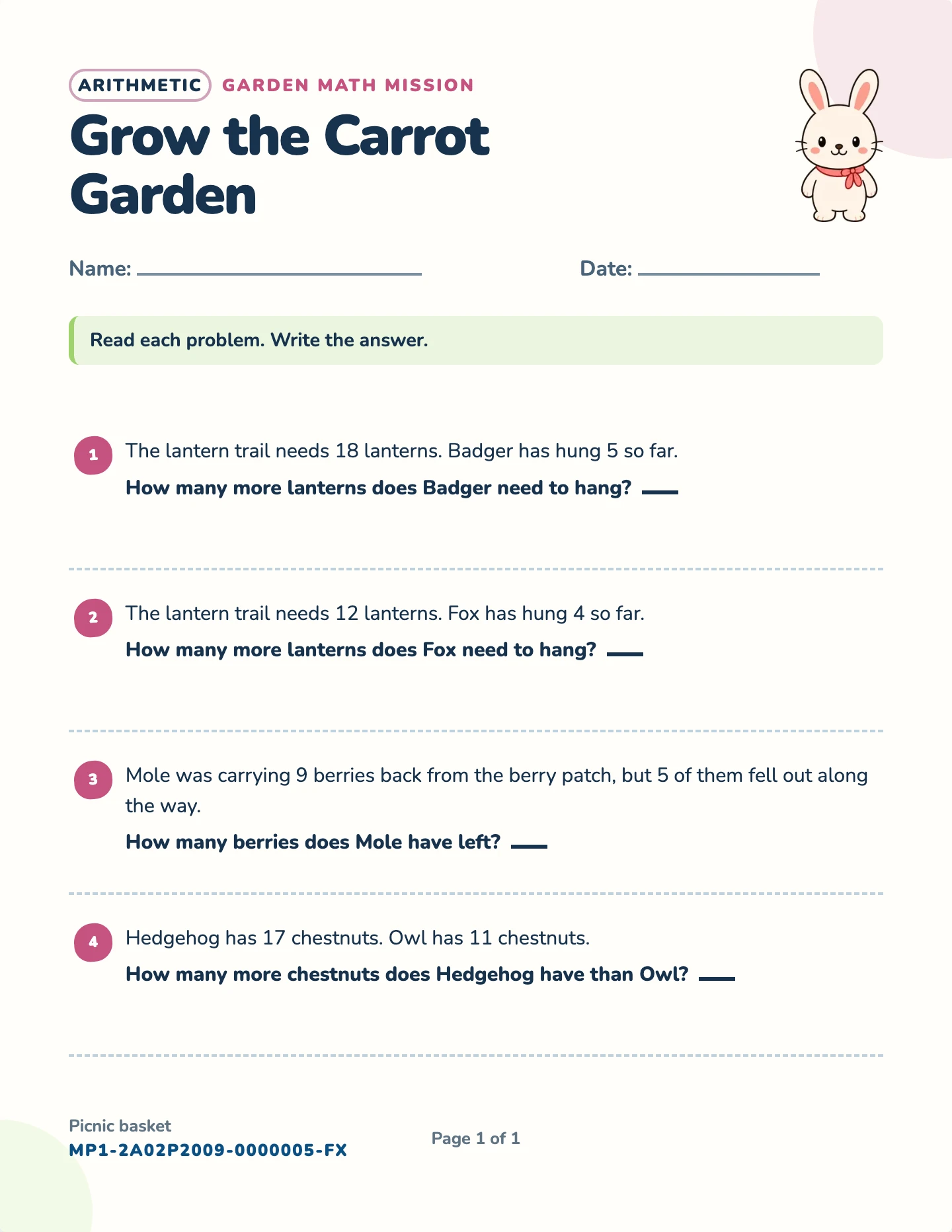
Subtraction hides inside more kinds of story than addition does — taking away, finding how many are left, and comparing two amounts all subtract. These free printable worksheets practice spotting subtraction in each of those disguises.
Some problems are plain take-aways: a few berries fall out of a basket, and the child finds what is left. Others ask how many more are needed to reach a target, or how many more one character has than another. Those last two are the ones children reach for addition on by mistake, so the sheets mix them in deliberately — the point is to decide the operation, not to be told it.
Why this sheet works
Numbers stay small and every answer stays positive, so a child is never subtracting a bigger number from a smaller one or landing below zero. The result is always something they could act out with counters if they wanted to, which keeps subtraction concrete while the reading gets harder.
How this one works
One question from this sheet, worked through a step at a time.
How many stickers are Nina's?
Of the 19 stickers that Zoe and Nina share, 14 are Zoe's.
Of the 19 stickers that Zoe and Nina share, 14 are Zoe's.
numbers:1914
19 − 14
asked:How many stickers are Nina's?
19 − 14 =5
5 stickers
Read it through once and do NOTHING. Grabbing the numbers on the first read means choosing an operation before you know the story, and that choice is the only hard part of a word problem.
Now the numbers: 19 and 14. Finding them is not the same as knowing what to do with them — that comes next, and it comes from the story rather than from the numbers.
You are told the whole and one part, and asked for the other part — so it is a take-away. So this one is a subtraction: 19 − 14.
19 − 14 = 5 stickers. And answer the question that was ASKED — "How many stickers are Nina's?" — in stickers, because the sum on its own is not yet an answer.