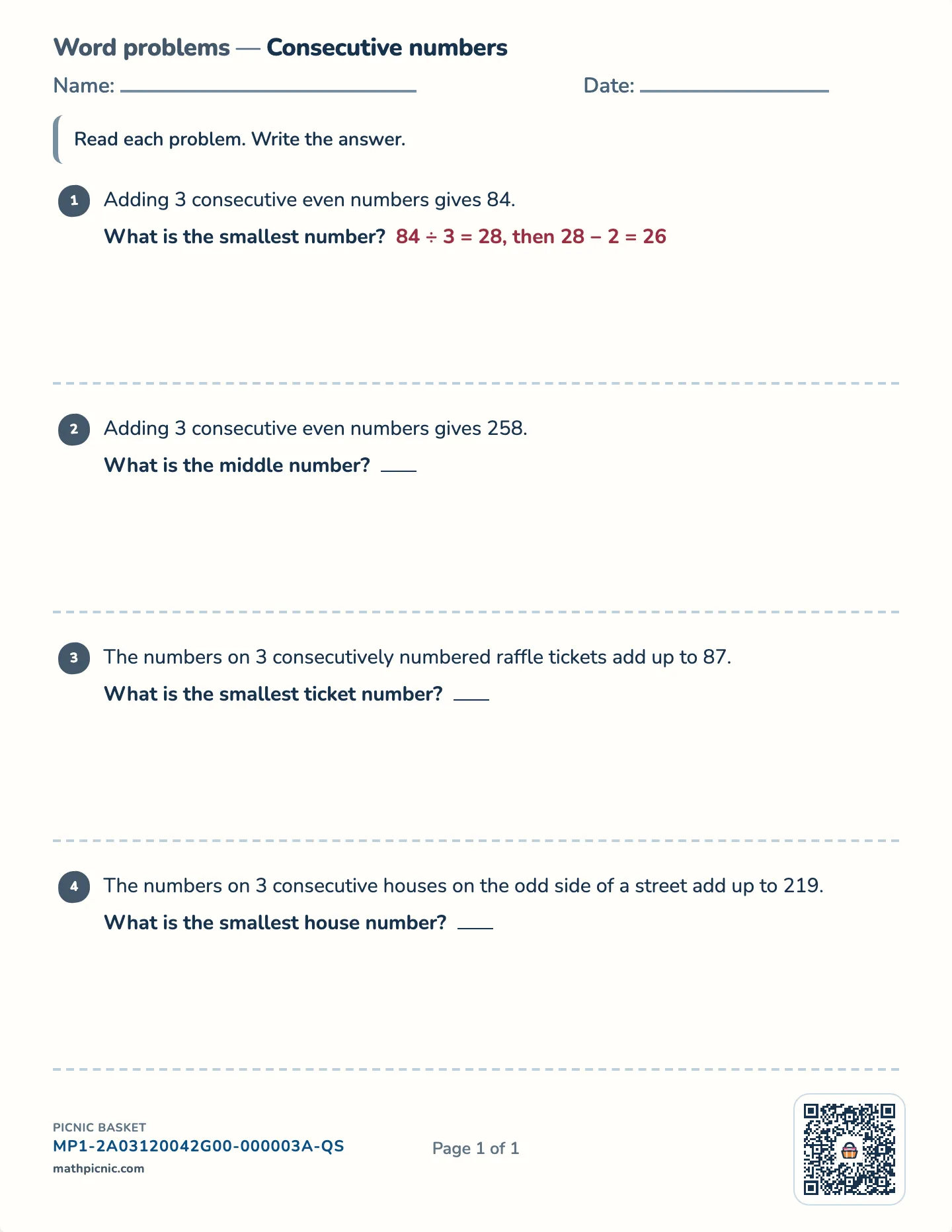
Three numbers in a row that add to a given total: which three? These free printable word problems introduce the idea that a run of numbers can be written from a single unknown, which is the trick every later one turns on.
Consecutive numbers are the cleanest place to practise defining a whole set from one letter. If the first is x, the next is x + 1 and the third x + 2, and three of them adding to forty-eight is one equation a child can solve. The insight — that you do not need three unknowns for three numbers — is worth more than the answer.
Why this sheet works
Even and odd runs are the useful twist. Consecutive even numbers go up in twos, so the set is x, x + 2, x + 4, and a child who reaches for x + 1 out of habit gets a run that is not even at all. Reading whether the story wants any numbers, or even ones, or odd ones, is the step that catches people out.
How this one works
One question from this sheet, worked through a step at a time.
What is the smallest number?
Adding 3 consecutive even numbers gives 84.
84 ÷ 3 = 28
84 ÷ 3 = 28
28 − 2 = 26
asked:What is the smallest number?
26
Read it through once. Consecutive whole numbers step up by 1 each time, so their MIDDLE value is also their AVERAGE — find that and the rest are one step away.
Find the middle: the sum divided by how many numbers there are — 84 ÷ 3 = 28.
The others are one step either side of the middle: 28 − 2 = 26.
Answer the question that was asked — "What is the smallest number?" — 26.