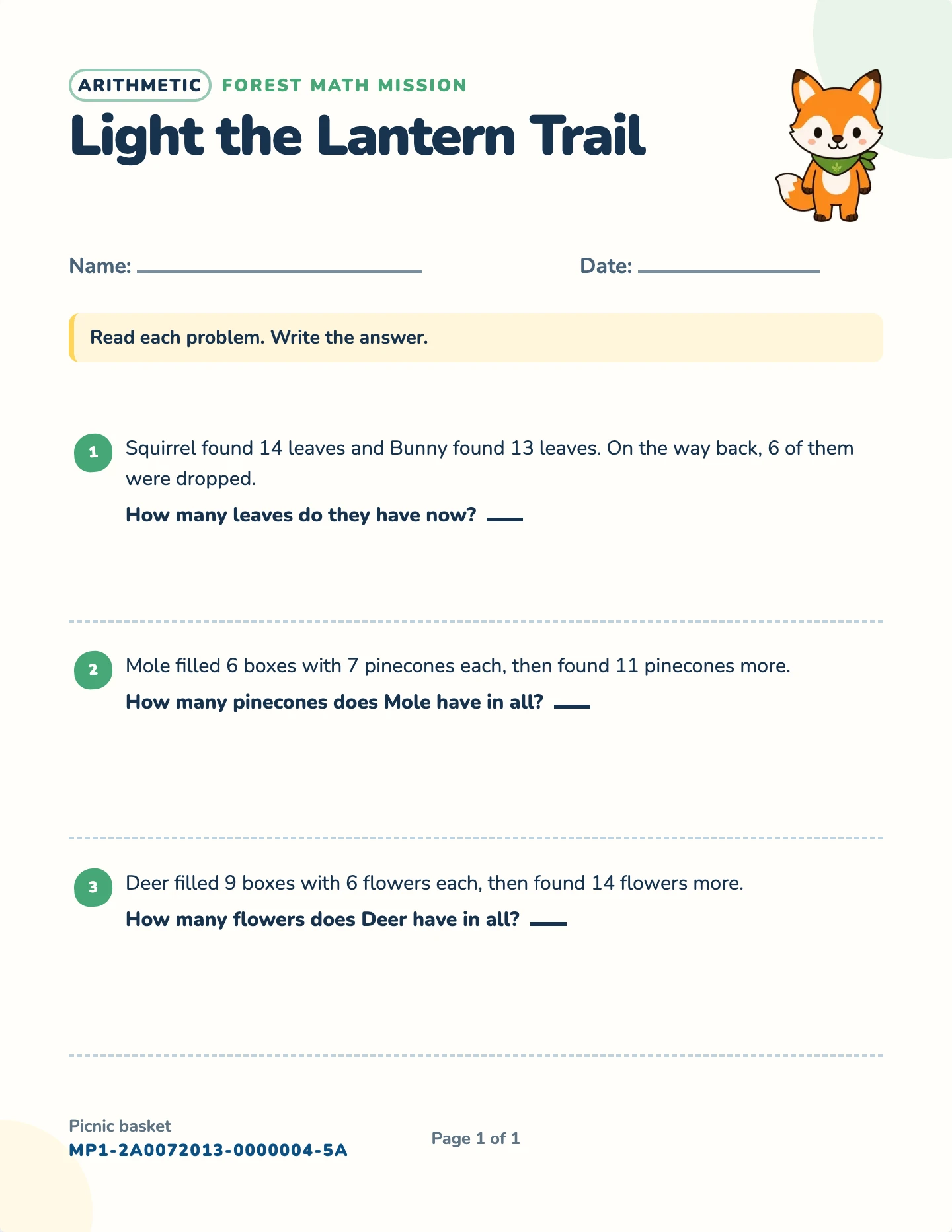
A two-step problem is where word problems get genuinely hard: the answer to the first calculation is not the answer to the question. These free printable worksheets practice holding a problem across two operations.
The jump from one step to two is bigger than it looks. A child has to work out an in-between number, remember that it is not the final answer, and then do something else with it. Sheets here build stories that combine two operations in order — fill several equal boxes and then add a few more, or find a total across days and then take some away — so both steps are needed and neither can be skipped.
Why this sheet works
Numbers stay small so the reasoning stays visible. The difficulty is deliberately in the structure, not the arithmetic: a child who can add and multiply fluently can still be stopped cold by a problem that needs both, and that gap is exactly what this practice closes.
How this one works
One question from this sheet, worked through a step at a time.
How many plums does Theo have now?
Theo keeps 48 plums. After a cousin hands over 10, Theo gives 28 to a friend.
Theo keeps 48 plums. After a cousin hands over 10, Theo gives 28 to a friend.
asked:How many plums does Theo have now?
48 + 10 = 58
48 + 10 = 58
58 − 28 = 30
48 + 10 = 58
58 − 28 = 30
30 plums
Read it through and count the QUESTIONS, not the numbers. There are two here, and only one of them is asked out loud — the number you were asked for cannot be reached from the story in one go, so something has to be worked out first.
Every number here is used, which will not always be true — a story may mention something true that the question never asks about. Check what the question needs rather than collecting what the text offers.
The first thing that CAN be worked out is 48 and 10, by adding: 48 + 10 = 58. That 58 is not the answer — it is the number the story never gave you.
Now the second step, and its first number is the 58 you just worked out rather than anything written in the story. Take away the 28: 58 − 28 = 30.
Two steps, and the answer to the question that was asked — "How many plums does Theo have now?" — is 30 plums.
1Theo keeps 48 plums. After a cousin hands over 10, Theo gives 28 to a friend.How many plums does Theo have now?
2Theo has 31 potatoes. A cousin hands over 7. Then Theo donates 5 to the club.(a)How many potatoes did Theo have in total? (b)How many potatoes does Theo have now?
3Theo counts 30 apples at home. A neighbor drops off 26; next, Theo gives 24 to a younger sibling.How many apples does Theo have now?