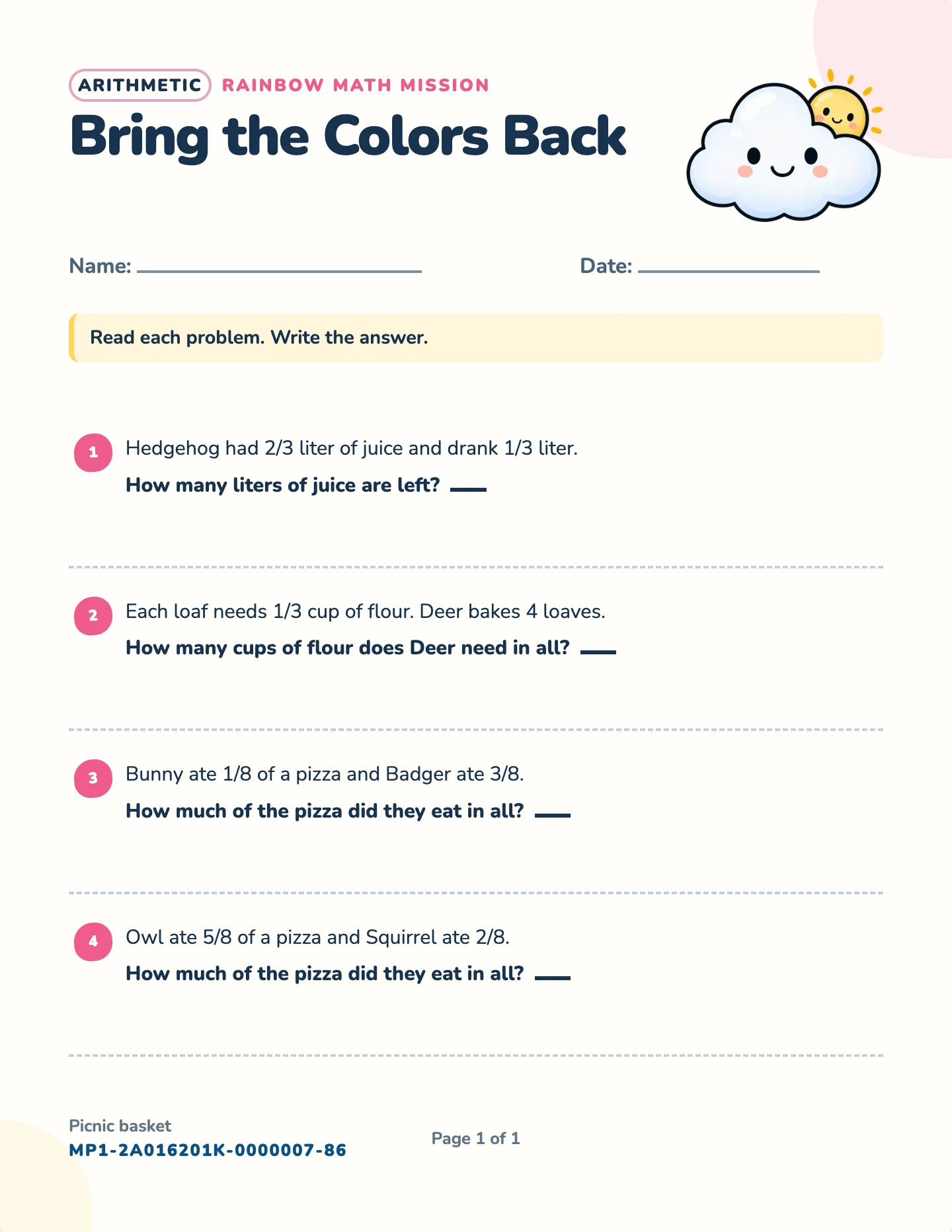
Once a child can add and subtract fractions, the next question is when to. These free printable worksheets put fractions inside real situations — recipes, juice, ribbon, pizza — so the fraction arithmetic has a reason to happen.
The stories are the kind where fractions genuinely live: a recipe that needs part of a cup and then a little more, a length of ribbon with some used up, two people sharing one pizza. Grade four keeps the denominators the same so the focus is the situation; grade five moves to unlike denominators, where a child has to find a common denominator before the story can be answered. Multiplying shows up as whole batches of a fractional amount — four loaves that each need part of a cup.
Why this sheet works
Every answer is exact and reduced to lowest terms, and shared-whole problems never total more than one — two people can eat 5/8 and 2/8 of a pizza, never 9/8 of it. These sheets are made to print and work on paper rather than tap out on a screen, since the answer is a fraction.
How this one works
One question from this sheet, worked through a step at a time.
How much did they use altogether?
Milo used 3/4 cup of birdseed and Courtney used 1/4 cup.
Milo used 3/4 cup of birdseed and Courtney used 1/4 cup.
numbers:3414
34+14
asked:How much did they use altogether?
34+14=1
1cup
Read it through once and do NOTHING. Grabbing the numbers on the first read means choosing an operation before you know the story, and that choice is the only hard part of a word problem.
Now the numbers: 3/4 and 1/4. Finding them is not the same as knowing what to do with them — that comes next, and it comes from the story rather than from the numbers.
Amounts are joining together. So this one is an addition: 3/4 + 1/4.
3/4 + 1/4 = 1 cup. And answer the question that was ASKED — "How much did they use altogether?" — in cup, because the sum on its own is not yet an answer.