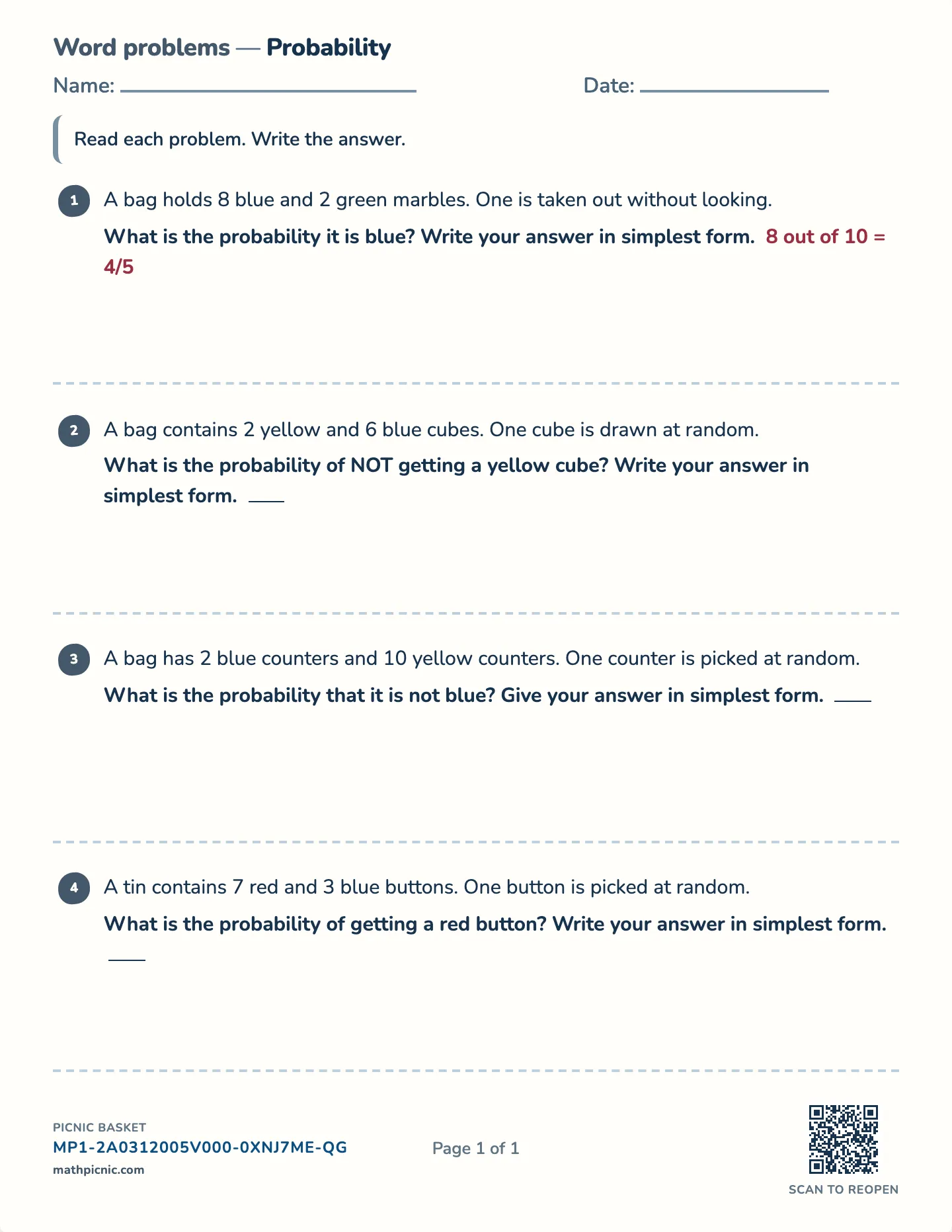
Probability starts with one draw from a bag. These free printable worksheets tell that bag as a story — so many red, so many blue — and ask for the chance of a color, or the chance of not that color, written as a fraction in simplest form.
Every bag holds two colors and a whole number of each, and the total is always a composite number — 6, 8, 10, or 12 — so the fraction genuinely reduces: 3 out of 12 is a quarter, and the reduction is part of the work rather than an afterthought. No answer is ever a flat half, so a child cannot guess it by symmetry, and every color has at least two counters, so the bag is read rather than glanced at.
Why this sheet works
Two questions come off one bag. The probability of a color counts the favorable counters over the total; the probability of not that color is the same bag read the other way, and the two are what a student later sees add to one. Because the bag has exactly two colors, not red is simply the blue count — no child is asked to subtract a probability from one before they have met the idea.
1A bag holds 8 blue and 2 green marbles. One is taken out without looking.What is the probability it is blue? Write your answer in simplest form.
2A bag contains 2 yellow and 6 blue cubes. One cube is drawn at random.What is the probability of NOT getting a yellow cube? Write your answer in simplest form.
3A bag has 2 blue counters and 10 yellow counters. One counter is picked at random.What is the probability that it is not blue? Give your answer in simplest form.
4A tin contains 7 red and 3 blue buttons. One button is picked at random.What is the probability of getting a red button? Write your answer in simplest form.
Word problems · ProbabilityAnswer key
1. 8 out of 10 = 4/52. not yellow: 6 out of 8 = 3/43. not blue: 10 out of 12 = 5/64. 7 out of 10 = 7/10