If something happens 3 times in 10, how often is it in 200 tries? These free printable worksheets turn a probability into a predicted count — the everyday use of probability — with every answer a whole number.
A probability is a rate, and a count is that rate applied. P(red) = 3/10 means 3 of every 10, so over 200 spins the walk splits the tries into 20 tens and takes 3 from each: 60. Saying it as “groups of ten, three from each” is what keeps it a multiplication a child understands rather than a formula, and it is why the numbers are built so the trials always divide the denominator.
Why this sheet works
The probability is shown as a fraction on some sheets and a percent on others, because 3/10 and 30% are the same rate said two ways and a child should meet both. Either way the trial count is chosen so the answer lands whole — no sheet asks for 62.5 of anything.
How this one works
One question from this sheet, worked through a step at a time.
P(a win) = 13/20. In 200 games, how many are wins?
200÷20=10
13×10=130
13/20 means 13 out of every 20. So split the 200 into groups of 20: 200 ÷ 20 = 10.
Each group of 20 gives 13 of them, and there are 10 groups: 13 × 10 = 130.
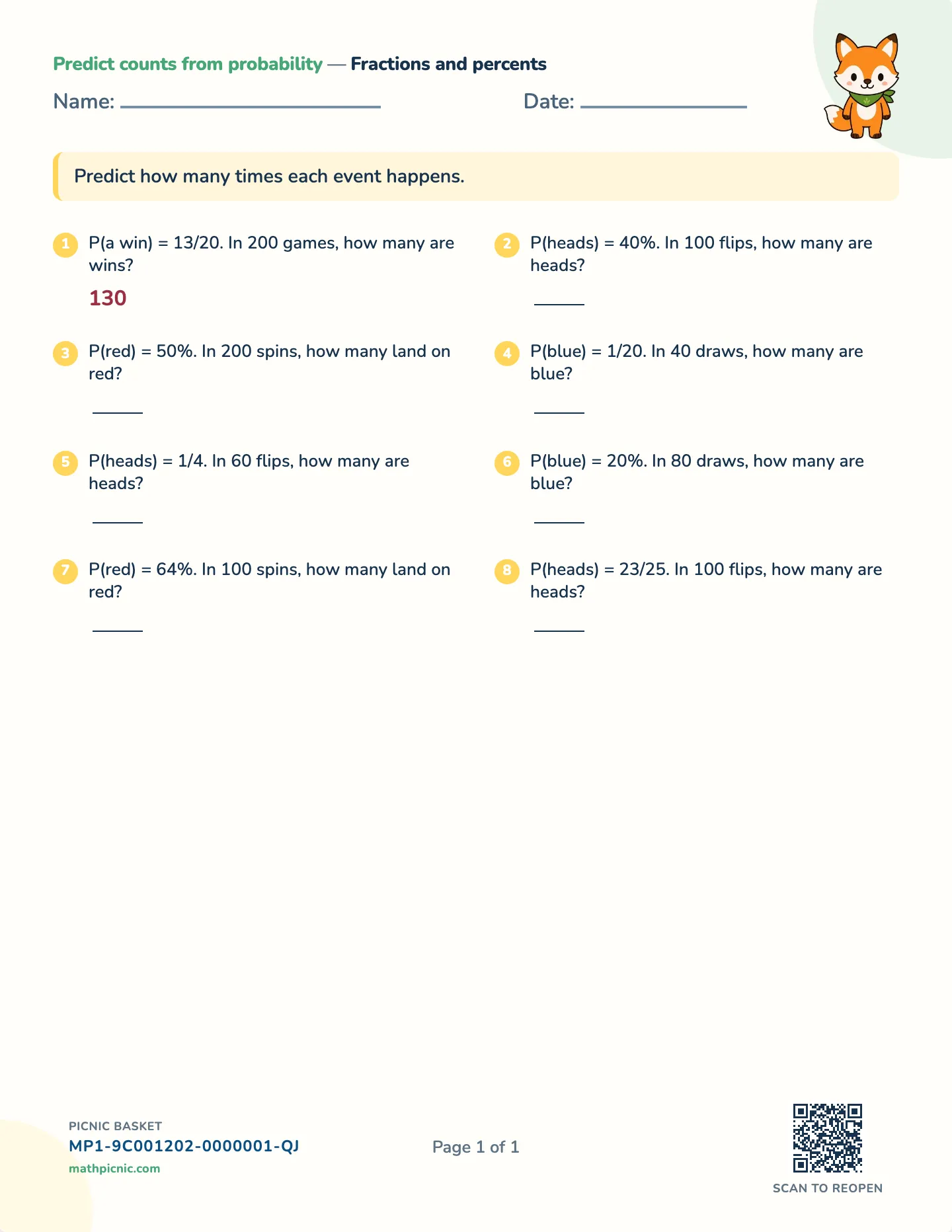
Predict counts from probabilityFractions and percents
Name: Date:
Predict how many times each event happens.
1
P(a win) = 13/20. In 200 games, how many are wins?
2
P(heads) = 40%. In 100 flips, how many are heads?
3
P(red) = 50%. In 200 spins, how many land on red?
4
P(blue) = 1/20. In 40 draws, how many are blue?
5
P(heads) = 1/4. In 60 flips, how many are heads?
6
P(blue) = 20%. In 80 draws, how many are blue?
7
P(red) = 64%. In 100 spins, how many land on red?
8
P(heads) = 23/25. In 100 flips, how many are heads?
Predict counts from probability · Fractions and percentsAnswer key
1. P(a win) = 13/20. In 200 games, how many are wins? → 1302. P(heads) = 40%. In 100 flips, how many are heads? → 403. P(red) = 50%. In 200 spins, how many land on red? → 1004. P(blue) = 1/20. In 40 draws, how many are blue? → 25. P(heads) = 1/4. In 60 flips, how many are heads? → 156. P(blue) = 20%. In 80 draws, how many are blue? → 167. P(red) = 64%. In 100 spins, how many land on red? → 648. P(heads) = 23/25. In 100 flips, how many are heads? → 92