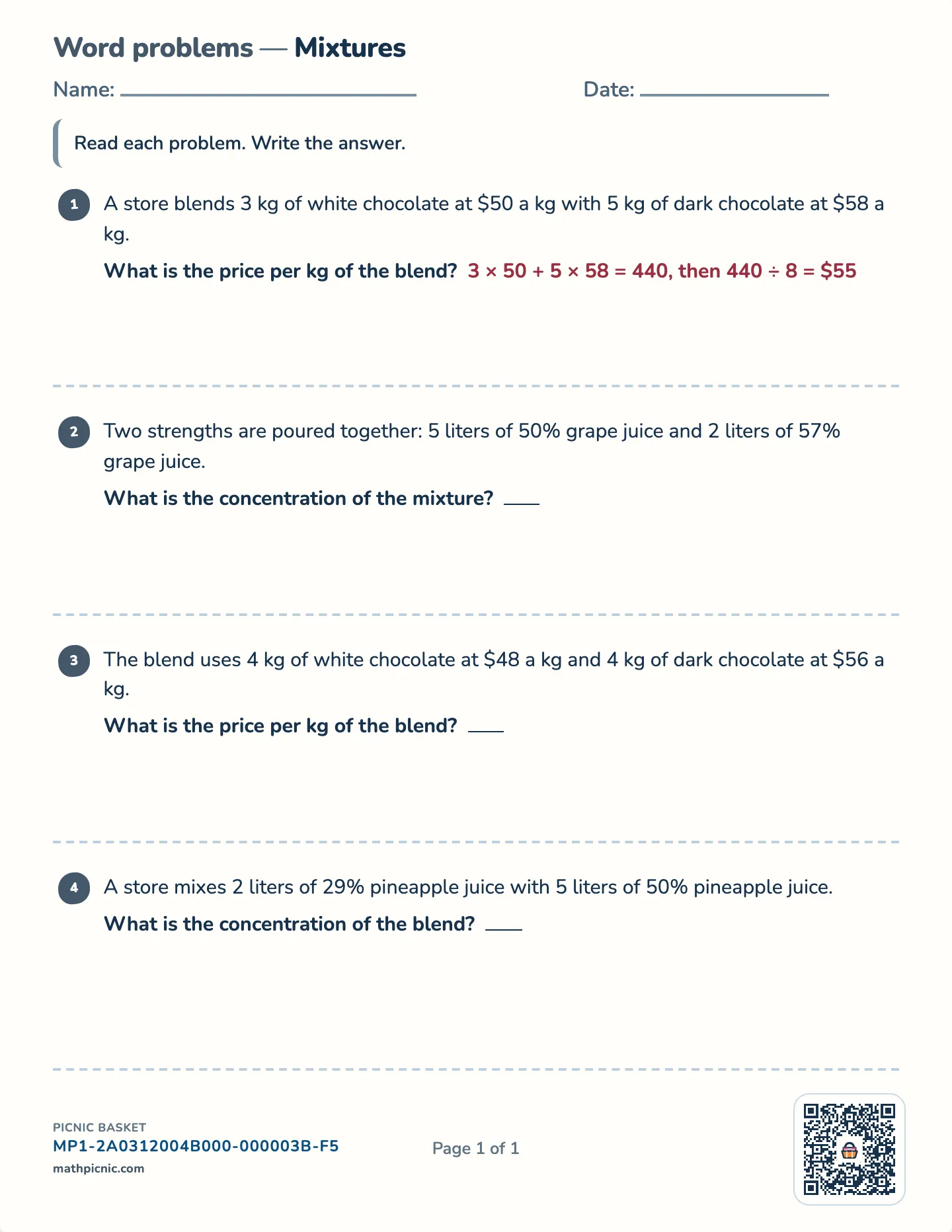
Two things at two prices, poured into one bag: what does the blend cost? These free printable word problems build the two-column reasoning that value and systems problems all share, with the numbers kept whole so the structure shows.
A mixture problem is a value problem wearing a different coat. Each ingredient contributes an amount and a worth, and the blend is the two worths added and the two amounts added — the same count-and-value split, now with a price on each part. A child who has met coins-and-notes recognises the shape immediately.
Why this sheet works
The reasoning that has to be new is that the blended price is not the average of the two prices unless the amounts are equal. Three kilograms of cheap nuts with one of dear ones sits much closer to the cheap price, and seeing why — the cheap ones outweigh the dear ones in the total — is the idea the page is really after.
How this one works
One question from this sheet, worked through a step at a time.
What is the price per kg of the blend?
A store blends 3 kg of white chocolate at $50 a kg with 5 kg of dark chocolate at $58 a kg.
3 × 50 + 5 × 58 = 440
3 × 50 + 5 × 58 = 440
440 ÷ 8 = $55
asked:What is the price per kg of the blend?
$55
Read it through once. Two things at DIFFERENT rates are combined. You cannot just average the two rates — the bigger amount pulls the blend toward its own rate, so each rate has to be WEIGHTED by how much of it there is.
Weight each amount by its rate and add them up: 3 × 50 + 5 × 58 = 440. That is the total spread across the whole mixture.
Now divide that total by how much there is altogether: 440 ÷ 8 = $55.
Answer the question that was asked — "What is the price per kg of the blend?" — $55.