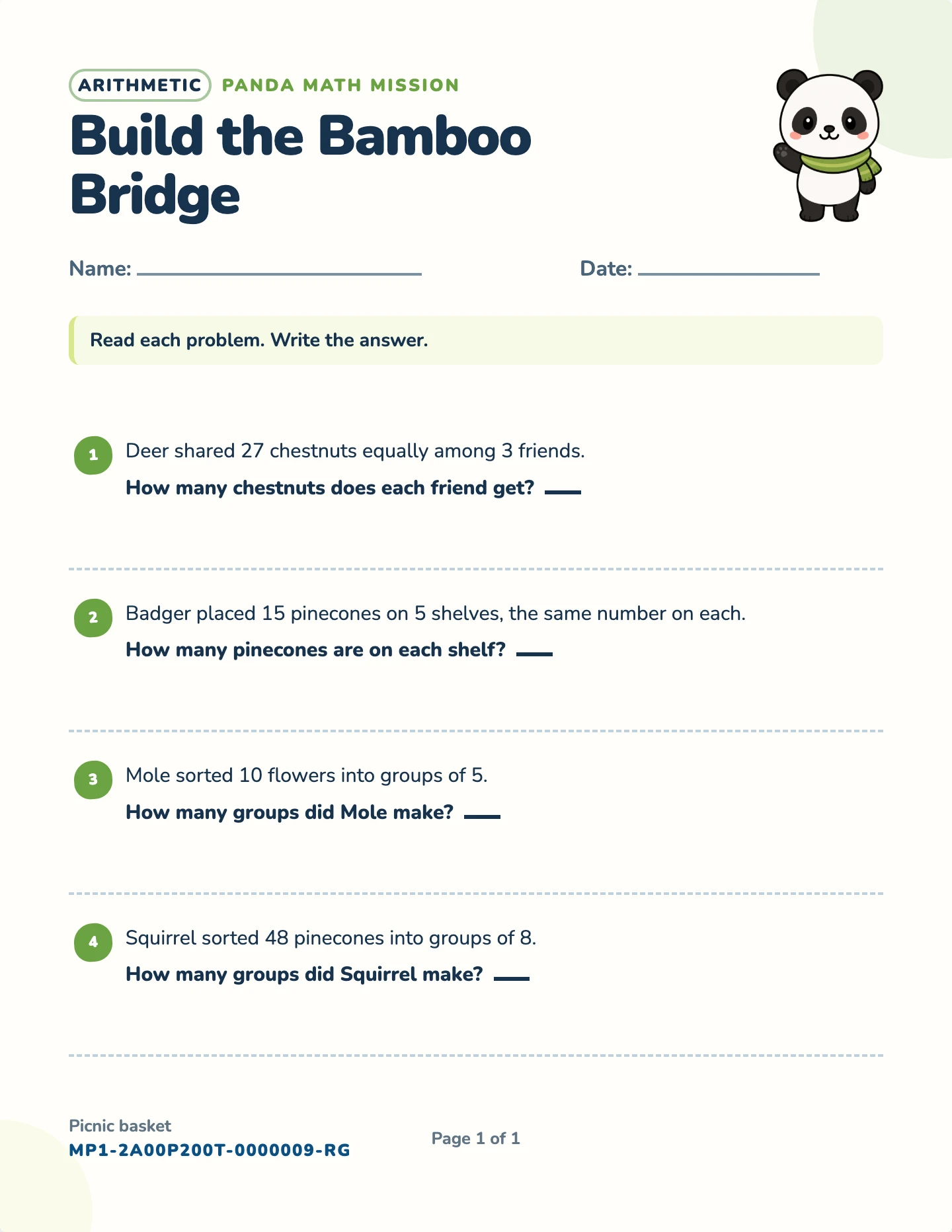
Division shows up as two different questions — sharing a pile equally among friends, and grouping a pile into equal batches. These free printable worksheets tell both kinds of story so a child hears division in each.
Sharing problems hand out a total equally and ask how many each person gets; grouping problems pack a total into equal-sized batches and ask how many batches there are. They are the same operation from opposite ends, and a child who meets both stops thinking division is only "splitting between people." Every total divides evenly, so answers are whole numbers a child can check by multiplying back.
Why this sheet works
The numbers come from the same tables the child is practicing in multiplication, which is the point — division facts are multiplication facts read backwards, and seeing 24 shared among 3 as the partner of 3 × 8 is what makes both stick.
How this one works
One question from this sheet, worked through a step at a time.
How many crates did Noah fill?
Noah packed 12 tickets into crates of 3.
Noah packed 12 tickets into crates of 3.
numbers:123
12 ÷ 3
asked:How many crates did Noah fill?
12 ÷ 3 =4
4 crates
Read it through once and do NOTHING. Grabbing the numbers on the first read means choosing an operation before you know the story, and that choice is the only hard part of a word problem.
Now the numbers: 12 and 3. Finding them is not the same as knowing what to do with them — that comes next, and it comes from the story rather than from the numbers.
One total split into groups of a known size, with the question asking HOW MANY groups — which is the other thing dividing asks. So this one is a division: 12 ÷ 3.
12 ÷ 3 = 4 crates. And answer the question that was ASKED — "How many crates did Noah fill?" — in crates, because the sum on its own is not yet an answer.