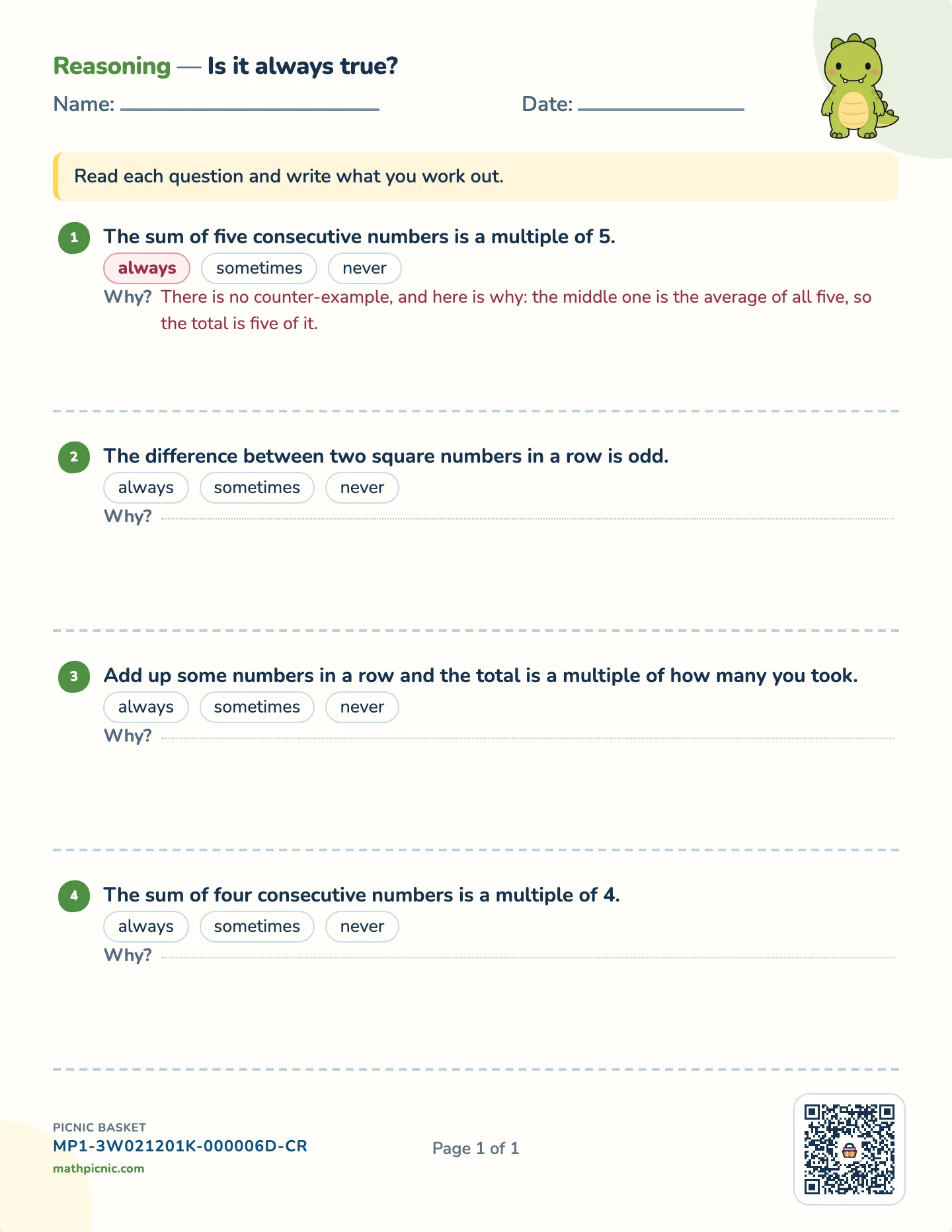
"The sum of two odd numbers is even." Is that always true — and how would you show it? These free printable worksheets make a claim about numbers and ask a child to prove it or break it, which is where mathematical proof begins.
The asymmetry at the heart of proof is the thing to learn here, and it is not obvious. One counterexample is enough to sink a claim forever, while no number of examples is ever enough to establish one — checking that it works for three, five, and nine says nothing about the tenth. A child who feels that difference has understood something no amount of arithmetic teaches.
Why this sheet works
The claims are chosen so a real reason is within reach. Two odd numbers are each one more than an even number, so their sum is two more than an even number, which is even — that is an argument, not a list of cases, and building it is the work. Where a claim is false, the counterexample is usually hiding among zero, one, and the negatives.
How this one works
One question from this sheet, worked through a step at a time.
The sum of five consecutive numbers is a multiple of 5.
The sum of five consecutive numbers is a multiple of 5.
alwayssometimesnever
alwayssometimesnever
always
Before trying anything, notice what each answer would COST. One example that works proves nothing at all. One that fails rules out "always" on its own. They are not the same size of evidence.
So hunt for a counter-example — a case where the claim breaks. That is the cheapest question to ask, and its answer decides between all three.
There is no counter-example, and here is why: the middle one is the average of all five, so the total is five of it. So the answer is always.
1The sum of five consecutive numbers is a multiple of 5.alwayssometimesneverWhy?
2The difference between two square numbers in a row is odd.alwayssometimesneverWhy?
3Add up some numbers in a row and the total is a multiple of how many you took.alwayssometimesneverWhy?
4The sum of four consecutive numbers is a multiple of 4.alwayssometimesneverWhy?
Reasoning · Is it always true?Answer key
1. The sum of five consecutive numbers is a multiple of 5. → always2. The difference between two square numbers in a row is odd. → always3. Add up some numbers in a row and the total is a multiple of how many you took. → sometimes4. The sum of four consecutive numbers is a multiple of 4. → never