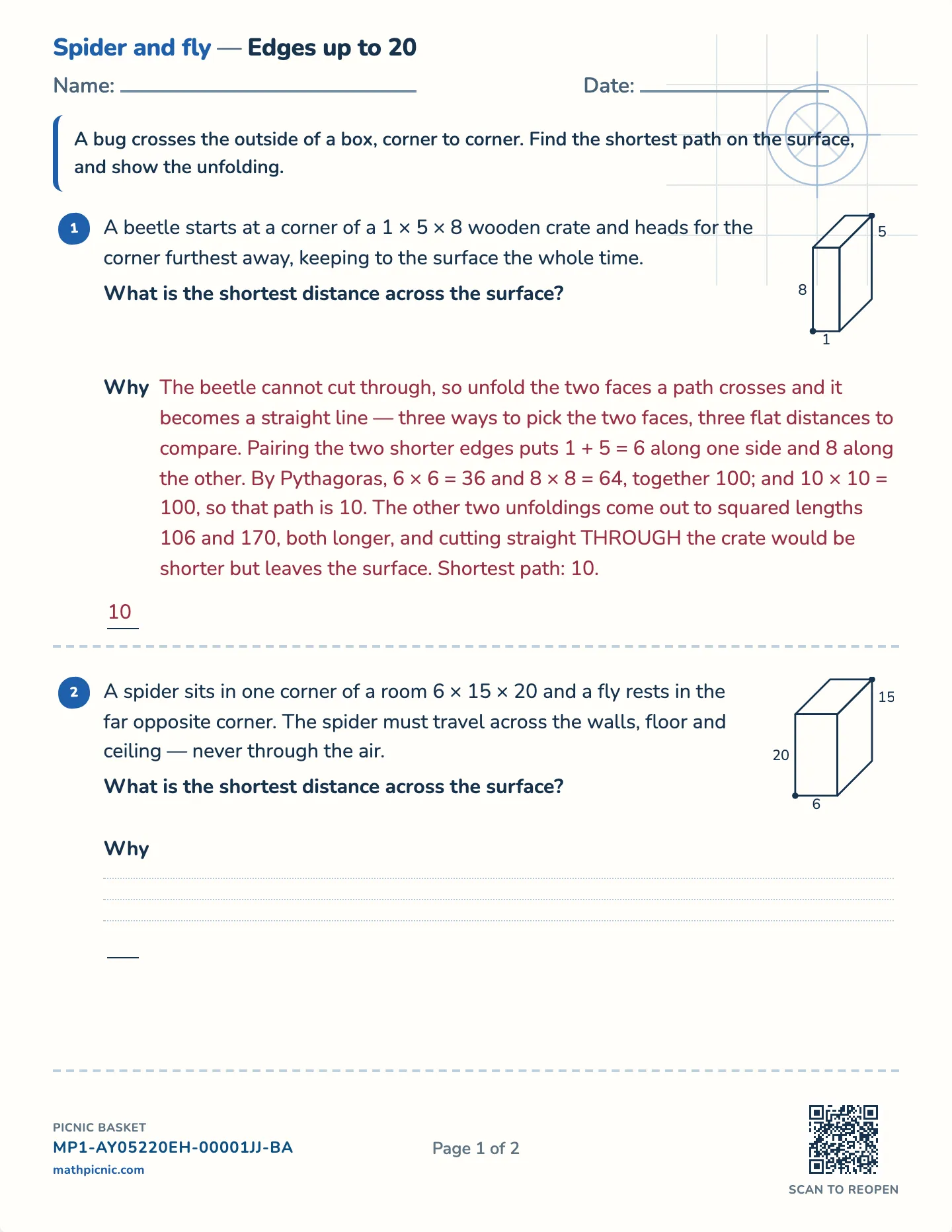
A spider in one corner of a room, a fly in the far opposite corner, and the spider can only travel along the walls, floor and ceiling. The shortest route is not the one that looks obvious — and finding it turns a bent, three-dimensional path into a single straight line.
The trick is Dudeney's, from 1903: a straight path that crosses two faces of a box becomes an actual straight line the moment you unfold those two faces flat onto the table. So the shortest surface route is just the shortest straight line across a flattened rectangle — and since there are three ways to choose which pair of faces to unfold, there are three flat distances to compare and the smallest wins. For a box sorted a ≤ b ≤ c the winner always pairs the two shorter edges: the rectangle is (a + b) by c, and Pythagoras finishes it.
Why this sheet works
Two wrong answers are worth reaching. The first is to cut straight through the box — the space diagonal really is shorter, but the bug is on the surface and cannot take it, and seeing why that route is disallowed is half the lesson. The second is to unfold the wrong pair of faces; the runner-up is often close enough to look right, so the sheet is built so the choice is real work rather than obvious.
A bug crosses the outside of a box, corner to corner. Find the shortest path on the surface, and show the unfolding.
1A beetle starts at a corner of a 1 × 5 × 8 wooden crate and heads for the corner furthest away, keeping to the surface the whole time.What is the shortest distance across the surface?Why
2A spider sits in one corner of a room 6 × 15 × 20 and a fly rests in the far opposite corner. The spider must travel across the walls, floor and ceiling — never through the air.What is the shortest distance across the surface?Why
Spider and flyEdges up to 20
Name: Date:
A bug crosses the outside of a box, corner to corner. Find the shortest path on the surface, and show the unfolding.
3A spider sits in one corner of a room 2 × 10 × 16 and a fly rests in the far opposite corner. The spider must travel across the walls, floor and ceiling — never through the air.What is the shortest distance across the surface?Why
4A spider sits in one corner of a room 3 × 6 × 12 and a fly rests in the far opposite corner. The spider must travel across the walls, floor and ceiling — never through the air.What is the shortest distance across the surface?Why
Spider and fly · Edges up to 20Answer key
1. The beetle cannot cut through, so unfold the two faces a path crosses and it becomes a straight line — three ways to pick the two faces, three flat distances to compare. Pairing the two shorter edges puts 1 + 5 = 6 along one side and 8 along the other. By Pythagoras, 6 × 6 = 36 and 8 × 8 = 64, together 100; and 10 × 10 = 100, so that path is 10. The other two unfoldings come out to squared lengths 106 and 170, both longer, and cutting straight THROUGH the crate would be shorter but leaves the surface. Shortest path: 10.2. The spider cannot cut through, so unfold the two faces a path crosses and it becomes a straight line — three ways to pick the two faces, three flat distances to compare. Pairing the two shorter edges puts 6 + 15 = 21 along one side and 20 along the other. By Pythagoras, 21 × 21 = 441 and 20 × 20 = 400, together 841; and 29 × 29 = 841, so that path is 29. The other two unfoldings come out to squared lengths 901 and 1261, both longer, and cutting straight THROUGH the room would be shorter but leaves the surface. Shortest path: 29.3. The spider cannot cut through, so unfold the two faces a path crosses and it becomes a straight line — three ways to pick the two faces, three flat distances to compare. Pairing the two shorter edges puts 2 + 10 = 12 along one side and 16 along the other. By Pythagoras, 12 × 12 = 144 and 16 × 16 = 256, together 400; and 20 × 20 = 400, so that path is 20. The other two unfoldings come out to squared lengths 424 and 680, both longer, and cutting straight THROUGH the room would be shorter but leaves the surface. Shortest path: 20.4. The spider cannot cut through, so unfold the two faces a path crosses and it becomes a straight line — three ways to pick the two faces, three flat distances to compare. Pairing the two shorter edges puts 3 + 6 = 9 along one side and 12 along the other. By Pythagoras, 9 × 9 = 81 and 12 × 12 = 144, together 225; and 15 × 15 = 225, so that path is 15. The other two unfoldings come out to squared lengths 261 and 333, both longer, and cutting straight THROUGH the room would be shorter but leaves the surface. Shortest path: 15.