Three teas, two coffees and one cocoa come to 96c. One tea, two coffees and three cocoas come to 104c. What do one of each cost? Fifty cents — and you cannot work out what a tea costs, then or ever.
Put the two facts side by side and they buy four teas, four coffees and four cocoas for 200c. One of each is a quarter of that. No single price is ever found, and none is needed — which is the part that surprises a child who has been taught that a puzzle is a set of unknowns to solve one at a time.
Why this sheet works
Two facts cannot pin down three prices, so half of these questions genuinely have no answer. That half is what makes the other half worth asking. A child who ignores the point, hunts for one price list that fits and adds it up will be right every time on the answerable questions and confidently wrong on the rest — the method is run to the end and it loses.
Not every price can be found. Answer what you can, or write CANNOT TELL.
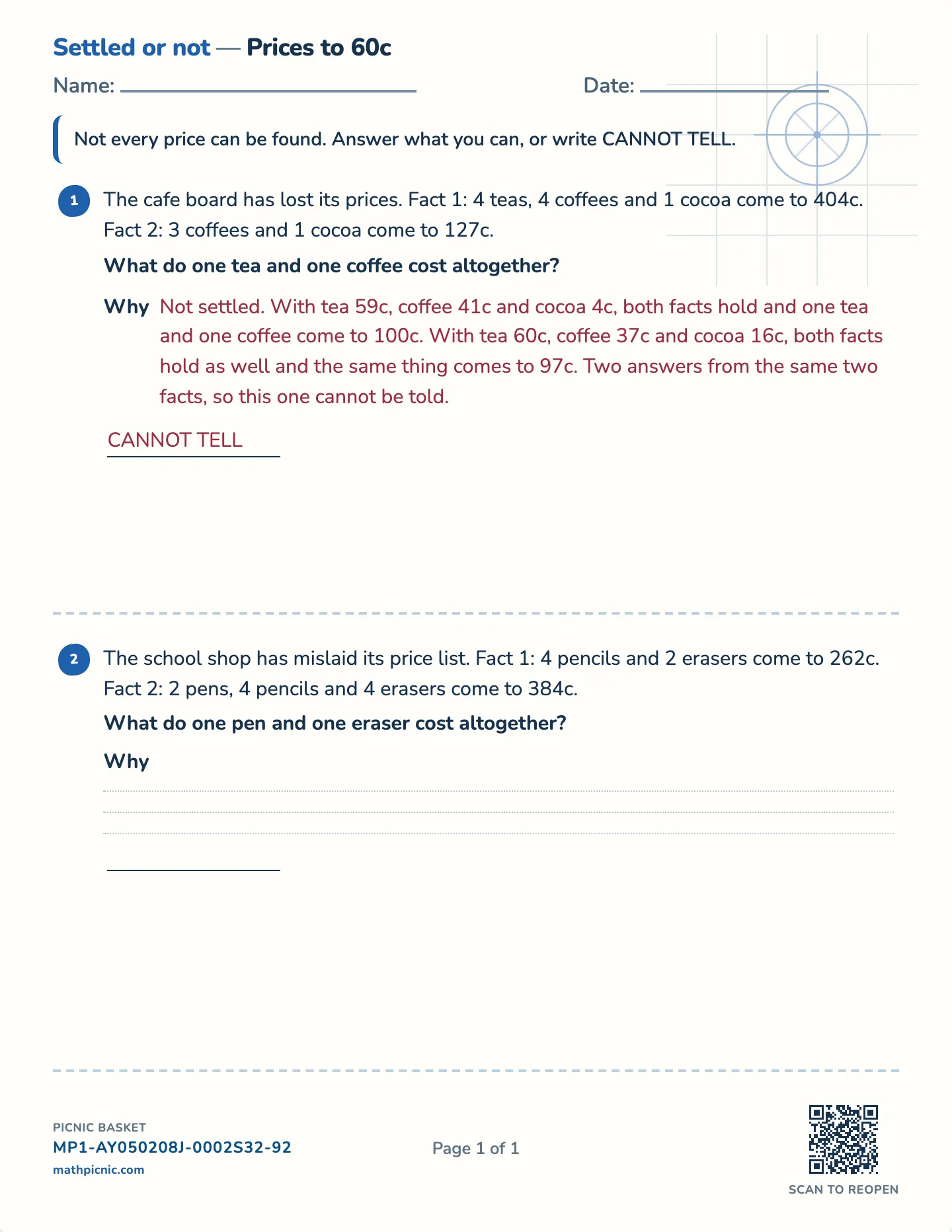
1The cafe board has lost its prices. Fact 1: 4 teas, 4 coffees and 1 cocoa come to 404c. Fact 2: 3 coffees and 1 cocoa come to 127c.What do one tea and one coffee cost altogether?Why
2The school shop has mislaid its price list. Fact 1: 4 pencils and 2 erasers come to 262c. Fact 2: 2 pens, 4 pencils and 4 erasers come to 384c.What do one pen and one eraser cost altogether?Why
Settled or not · Prices to 60cAnswer key
1. Not settled. With tea 59c, coffee 41c and cocoa 4c, both facts hold and one tea and one coffee come to 100c. With tea 60c, coffee 37c and cocoa 16c, both facts hold as well and the same thing comes to 97c. Two answers from the same two facts, so this one cannot be told.2. Fact 2 less fact 1: 384 − 262 = 122c, and that buys 2 pens and 2 erasers — two lots of what the question asks for. So one lot is 122 ÷ 2 = 61c. The answer came from the two totals alone and never from a price: a pen could be 2c or 4c and both facts would still hold.