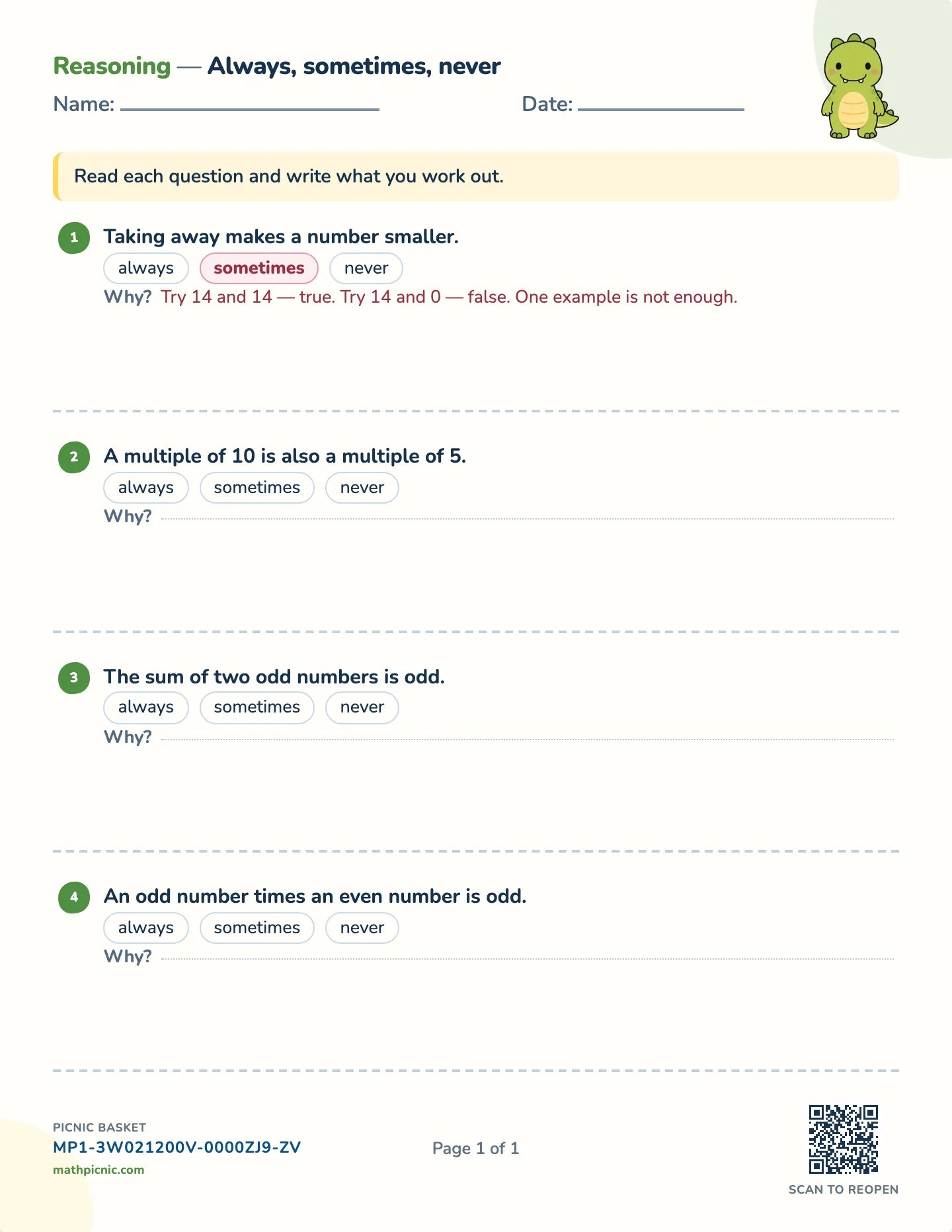
A claim about numbers is made, and the question is whether it holds every time, some of the time, or none of the time. These free printable worksheets give the statement and leave room for the example that settles it.
"Taking away makes a number smaller" feels obviously true and is only sometimes true, because taking away zero changes nothing. Finding that one case is the work, and it is the beginning of mathematical proof: a single counterexample is enough to demote "always" to "sometimes", while no number of examples is ever enough to promote "sometimes" to "always".
Why this sheet works
The asymmetry is worth naming out loud, because it is what separates this from a guessing exercise. To argue for "always" a child has to give a reason; to argue against it they need one example. Both are written on the page, and the reason is the part to read.
How this one works
One question from this sheet, worked through a step at a time.
Taking away makes a number smaller.
Taking away makes a number smaller.
alwayssometimesnever
alwayssometimesnever
sometimes
Before trying anything, notice what each answer would COST. One example that works proves nothing at all. One that fails rules out "always" on its own. They are not the same size of evidence.
So hunt for a counter-example — a case where the claim breaks. That is the cheapest question to ask, and its answer decides between all three.
Try 14 and 14 — true. Try 14 and 0 — false. One example is not enough. So the answer is sometimes.
1Taking away makes a number smaller.alwayssometimesneverWhy?
2A multiple of 10 is also a multiple of 5.alwayssometimesneverWhy?
3The sum of two odd numbers is odd.alwayssometimesneverWhy?
4An odd number times an even number is odd.alwayssometimesneverWhy?
Reasoning · Always, sometimes, neverAnswer key
1. Taking away makes a number smaller. → sometimes2. A multiple of 10 is also a multiple of 5. → always3. The sum of two odd numbers is odd. → never4. An odd number times an even number is odd. → never