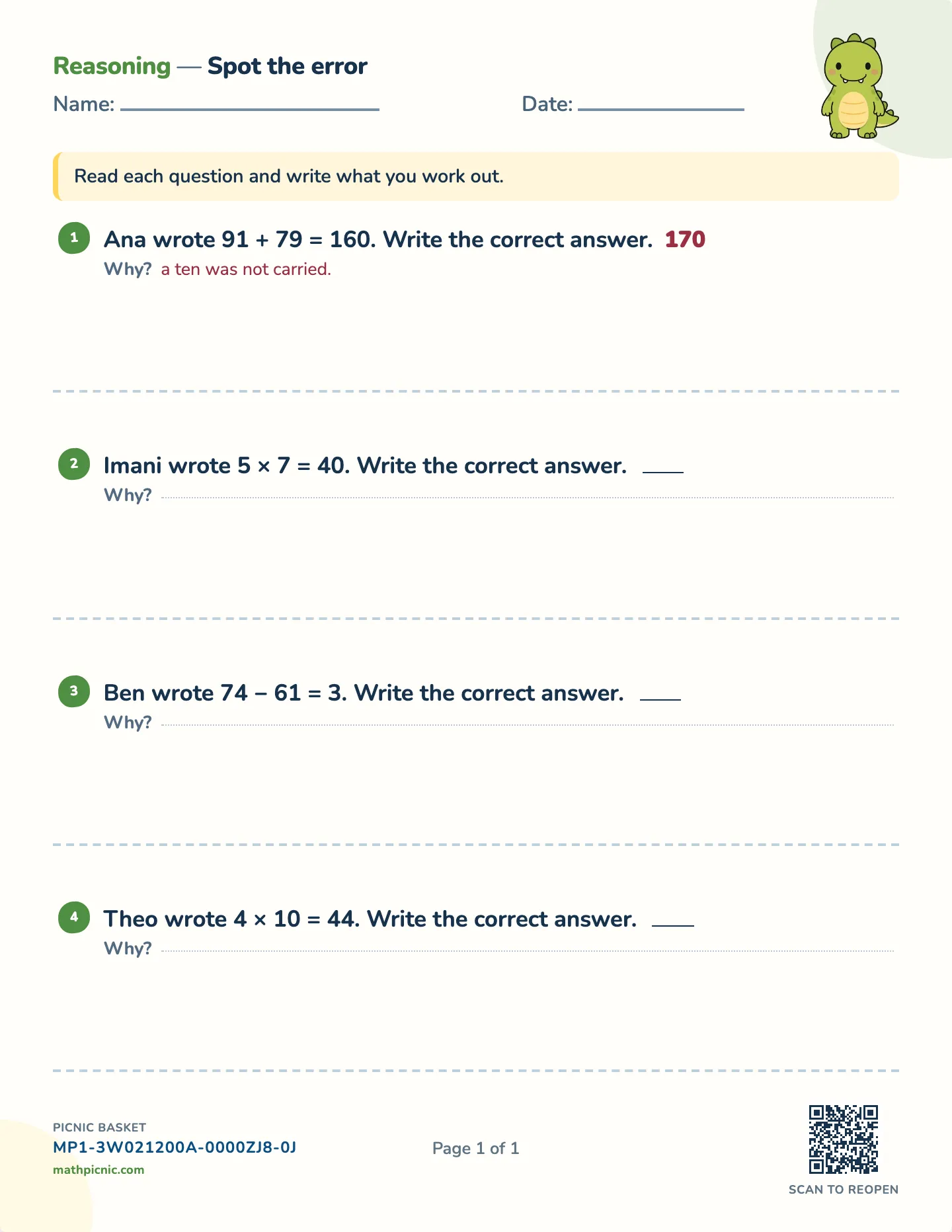
Someone has worked a question out and got it wrong. These free printable worksheets show the wrong answer and ask for the right one, with room to say what went wrong.
Marking someone else's work is a different job from doing your own, and it is a harder one. A child solving a question chooses their own route; a child checking one has to follow somebody else's and find where it left the road. That is the skill every proof, every debugging session and every re-read of your own work depends on.
Why this sheet works
The errors are the ones children actually make — a digit carried that should not have been, a times table one out, an operation done in the wrong order. Recognizing a mistake as familiar is uncomfortable and useful, because a child who can name it in someone else's work starts catching it in their own.
How this one works
One question from this sheet, worked through a step at a time.
Ana wrote 91 + 79 = 160. Write the correct answer.
Ana wrote 91 + 79 = 160. Write the correct answer.
91+79=170
91+79=170
they wrote:160
Do not check by reading their working. Somebody else's answer is the most persuasive thing on the page, and rereading it is how you end up agreeing with it — work the sum yourself first, then compare.
On your own: 91 + 79 = 170.
Now compare. They wrote 160, and it should be 170 — out by 10. The correct answer is 170.
1Ana wrote 91 + 79 = 160. Write the correct answer. Why?
2Imani wrote 5 × 7 = 40. Write the correct answer. Why?
3Ben wrote 74 − 61 = 3. Write the correct answer. Why?
4Theo wrote 4 × 10 = 44. Write the correct answer. Why?
Reasoning · Spot the errorAnswer key
1. 91 + 79 = 170, not 160 (a ten was not carried)2. 5 × 7 = 35, not 40 (the count is one group too many)3. 74 − 61 = 13, not 3 (a ten was paid back that had never been borrowed)4. 4 × 10 = 40, not 44 (the count is one group too many)