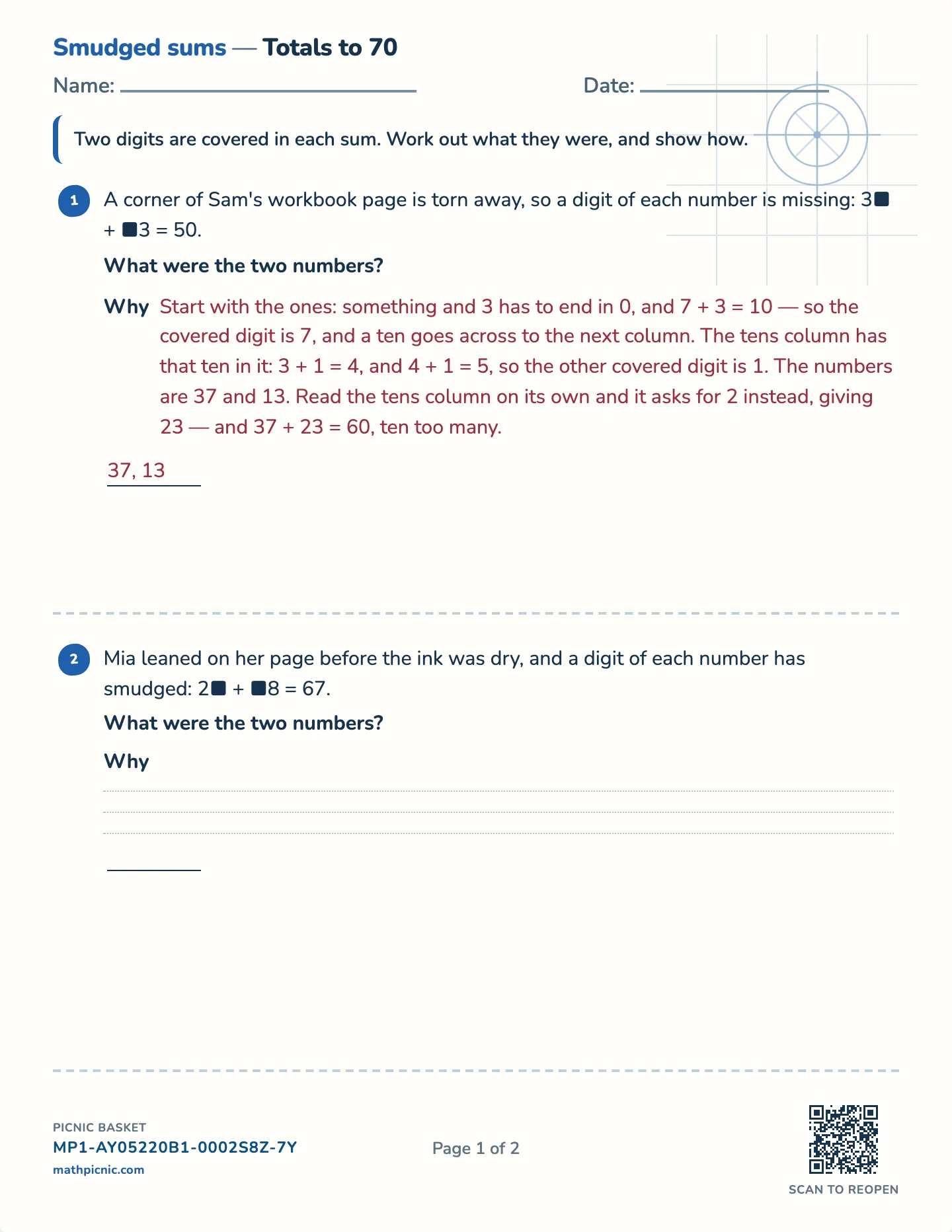
Two digits are covered and a single total has to find them both. What settles it is place value rather than algebra: a digit is a whole number under ten, and only one of them fits the ones column. Grades 2–3 arithmetic, asked backwards.
Why this sheet works
Most children get the first digit quickly and the second one ten too big. That near miss is the lesson — the harder half was done right — and the answer key prints the whole route, so you can show where the ten went.
Two digits are covered in each sum. Work out what they were, and show how.
1A corner of Sam's workbook page is torn away, so a digit of each number is missing: 3■ + ■3 = 50.What were the two numbers?Why
2Mia leaned on her page before the ink was dry, and a digit of each number has smudged: 2■ + ■8 = 67.What were the two numbers?Why
Smudged sumsTotals to 70
Name: Date:
Two digits are covered in each sum. Work out what they were, and show how.
3This sum was photocopied badly and two digits came out blank: 1■ + ■6 = 61.What were the two numbers?Why
4This sum was photocopied badly and two digits came out blank: 5■ + ■6 = 70.What were the two numbers?Why
Smudged sums · Totals to 70Answer key
1. Start with the ones: something and 3 has to end in 0, and 7 + 3 = 10 — so the covered digit is 7, and a ten goes across to the next column. The tens column has that ten in it: 3 + 1 = 4, and 4 + 1 = 5, so the other covered digit is 1. The numbers are 37 and 13. Read the tens column on its own and it asks for 2 instead, giving 23 — and 37 + 23 = 60, ten too many.2. Start with the ones: something and 8 has to end in 7, and 9 + 8 = 17 — so the covered digit is 9, and a ten goes across to the next column. The tens column has that ten in it: 2 + 1 = 3, and 3 + 3 = 6, so the other covered digit is 3. The numbers are 29 and 38. Read the tens column on its own and it asks for 4 instead, giving 48 — and 29 + 48 = 77, ten too many.3. Start with the ones: something and 6 has to end in 1, and 5 + 6 = 11 — so the covered digit is 5, and a ten goes across to the next column. The tens column has that ten in it: 1 + 1 = 2, and 2 + 4 = 6, so the other covered digit is 4. The numbers are 15 and 46. Read the tens column on its own and it asks for 5 instead, giving 56 — and 15 + 56 = 71, ten too many.4. Start with the ones: something and 6 has to end in 0, and 4 + 6 = 10 — so the covered digit is 4, and a ten goes across to the next column. The tens column has that ten in it: 5 + 1 = 6, and 6 + 1 = 7, so the other covered digit is 1. The numbers are 54 and 16. Read the tens column on its own and it asks for 2 instead, giving 26 — and 54 + 26 = 80, ten too many.