A log sawn into five pieces takes four cuts. Trees every five meters along a forty-meter path, one at each end, come to nine. Neither answer is the division — both are one away from it, in opposite directions.
There is almost no arithmetic here: one division at most, often none. The whole question is whether what is being counted is the things or the gaps between them, and which of those is one bigger. That is a decision rather than a calculation, and it is the earliest genuine decision this site can offer — a seven-year-old can meet it.
Why this sheet works
Four kinds of question share the page, and that is the design rather than variety for its own sake. Sawing a log gives one fewer cut than pieces. Trees with one at each end give one more tree than gap. Posts starting one gap in give exactly as many posts as gaps. A clock striking eight times has seven silences. A child who learns "add one" meets the log; a child who learns "subtract one" meets the path; no rule survives the sheet.
Decide whether you want the things or the gaps. Show your working.
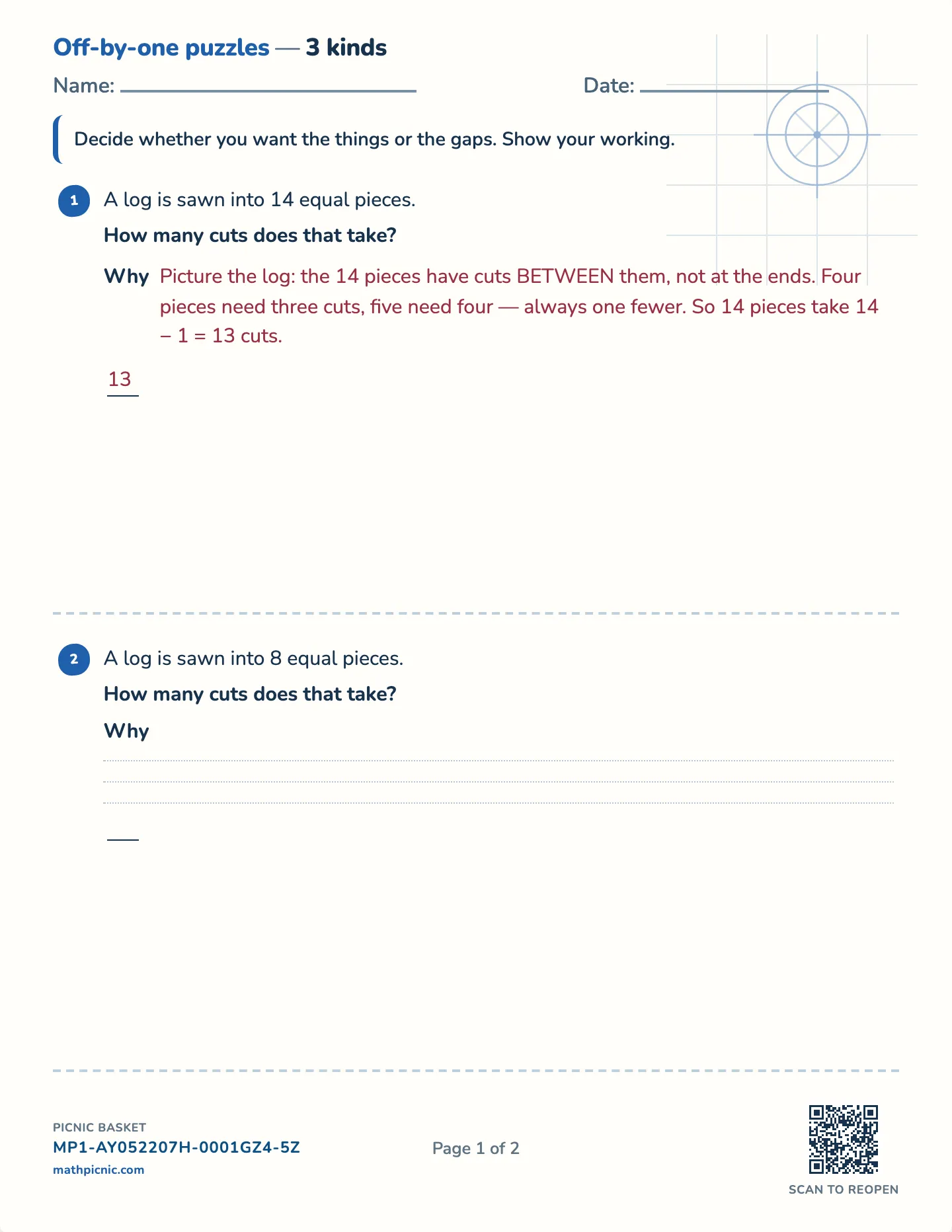
1A log is sawn into 14 equal pieces.How many cuts does that take?Why
2A log is sawn into 8 equal pieces.How many cuts does that take?Why
Off-by-one puzzles3 kinds
Name: Date:
Decide whether you want the things or the gaps. Show your working.
3A path is 14 meters long. A tree is planted every 2 meters, with one at each end.How many trees are there?Why
4A fence is 42 meters long. A post goes every 6 meters, starting 6 meters in from the left-hand end and finishing at the right-hand end.How many posts are there?Why
Off-by-one puzzles · 3 kindsAnswer key
1. Picture the log: the 14 pieces have cuts BETWEEN them, not at the ends. Four pieces need three cuts, five need four — always one fewer. So 14 pieces take 14 − 1 = 13 cuts.2. Picture the log: the 8 pieces have cuts BETWEEN them, not at the ends. Four pieces need three cuts, five need four — always one fewer. So 8 pieces take 8 − 1 = 7 cuts.3. 14 ÷ 2 = 7, but that counts the GAPS between the trees. There is a tree at both ends, so there is always one more tree than gap: 7 + 1 = 8 trees.4. 42 ÷ 6 = 7 gaps. This time there is no post at the left-hand end, so the posts and the gaps come out equal: 7 posts. Not every one of these questions adds one.