A number leaves 2 when divided by 3, 3 when divided by 5, and 2 when divided by 7. The smallest it can be is 23 — and Sun Tzu asked exactly this in the third century.
It is the rare question a nine-year-old can start and a first-year undergraduate can still find something in. Starting needs nothing but division with a remainder. Finishing well needs a method, and the method these sheets teach is a sieve rather than a formula: write the numbers that satisfy the first condition — they climb in steps of the first divisor — then check those against the second.
Why this sheet works
What makes the sieve worth teaching is what happens to the step. The numbers passing the first two conditions climb in steps of the two divisors multiplied, so the list to check against the third is short. Each condition multiplies the step, which is why the search finishes quickly and why a child can see that it must. The Chinese Remainder Theorem computes the same answer with a formula and shows none of that.
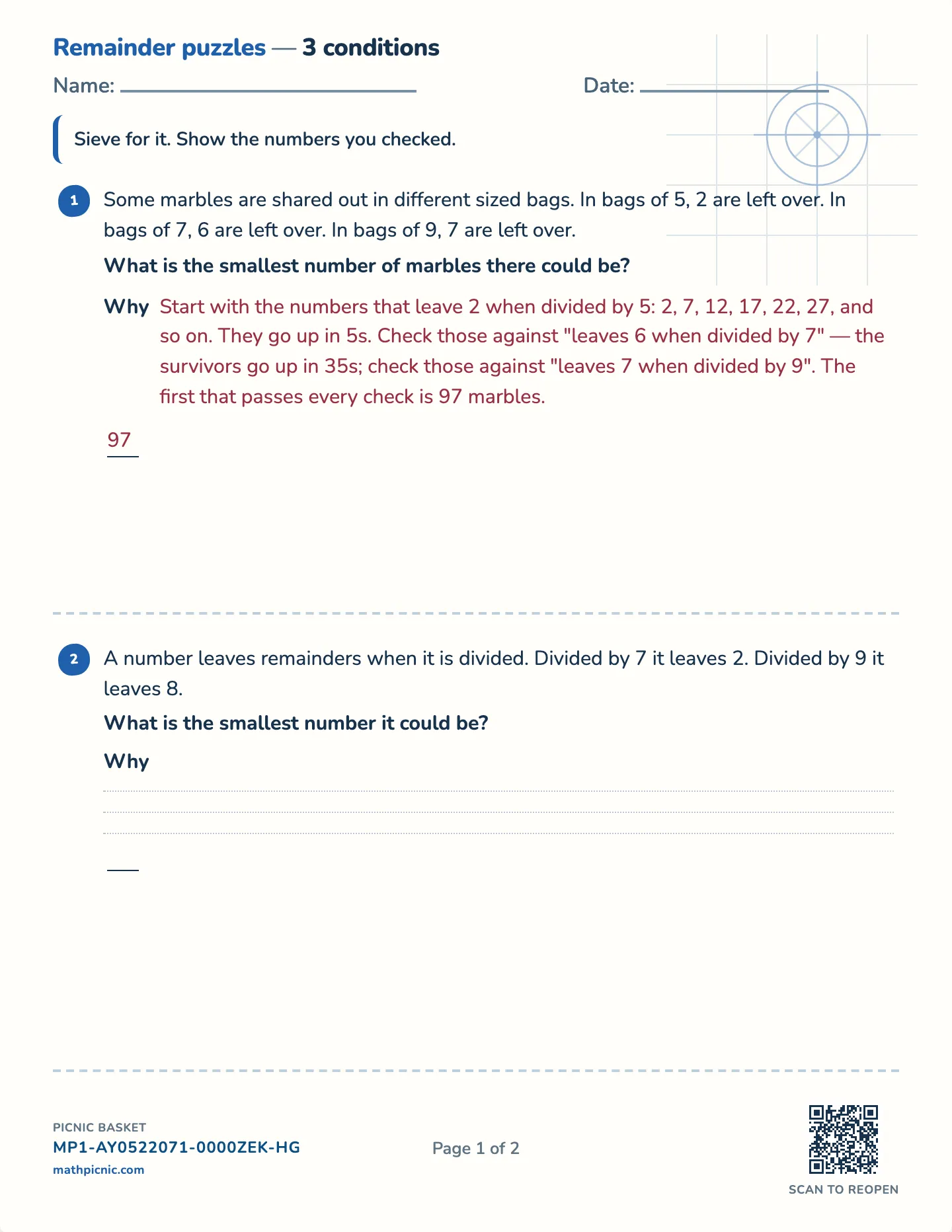
1Some marbles are shared out in different sized bags. In bags of 5, 2 are left over. In bags of 7, 6 are left over. In bags of 9, 7 are left over.What is the smallest number of marbles there could be?Why
2A number leaves remainders when it is divided. Divided by 7 it leaves 2. Divided by 9 it leaves 8.What is the smallest number it could be?Why
Remainder puzzles3 conditions
Name: Date:
Sieve for it. Show the numbers you checked.
3A number leaves remainders when it is divided. Divided by 3 it leaves 2. Divided by 7 it leaves 3. Divided by 8 it leaves 2.What is the smallest number it could be?Why
4Some marbles are shared out in different sized bags. In bags of 4, 3 are left over. In bags of 7, 6 are left over.What is the smallest number of marbles there could be?Why
Remainder puzzles · 3 conditionsAnswer key
1. Start with the numbers that leave 2 when divided by 5: 2, 7, 12, 17, 22, 27, and so on. They go up in 5s. Check those against "leaves 6 when divided by 7" — the survivors go up in 35s; check those against "leaves 7 when divided by 9". The first that passes every check is 97 marbles.2. Start with the numbers that leave 2 when divided by 7: 2, 9, 16, 23, 30, 37, and so on. They go up in 7s. Check those against "leaves 8 when divided by 9". The first that passes every check is 44.3. Start with the numbers that leave 2 when divided by 3: 2, 5, 8, 11, 14, 17, and so on. They go up in 3s. Check those against "leaves 3 when divided by 7" — the survivors go up in 21s; check those against "leaves 2 when divided by 8". The first that passes every check is 122.4. Start with the numbers that leave 3 when divided by 4: 3, 7, 11, 15, 19, 23, and so on. They go up in 4s. Check those against "leaves 6 when divided by 7". The first that passes every check is 27 marbles.