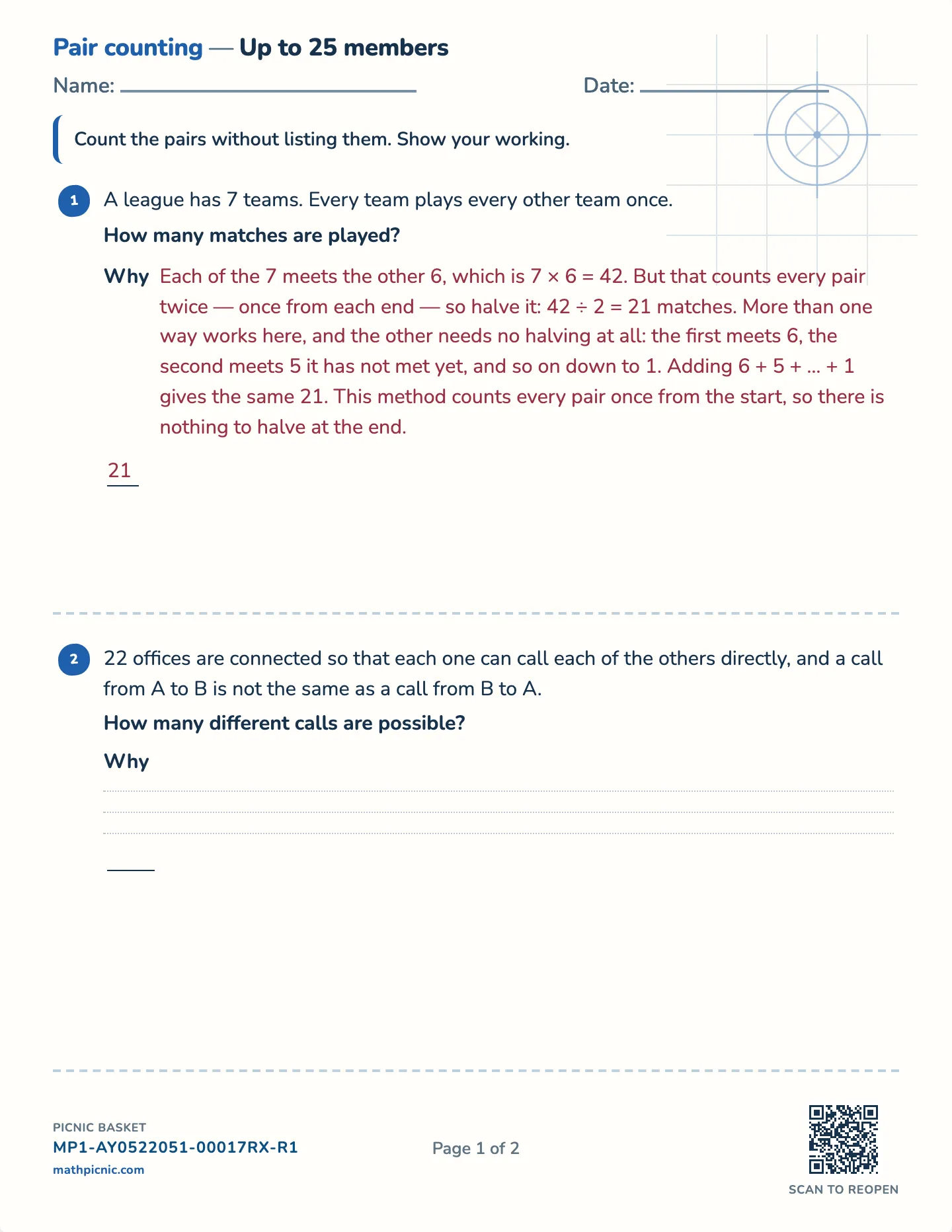
Twelve people, everyone shakes hands with everyone else once. Almost everybody answers 132 first. The answer is 66, and the reason is worth more than the number.
132 is 12 × 11, and it is not a careless answer — it is the right count of something else. Each of the twelve people shakes eleven hands, so that product really does count every handshake. It counts each one twice, once from each end, because a handshake belongs to two people. Halving is not a correction to a mistake; it is the last step of a method that was right all along.
Why this sheet works
So the sheet also asks the version where halving is wrong. When every team plays home AND away, a match at A against B and a match at B against A are different matches, and the answer is the full 12 × 11. Both shapes appear on the same page on purpose: a child who has learned "divide by two" as a rule meets the question that rule does not fit, and has to decide instead of apply.
Count the pairs without listing them. Show your working.
1A league has 7 teams. Every team plays every other team once.How many matches are played?Why
222 offices are connected so that each one can call each of the others directly, and a call from A to B is not the same as a call from B to A.How many different calls are possible?Why
Pair countingUp to 25 members
Name: Date:
Count the pairs without listing them. Show your working.
3A league has 9 teams. Every team plays every other team twice — once at home and once away.How many matches are played?Why
4A league has 6 teams. Every team plays every other team once.How many matches are played?Why
Pair counting · Up to 25 membersAnswer key
1. Each of the 7 meets the other 6, which is 7 × 6 = 42. But that counts every pair twice — once from each end — so halve it: 42 ÷ 2 = 21 matches. More than one way works here, and the other needs no halving at all: the first meets 6, the second meets 5 it has not met yet, and so on down to 1. Adding 6 + 5 + … + 1 gives the same 21. This method counts every pair once from the start, so there is nothing to halve at the end.2. Each of the 22 meets the other 21, and this time the two directions are different events. So 22 × 21 = 462 calls, with no halving.3. Each of the 9 meets the other 8, and this time the two directions are different events. So 9 × 8 = 72 matches, with no halving.4. Each of the 6 meets the other 5, which is 6 × 5 = 30. But that counts every pair twice — once from each end — so halve it: 30 ÷ 2 = 15 matches. More than one way works here, and the other needs no halving at all: the first meets 5, the second meets 4 it has not met yet, and so on down to 1. Adding 5 + 4 + … + 1 gives the same 15. This method counts every pair once from the start, so there is nothing to halve at the end.