Change one word and the same division gives a different answer. Stickers cost 12c and you have 38c — now it is 3, because 2c does not buy a sticker. How many are left over? 2. How many more would fill the last box? 10. Same numbers, same remainder, four answers, and the only thing that picks between them is the sentence.
Why this sheet works
That is the whole page, and it is why the arithmetic is deliberately easy. A child of eight can do every division here. What is being asked for is the reading, which is where the marks actually go — and a child who divides and stops writing will be right on roughly one question in four.
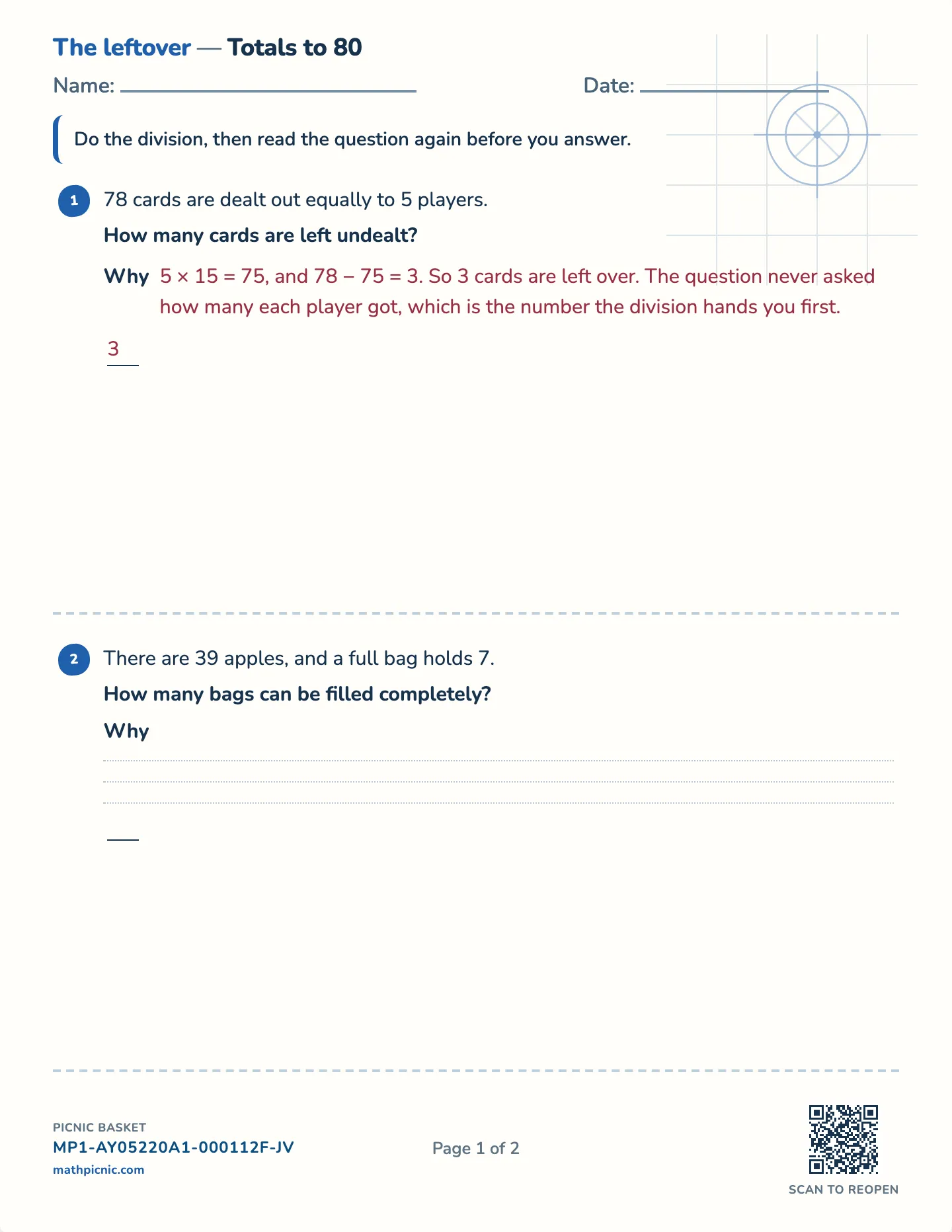
Do the division, then read the question again before you answer.
178 cards are dealt out equally to 5 players.How many cards are left undealt?Why
2There are 39 apples, and a full bag holds 7.How many bags can be filled completely?Why
The leftoverTotals to 80
Name: Date:
Do the division, then read the question again before you answer.
321 eggs are being packed into boxes of 9. The last box is not full.How many more eggs would fill it?Why
458 eggs come in from the hens. Each box holds 4.How many boxes are needed to pack them all?Why
The leftover · Totals to 80Answer key
1. 5 × 15 = 75, and 78 − 75 = 3. So 3 cards are left over. The question never asked how many each player got, which is the number the division hands you first.2. 7 × 5 = 35, and 39 − 35 = 4 over. The 4 left over is not enough for another bag, so the answer is 5 bags. This is the one kind where the division alone is right — which is why the sentence has to be read on every question and not just the numbers.3. 9 × 2 = 18, and 21 − 18 = 3 in the last box. A full box takes 9, so 9 − 3 = 6 more would fill it. Neither 2 nor 3 is the answer here, and both are on the page.4. 4 × 14 = 56, and 58 − 56 = 2 over. Those 2 still need somewhere to go, so one more box is wanted: 14 + 1 = 15 boxes. The division on its own would have said 14, and left 2 behind.