Mark points on a circle and join every pair with a chord. Two points make 2 regions, three make 4, four make 8, five make 16 — so six points make 32, surely? They make 31. The most famous broken pattern in mathematics, and the sheet is built around the moment it snaps.
The counts 1, 2, 4, 8, 16 are so convincingly the powers of two that almost everyone writes 32 for the sixth point — and it is worth writing, because being wrong here is the whole lesson. The real rule is not doubling at all: the regions are 1 + (the number of chords) + (the number of places two chords cross inside). There is one chord for every pair of points and one interior crossing for every set of four points, so the count is 1 + C(n,2) + C(n,4), which only happens to match 2ⁿ⁻¹ for the first five values.
Why this sheet works
Why four points per crossing? Because two chords cross inside exactly when their four endpoints alternate around the circle — so every choice of four points gives precisely one crossing, and every crossing comes from one such foursome. Counting the crossings is counting the foursomes. That is the step that turns a picture nobody can draw for twelve points into a short sum.
Join every pair of points on a circle and count the regions. The pattern doubles, then it does not.
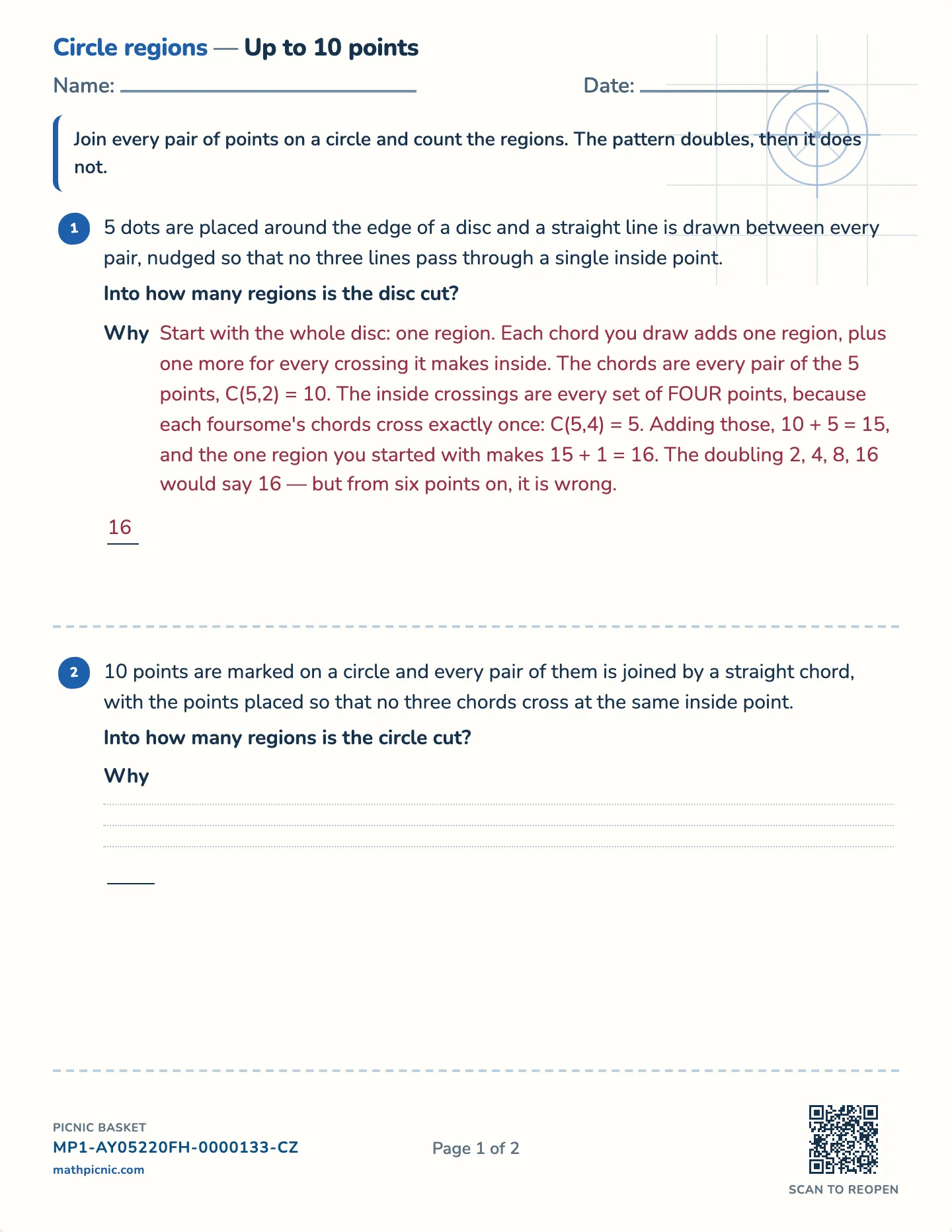
15 dots are placed around the edge of a disc and a straight line is drawn between every pair, nudged so that no three lines pass through a single inside point.Into how many regions is the disc cut?Why
210 points are marked on a circle and every pair of them is joined by a straight chord, with the points placed so that no three chords cross at the same inside point.Into how many regions is the circle cut?Why
Circle regionsUp to 10 points
Name: Date:
Join every pair of points on a circle and count the regions. The pattern doubles, then it does not.
34 dots are placed around the edge of a disc and a straight line is drawn between every pair, nudged so that no three lines pass through a single inside point.Into how many regions is the disc cut?Why
48 points are marked on a circle and every pair of them is joined by a straight chord, with the points placed so that no three chords cross at the same inside point.Into how many regions is the circle cut?Why
Circle regions · Up to 10 pointsAnswer key
1. Start with the whole disc: one region. Each chord you draw adds one region, plus one more for every crossing it makes inside. The chords are every pair of the 5 points, C(5,2) = 10. The inside crossings are every set of FOUR points, because each foursome's chords cross exactly once: C(5,4) = 5. Adding those, 10 + 5 = 15, and the one region you started with makes 15 + 1 = 16. The doubling 2, 4, 8, 16 would say 16 — but from six points on, it is wrong.2. Start with the whole circle: one region. Each chord you draw adds one region, plus one more for every crossing it makes inside. The chords are every pair of the 10 points, C(10,2) = 45. The inside crossings are every set of FOUR points, because each foursome's chords cross exactly once: C(10,4) = 210. Adding those, 45 + 210 = 255, and the one region you started with makes 255 + 1 = 256. The doubling 2, 4, 8, 16 would say 512 — but from six points on, it is wrong.3. Start with the whole disc: one region. Each chord you draw adds one region, plus one more for every crossing it makes inside. The chords are every pair of the 4 points, C(4,2) = 6. The inside crossings are every set of FOUR points, because each foursome's chords cross exactly once: C(4,4) = 1. Adding those, 6 + 1 = 7, and the one region you started with makes 7 + 1 = 8. The doubling 2, 4, 8, 16 would say 8 — but from six points on, it is wrong.4. Start with the whole circle: one region. Each chord you draw adds one region, plus one more for every crossing it makes inside. The chords are every pair of the 8 points, C(8,2) = 28. The inside crossings are every set of FOUR points, because each foursome's chords cross exactly once: C(8,4) = 70. Adding those, 28 + 70 = 98, and the one region you started with makes 98 + 1 = 99. The doubling 2, 4, 8, 16 would say 128 — but from six points on, it is wrong.