Multiply a hundred sevens together. The number has eighty-five digits and nothing will display it. What is its last digit? One — and a child can get there in under a minute.
Every other challenge sheet here is hard because something is missing. This one is hard because nothing is: the child has all the information and still cannot do the arithmetic, so the only way through is to notice that powers of 7 end in 7, 9, 3, 1 and then 7 again. Four values, forever. That shift — from computing to finding the pattern that makes computing unnecessary — is a large part of what number theory is.
Why this sheet works
Finding the cycle is the easy half. Landing on the right member of it is where the question bites, and it bites hardest when the division comes out even: 100 divided by 4 leaves nothing, so the hundredth power is the LAST of the four, not the first. A child who works out the remainder and counts from the start of the list gets 7 instead of 1. It is the fencepost error, arriving several grades later than usual and dressed up beyond recognition.
The number is far too big to write. Find what repeats, and count carefully.
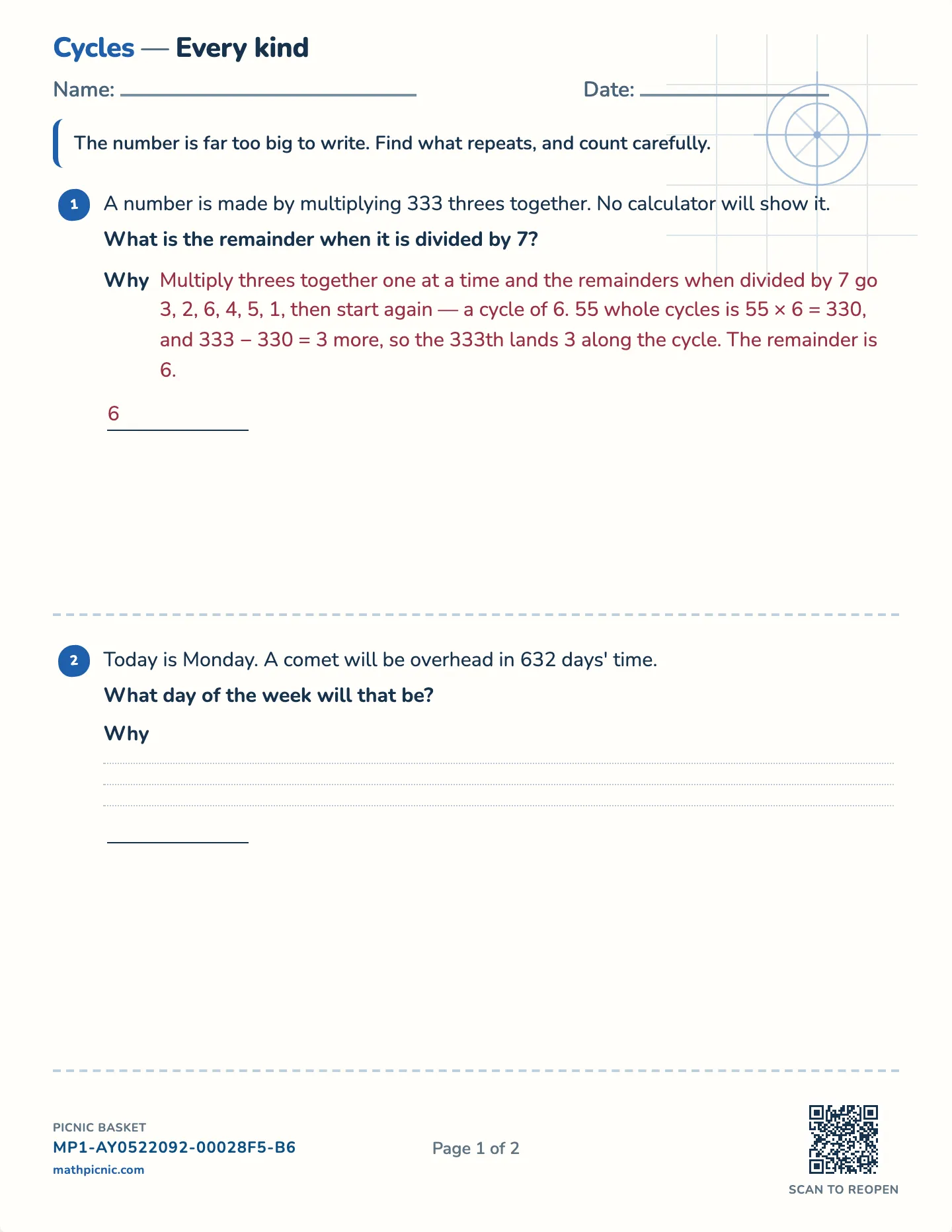
1A number is made by multiplying 333 threes together. No calculator will show it.What is the remainder when it is divided by 7?Why
2Today is Monday. A comet will be overhead in 632 days' time.What day of the week will that be?Why
CyclesEvery kind
Name: Date:
The number is far too big to write. Find what repeats, and count carefully.
3A number is made by multiplying 40 sevens together. It is far too big for any calculator to show.What is its last digit?Why
4A number is made by multiplying 40 eights together. It is far too big for any calculator to show.What is its last digit?Why
Cycles · Every kindAnswer key
1. Multiply threes together one at a time and the remainders when divided by 7 go 3, 2, 6, 4, 5, 1, then start again — a cycle of 6. 55 whole cycles is 55 × 6 = 330, and 333 − 330 = 3 more, so the 333th lands 3 along the cycle. The remainder is 6.2. Days of the week repeat every 7, so only the leftover matters. 90 whole weeks is 90 × 7 = 630 days, and 632 − 630 = 2 left over. So the comet arrives 2 days after Monday: Wednesday.3. Powers of 7 end in 7, 9, 3, 1, then start again — a cycle of 4. 40 ÷ 4 = 10 exactly, so the 40th lands on the LAST of the four, not the first. Its last digit is 1.4. Powers of 8 end in 8, 4, 2, 6, then start again — a cycle of 4. 40 ÷ 4 = 10 exactly, so the 40th lands on the LAST of the four, not the first. Its last digit is 6.