A grid of dots, and every rectangle you can draw with its sides on the grid. A 4-by-4 grid has 36 of them — but the child who counts only the little squares stops at 9, because they forgot every rectangle bigger than one cell.
A rectangle with sides on the grid is pinned down by choosing two of the columns — its left and right edges — and two of the rows — its top and bottom. So the count is a PRODUCT of two combinations: C(w,2) for the columns and C(h,2) for the rows. A 4-by-4 grid of dots gives C(4,2) × C(4,2) = 6 × 6 = 36. The tempting wrong answer is the number of unit cells, (w−1)(h−1) = 9, which counts only the smallest squares and forgets the larger rectangles entirely.
Why this sheet works
This is the same 'a shape is a choice' idea as counting triangles from the dots, but the correction goes the other way: nothing is subtracted here — instead two independent choices are multiplied, because every pair of columns can pair with every pair of rows. Seeing that a rectangle is two-decisions-multiplied rather than a picture to draw is the whole lesson, and it is the cleanest first taste of why combinations multiply.
Count the rectangles you can make from a grid of dots, and show why it is a product of two combinations.
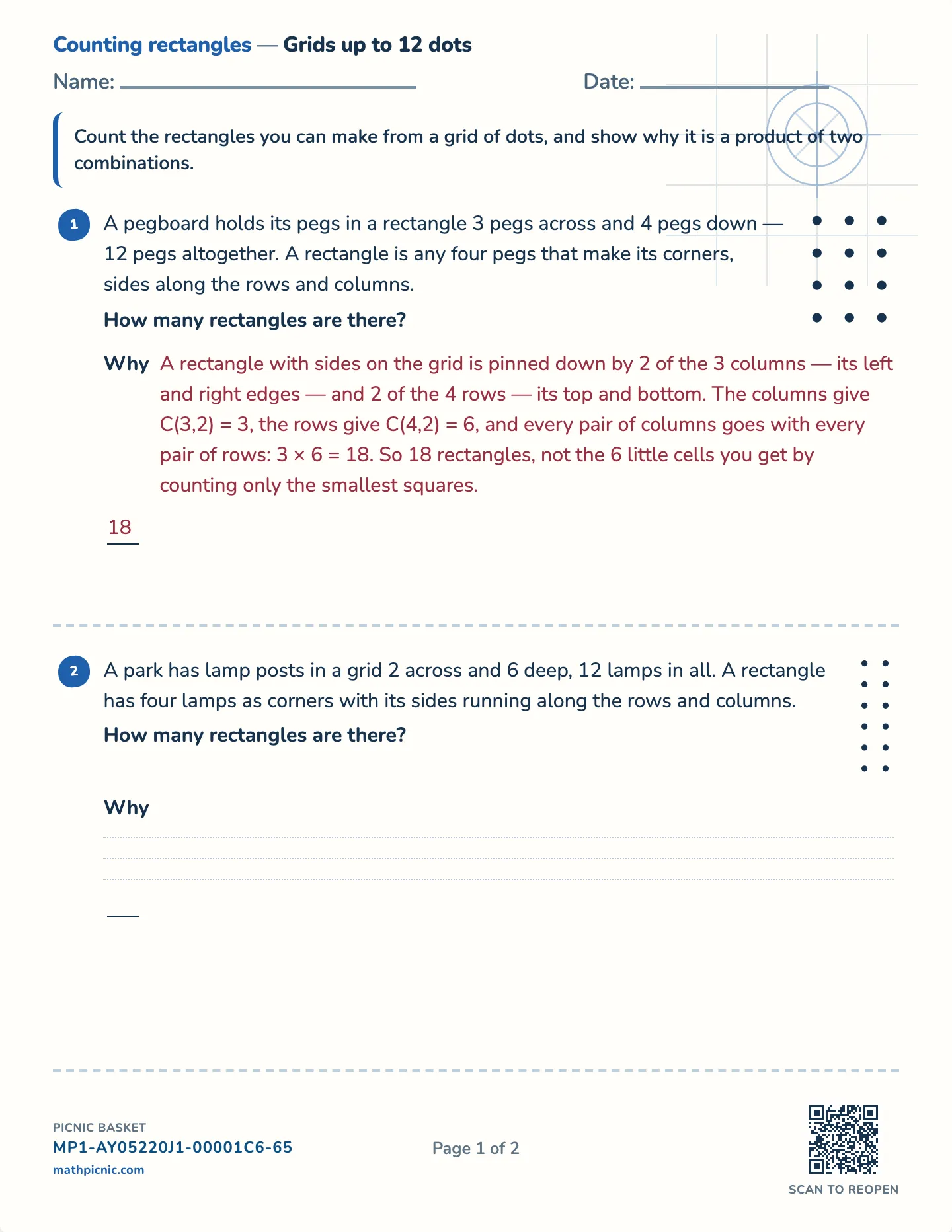
1A pegboard holds its pegs in a rectangle 3 pegs across and 4 pegs down — 12 pegs altogether. A rectangle is any four pegs that make its corners, sides along the rows and columns.How many rectangles are there?Why
2A park has lamp posts in a grid 2 across and 6 deep, 12 lamps in all. A rectangle has four lamps as corners with its sides running along the rows and columns.How many rectangles are there?Why
Counting rectanglesGrids up to 12 dots
Name: Date:
Count the rectangles you can make from a grid of dots, and show why it is a product of two combinations.
3A park has lamp posts in a grid 2 across and 3 deep, 6 lamps in all. A rectangle has four lamps as corners with its sides running along the rows and columns.How many rectangles are there?Why
4A pegboard holds its pegs in a rectangle 3 pegs across and 3 pegs down — 9 pegs altogether. A rectangle is any four pegs that make its corners, sides along the rows and columns.How many rectangles are there?Why
Counting rectangles · Grids up to 12 dotsAnswer key
1. A rectangle with sides on the grid is pinned down by 2 of the 3 columns — its left and right edges — and 2 of the 4 rows — its top and bottom. The columns give C(3,2) = 3, the rows give C(4,2) = 6, and every pair of columns goes with every pair of rows: 3 × 6 = 18. So 18 rectangles, not the 6 little cells you get by counting only the smallest squares.2. A rectangle with sides on the grid is pinned down by 2 of the 2 columns — its left and right edges — and 2 of the 6 rows — its top and bottom. The columns give C(2,2) = 1, the rows give C(6,2) = 15, and every pair of columns goes with every pair of rows: 1 × 15 = 15. So 15 rectangles, not the 5 little cells you get by counting only the smallest squares.3. A rectangle with sides on the grid is pinned down by 2 of the 2 columns — its left and right edges — and 2 of the 3 rows — its top and bottom. The columns give C(2,2) = 1, the rows give C(3,2) = 3, and every pair of columns goes with every pair of rows: 1 × 3 = 3. So 3 rectangles, not the 2 little cells you get by counting only the smallest squares.4. A rectangle with sides on the grid is pinned down by 2 of the 3 columns — its left and right edges — and 2 of the 3 rows — its top and bottom. The columns give C(3,2) = 3, the rows give C(3,2) = 3, and every pair of columns goes with every pair of rows: 3 × 3 = 9. So 9 rectangles, not the 4 little cells you get by counting only the smallest squares.