−(x − 7) becomes −x + 7, and the second sign is the one that gets left behind. These free printable worksheets show a line of working with a sign or a divisor that reached only the first term, and ask which answer is correct.
An invisible multiplier is the hardest one to remember. A child who confidently expands 3(x − 7) will often write −(x − 7) as −x − 7, because there is no number in front to prompt the second multiplication — the minus is doing the work of a −1 that nobody wrote down.
Why this sheet works
Dividing through has the same shape and the same failure. In (6x + 24) ÷ 6 both terms have to be divided, and the tempting shortcut is to strike the 6 against the 6x and lose the x with it. Seeing that written out by somebody else is what makes it noticeable.
How this one works
One question from this sheet, worked through a step at a time.
Ana wrote (3x + 24) ÷ 3 − (x + 5) = 13. Which is correct?
(3x + 24) ÷ 3 − (x + 5)
(3x + 24) ÷ 3 − (x + 5)=x + 8 − x − 5
(3x + 24) ÷ 3 − (x + 5)=x + 8 − x − 5
(3x + 24) ÷ 3 − (x + 5)=3
(3x + 24) ÷ 3 − (x + 5)=3
they wrote:13
Do not check by reading their line. Somebody else's working is the most persuasive thing on the page, and rereading it is how you end up agreeing with it — do the step yourself first, then compare.
On your own, and writing the step nobody writes down: (3x + 24) ÷ 3 − (x + 5) becomes x + 8 − x − 5.
Tidy that up and it is 3.
Now compare. They wrote 13, and the minus reached the x in the second bracket but not the number — so the correct answer is 3.
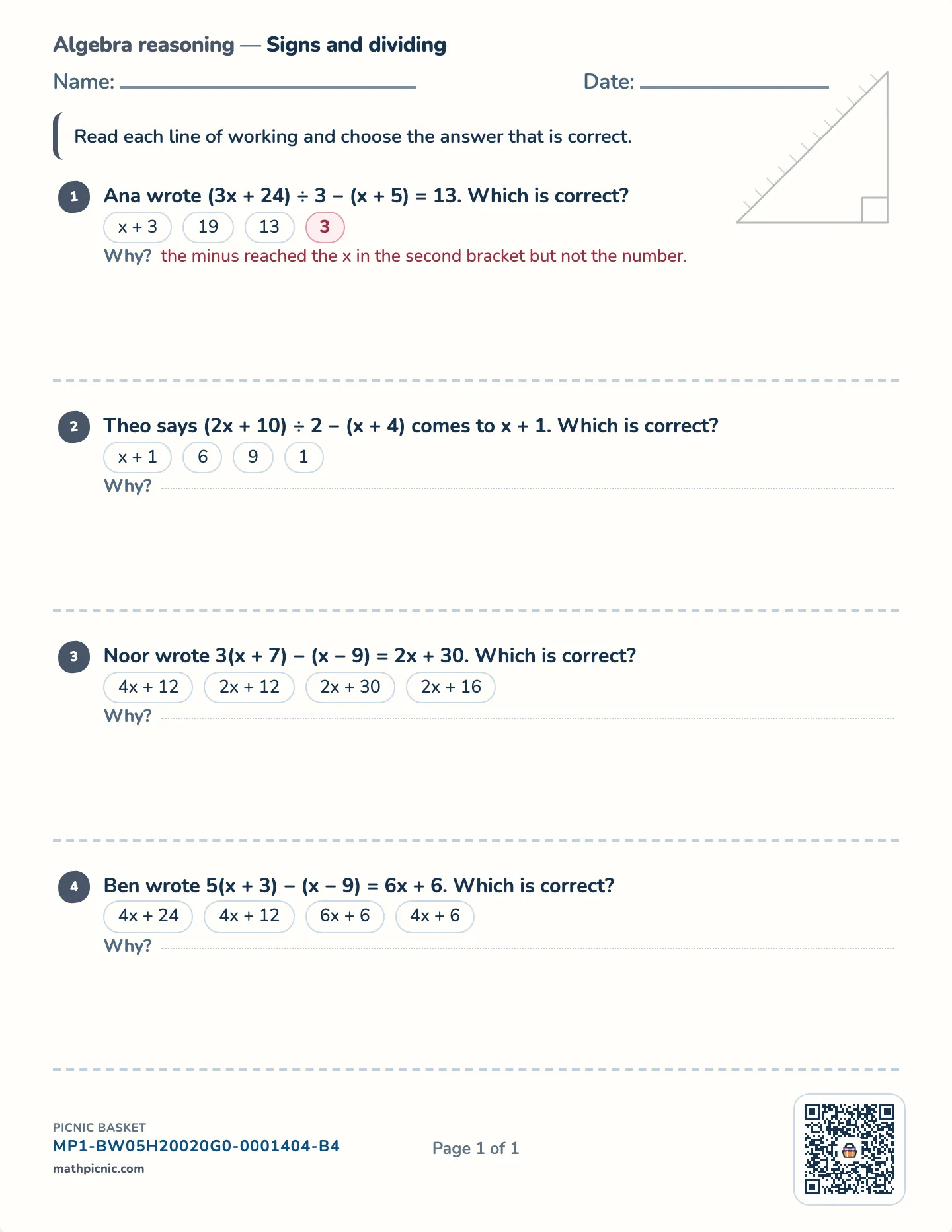
Read each line of working and choose the answer that is correct.
1Ana wrote (3x + 24) ÷ 3 − (x + 5) = 13. Which is correct?x + 319133Why?
2Theo says (2x + 10) ÷ 2 − (x + 4) comes to x + 1. Which is correct?x + 1691Why?
3Noor wrote 3(x + 7) − (x − 9) = 2x + 30. Which is correct?4x + 122x + 122x + 302x + 16Why?
4Ben wrote 5(x + 3) − (x − 9) = 6x + 6. Which is correct?4x + 244x + 126x + 64x + 6Why?
Algebra reasoning · Signs and dividingAnswer key
1. (3x + 24) ÷ 3 − (x + 5) = 3, not 13 (the minus reached the x in the second bracket but not the number)2. (2x + 10) ÷ 2 − (x + 4) = 1, not x + 1 (the two x terms were never cancelled against each other)3. 3(x + 7) − (x − 9) = 2x + 30, which is what was written — this line is correct4. 5(x + 3) − (x − 9) = 4x + 24, not 6x + 6 (the second bracket was added instead of subtracted)