Two square gardens sit side by side. The bigger one covers 96 square meters more than the smaller. Both sides are a whole number of meters between 10 and 33. How long is each side?
Two square gardens, one a stated amount bigger, and both sides a whole number of meters inside a stated range. It looks like a search — square everything and subtract in pairs — and it is not one: a difference of two squares factorises, and that turns the search into a short list. Grades 6–8, using an identity they have already met the other way round.
Why this sheet works
Two facts, and neither is enough alone. Children who find the identity usually take the first pair that works and stop; the range is what rules the others out, and it is the fact most likely to be read as decoration. One further step gives fractions when it is skipped, and reads like an arithmetic slip when it is not one.
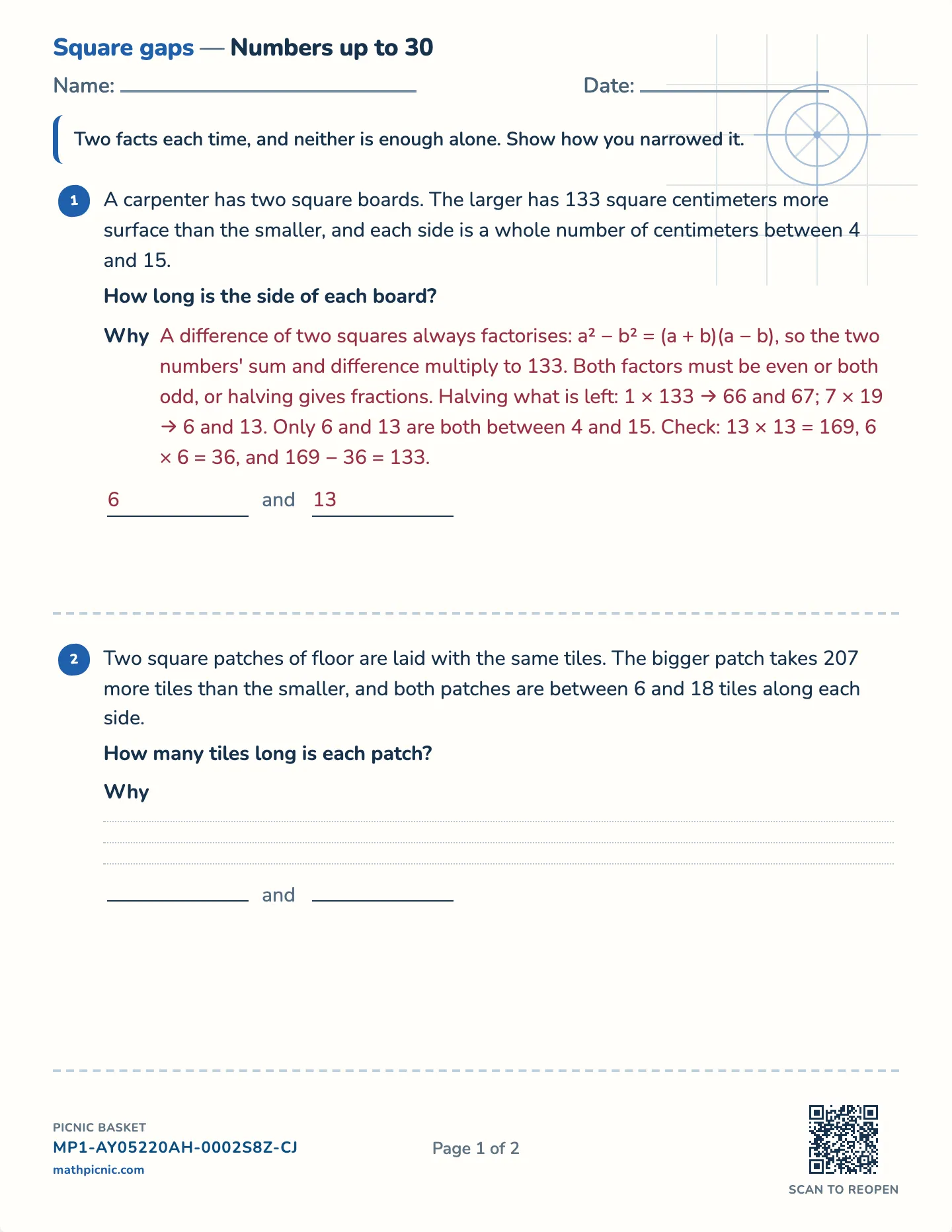
Two facts each time, and neither is enough alone. Show how you narrowed it.
1A carpenter has two square boards. The larger has 133 square centimeters more surface than the smaller, and each side is a whole number of centimeters between 4 and 15.How long is the side of each board?Whyand
2Two square patches of floor are laid with the same tiles. The bigger patch takes 207 more tiles than the smaller, and both patches are between 6 and 18 tiles along each side.How many tiles long is each patch?Whyand
Square gapsNumbers up to 30
Name: Date:
Two facts each time, and neither is enough alone. Show how you narrowed it.
3A carpenter has two square boards. The larger has 224 square centimeters more surface than the smaller, and each side is a whole number of centimeters between 8 and 20.How long is the side of each board?Whyand
4Two whole numbers are both between 2 and 11. Squaring the bigger one gives 39 more than squaring the smaller one.What are the two numbers?Whyand
Square gaps · Numbers up to 30Answer key
1. A difference of two squares always factorises: a² − b² = (a + b)(a − b), so the two numbers' sum and difference multiply to 133. Both factors must be even or both odd, or halving gives fractions. Halving what is left: 1 × 133 → 66 and 67; 7 × 19 → 6 and 13. Only 6 and 13 are both between 4 and 15. Check: 13 × 13 = 169, 6 × 6 = 36, and 169 − 36 = 133.2. A difference of two squares always factorises: a² − b² = (a + b)(a − b), so the two numbers' sum and difference multiply to 207. Both factors must be even or both odd, or halving gives fractions. Halving what is left: 1 × 207 → 103 and 104; 3 × 69 → 33 and 36; 9 × 23 → 7 and 16. Only 7 and 16 are both between 6 and 18. Check: 16 × 16 = 256, 7 × 7 = 49, and 256 − 49 = 207.3. A difference of two squares always factorises: a² − b² = (a + b)(a − b), so the two numbers' sum and difference multiply to 224. Both factors must be even or both odd, or halving gives fractions. Halving what is left: 2 × 112 → 55 and 57; 4 × 56 → 26 and 30; 8 × 28 → 10 and 18; 14 × 16 → 1 and 15. Only 10 and 18 are both between 8 and 20. Check: 18 × 18 = 324, 10 × 10 = 100, and 324 − 100 = 224.4. A difference of two squares always factorises: a² − b² = (a + b)(a − b), so the two numbers' sum and difference multiply to 39. Both factors must be even or both odd, or halving gives fractions. Halving what is left: 1 × 39 → 19 and 20; 3 × 13 → 5 and 8. Only 5 and 8 are both between 2 and 11. Check: 8 × 8 = 64, 5 × 5 = 25, and 64 − 25 = 39.