Math test
Name: Date:
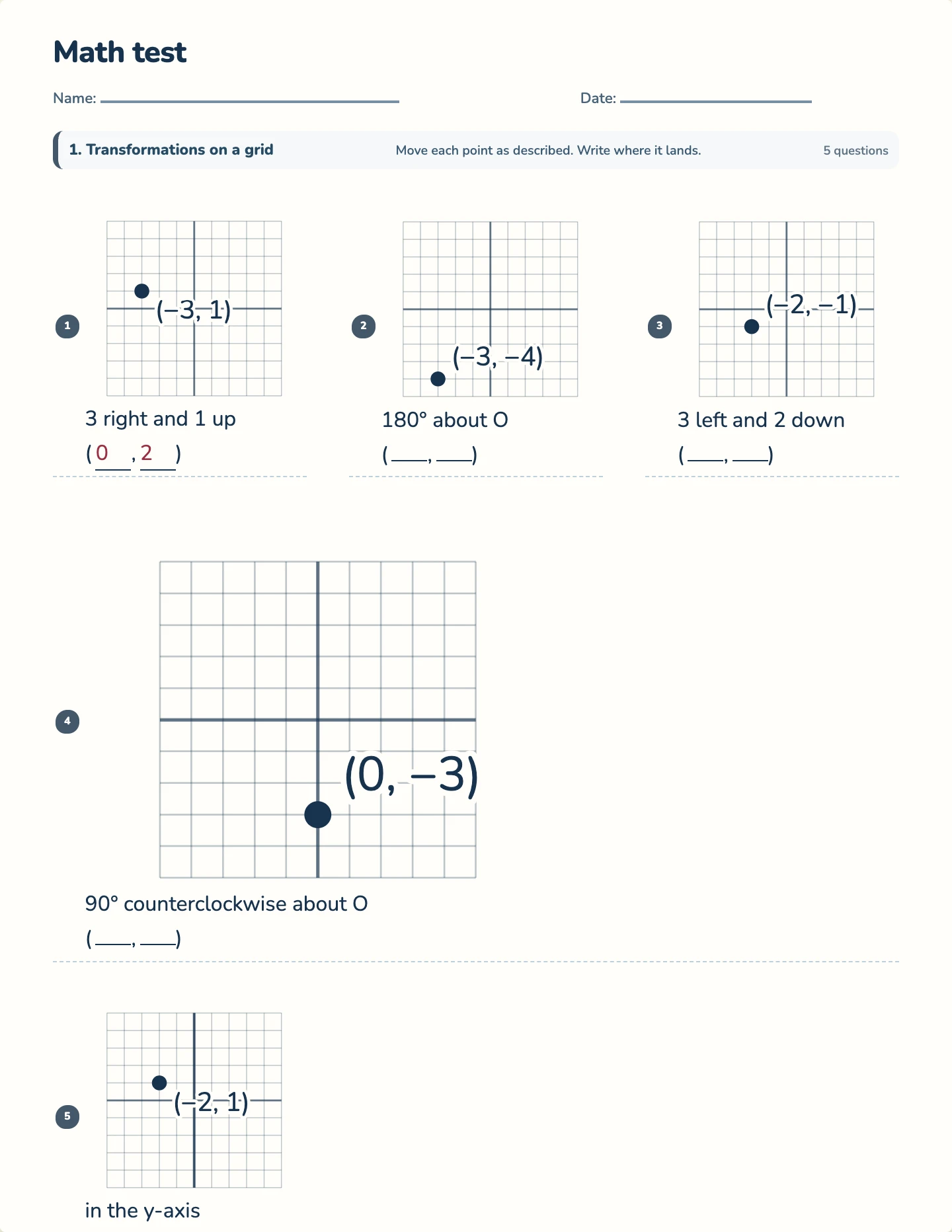
1. Transformations on a gridMove each point as described. Write where it lands.5 questions
13 right and 1 up ()
2180° about O ()
33 left and 2 down ()
490° counterclockwise about O ()
5in the y-axis ()

Slide, turn, and flip a shape without changing it — then decide when two shapes are the same or merely alike.
The answer key prints on a separate page.
Reflections, rotations, and translations all move a figure without resizing it, which is the fact the first section is really testing: after any of them the shape is congruent to what it started as, same size and same angles, just somewhere else. The reliable error is a rotation or reflection that quietly changes a length, and comparing before-and-after is how a child learns that a rigid motion is not allowed to.
Similarity is the deliberate contrast — same shape, different size, tied together by a scale factor. Angles are preserved, sides are multiplied, and a child who treats similar figures as congruent will look for equal sides that are not there. The congruence criteria close the paper by asking the sharper question: how little do you need to know to be sure two triangles are identical? SSS, SAS, and ASA are the minimum, and knowing which three facts are enough is the reasoning the unit is for.