Infinite geometric series worksheets

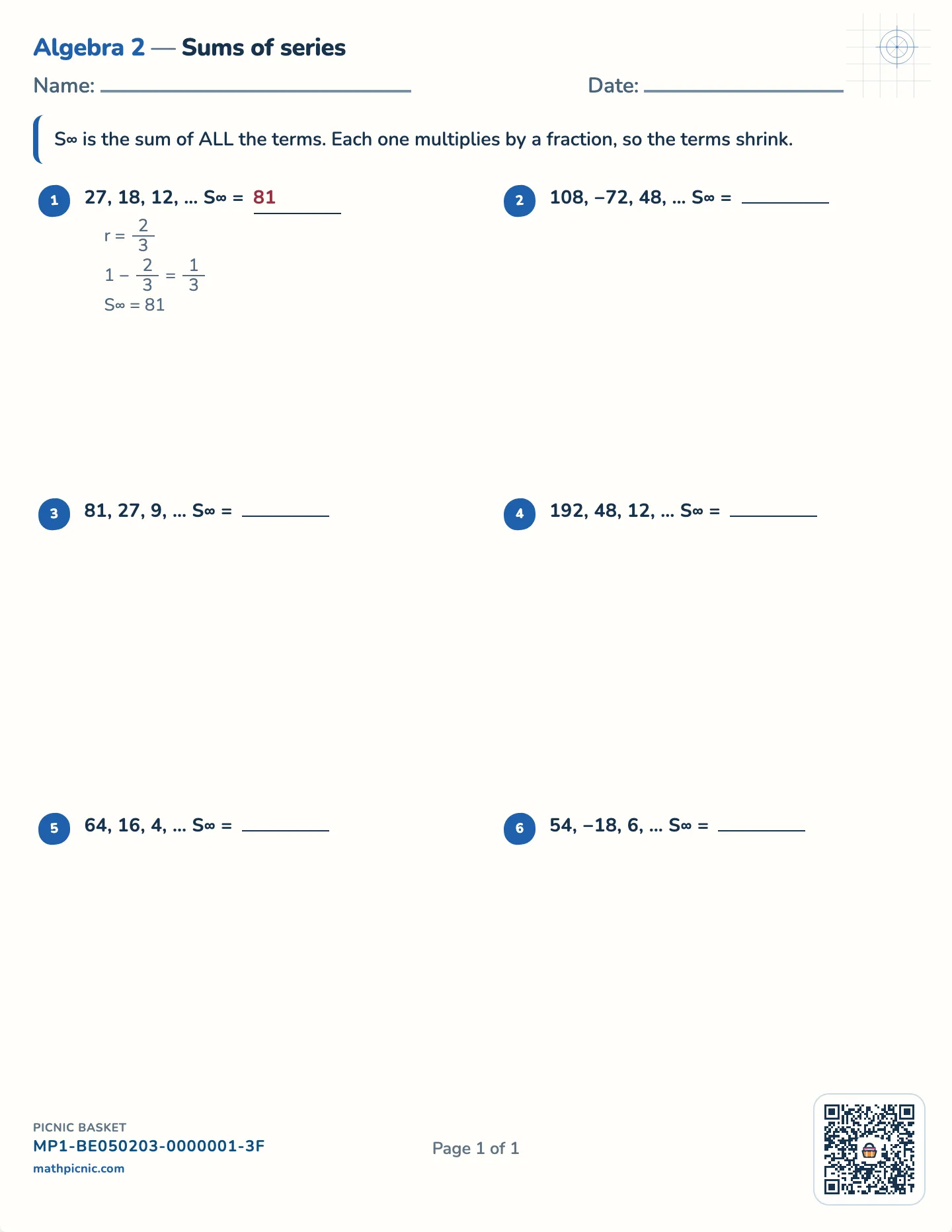
When each term is a fraction of the one before, the series goes on forever and still has a total. These free printable worksheets give the first three terms, like 27, 18, 12, …, and ask for the sum of all of them; the answer key names r, works out 1 − r, and gives the exact total.

Infinite geometric series
Infinite geometric series worksheet — Ratios between −1 and 1, exact sums, free printable with answer key

The answer key prints on a separate page.

What's on this sheet

Why a never-ending sum can be finished is visible in the numbers. 27, 18, 12, … has ratio 2/3 and adds up to 81. After one term the running total is 54 short of that; after two, 36 short; after three, 24 short. The gap is multiplied by 2/3 at every step, so it shrinks toward nothing, and 81 is the one number the total gets as close to as you like. The formula a/(1 − r) is that observation written once: 27 ÷ 1/3 = 81.

Why this sheet works

The ratios are 1/2, 1/3, 2/3, 1/4, 3/4, 1/5 and 2/5, and −1/2, −1/3 and −2/3, where the terms swap sign. The negative ones are where the sheet earns its keep: for 108, −72, 48, … the bottom is 1 − (−2/3), which is 1 + 2/3 = 5/3, and the key writes it that way so a dropped minus cannot hide. The terms on the page are always whole numbers, so the ratio can be read off them, but the total is a fraction about half the time: 108 − 72 + 48 − ⋯ comes to 324/5.

How this one works

S∞ for 27, 18, 12, …

r =
1 −=
S∞ =81
  1. Every term is of the one before it, so they get smaller and smaller — 27, 18, 12, and on forever. Adding infinitely many numbers sounds like it must run away, but shrinking terms pile up to a finite total.
  2. The rule is: divide the first term by what is LEFT of 1 after taking the ratio away. Here that is 1 − = .
  3. So the total is 27 divided by , which is 81. Dividing by a fraction less than 1 makes it bigger — which it has to be, since the first term alone is already 27.